

# Plyometrics for Everyday Women as Osteoporosis Prevention
Osteoporosis is not an inevitable fate. Yet many women perceive it as a natural consequence of aging – something that will simply come regardless of what we do. But the statistics tell a different story. According to data from the International Osteoporosis Foundation, over 200 million women worldwide suffer from this disease, and one in three women over 50 will experience a fracture as a result of osteoporosis. These are numbers worth reflecting on – and above all, worth acting upon.
The good news is that bones are not passive structures. They are living tissue that responds to stimuli from the environment, and one of the most effective stimuli is movement. Specifically, the type of movement that places dynamic impact on the skeleton – namely plyometrics. This form of exercise, long associated primarily with the world of professional athletes and sportspeople, has in recent years been finding its way to ordinary women who are looking for an effective way to take care of their health for the future.
Try our natural products




What plyometrics actually is and why it matters
Plyometrics is a training method based on fast, explosive movements – most commonly jumps, hops and bounds. The name comes from the Greek "plyo" (more) and "metric" (to measure), and the essence of the entire concept is the use of the so-called stretch-shortening cycle of muscles. In other words: the muscle first stretches rapidly and then immediately shortens, generating explosive force. It is precisely this force upon landing on the ground that creates the mechanical load which bone cells – osteoblasts – perceive as a signal to begin building new bone tissue.
This mechanism is nothing new. Researchers have been studying it for decades, and the results are compelling. A study published in the specialist journal Osteoporosis International showed that perimenopausal women who regularly performed high-impact jumps recorded a measurable increase in bone mineral density in the hip area after six months – precisely where fractures caused by osteoporosis are most frequent and most dangerous. Hip fractures have serious health consequences: up to 20% of patients die within a year of sustaining them due to complications.
So why isn't plyometrics part of every gynaecologist's or general practitioner's recommendations? Partly because it still lingers in the public consciousness as something extreme, demanding, reserved for young athletes. But the reality is different. Plyometrics for ordinary women does not have to mean training like an Olympic athlete. Regular, moderate and properly performed jumps are sufficient, and these are accessible to virtually any healthy woman regardless of age or previous sporting experience.
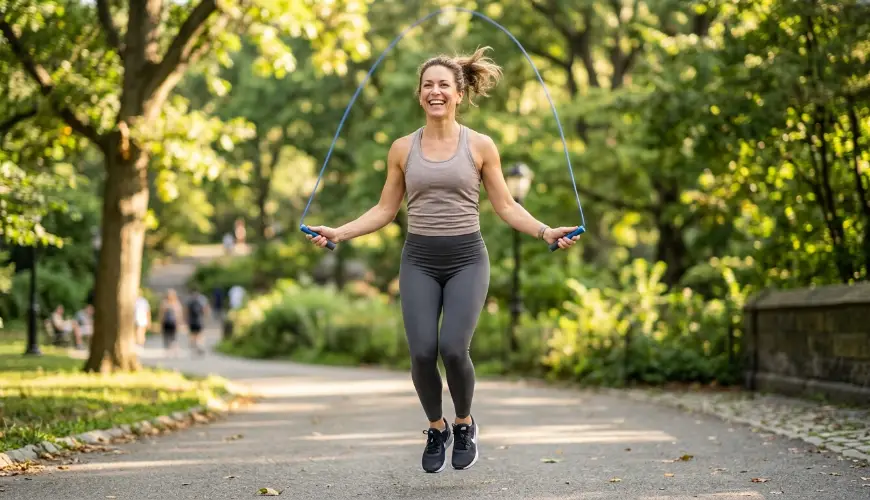
Take an example from everyday life: Jana, a forty-four-year-old teacher from Brno, started with simple on-the-spot hops on the recommendation of her physiotherapist. She didn't go to any specialist studio or purchase expensive equipment. Every morning before breakfast, she devoted ten minutes to jumping rope and basic jumps. After a year, the results of her densitometry – a bone mineral density examination – pleasantly surprised her. The values that had been slightly declining the year before had stabilised. Nothing dramatic, but exactly what she needed.
How jumps work as a natural protection for bones
To understand why plyometrics works better than, for example, walking or swimming, it is necessary to pause at the basic principle of bone adaptation. Bones adapt to the load they are subjected to – this is called Wolff's Law, named after the German surgeon Julius Wolff, who described it back in the 19th century. According to this principle, the greater and more varied the mechanical forces acting on a bone, the stronger and more resilient it becomes.
Walking is beneficial for overall health, but for bones it represents a relatively low stimulus – the impact with each step is only mild and the body quickly adapts to it. In contrast, a jump creates a force upon landing equivalent to several times the body weight, which is precisely the kind of intense signal that bone cells need to intensify their activity.
A research team from Oregon State University demonstrated that middle-aged women who incorporated just 10 to 20 jumps per day into their weekly programme achieved statistically significant improvement in bone mineral density in the hip area after four months. And importantly: the results were more pronounced in women who exercised at higher intensity, but even the most modest version produced a measurable effect. That is a message that ought to be heard much more loudly.
It is crucial to understand that plyometrics works in a complex way. It does not only stimulate the bones themselves, but also strengthens the muscles and tendons surrounding them, improves coordination and balance – and thereby indirectly reduces the risk of falls, which in older women with osteoporosis are the most common cause of fractures. As orthopaedic specialist and author of a book on osteoporosis prevention Dr. Michaël Hewitt said: "The best medicine for a fracture is the one that never happens – and for that you need not only strong bones, but also a stable body that knows how not to fall."
At the same time, plyometrics positively influences the hormonal environment in the body. High-impact physical activity stimulates the production of growth hormone and IGF-1, which play an important role in bone tissue metabolism. This is particularly relevant for women in perimenopause and menopause, when the natural decline in oestrogen significantly accelerates bone mass loss – in the first years after menopause, a woman can lose up to 20% of her total bone mass.
How to start safely and sensibly
One of the biggest mistakes women make when thinking about plyometrics is the belief that they must immediately jump high and intensively. This is not true. A safe and effective start can look very unassuming, yet still deliver results.
Basic principles for women starting out with plyometrics:
- Start with bilateral take-offs – on-the-spot jumps, jumping over a line or skipping rope are ideal entry points.
- Pay attention to proper landing – always land on the whole foot, with slightly bent knees, so that the joints absorb the impact naturally.
- Frequency is more important than intensity – 10 minutes three times a week is more than sufficient for a start and significantly better than a one-off hour session once a fortnight.
- Listen to your body – mild muscle fatigue is normal; pain in the joints or sharp pain anywhere in the body is a signal to stop and consult a specialist.
- Gradually increase the difficulty – after a few weeks, you can add jumps onto an elevated surface, long jumps or various jumping variations.
Women with already diagnosed osteoporosis or significant osteopenia should consult their doctor or physiotherapist before starting plyometric training. For them, modified versions of exercises exist that still stimulate bone tissue but minimise the risk of overloading or falling. In such a case, working with a certified physiotherapist or personal trainer specialising in the musculoskeletal system may be appropriate.
An important part of bone care is also nutrition. Calcium and vitamin D are essential for exercise to have a positive effect on bone tissue. Without sufficient intake of these nutrients, the body may be stimulated to build bone but have nothing to build with. The recommended daily calcium intake for adult women is approximately 1,000–1,200 mg, and for vitamin D 800–2,000 IU depending on age and sun exposure. These values can be met through a combination of a diet rich in dairy products, leafy vegetables and oily fish, together with quality dietary supplements if intake from food is insufficient.
Plyometrics is of course not the only type of movement that benefits bones. Strength training, dance with pronounced movements or even fast uphill walking also have their benefits. But it is precisely the combination of dynamic impact, speed of movement and engagement of the whole body that makes jumps and bounds one of the most effective tools in osteoporosis prevention – and at the same time one of the least utilised.
Perhaps it is time to change that. Women who invest ten minutes a day in jumping today are investing in their joints, spine and hips twenty years from now. And that is a return on investment that cannot be compared to any financial investment. Bones that are trained today are the bones that will keep you on your feet tomorrow – both literally and figuratively. Taking care of the musculoskeletal system is not a luxury or the privilege of athletes. It is a responsibility towards oneself, and plyometrics is one of the most direct ways to fulfil it.