

# Broth vs. Collagen Supplements in Practice
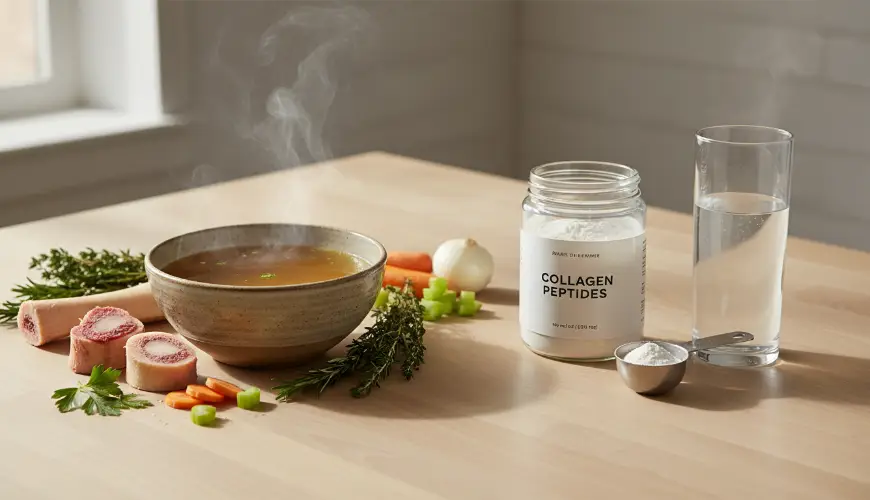
When people hear collagen, most think of anti-wrinkle creams or trendy supplements in shiny packaging. But collagen is actually the most abundant protein in the human body – it makes up roughly one-third of all proteins and literally holds together skin, joints, tendons, bones, and the intestinal wall. After the age of thirty, its natural production declines at a rate of approximately one percent per year, which is why more and more people are looking for ways to supply it from the outside. And this is precisely where the question arises that has been dividing advocates of traditional eating and modern nutrition consultants in recent years: is it better to reach for good old-fashioned bone broth, or for collagen supplements in the form of powder or capsules?
The answer isn't as straightforward as it might seem. Both options have their strengths, their limitations, and their specific role in one's diet. To make an informed decision, it's worth examining what exactly each of them offers, how the body processes it, and what science says about their effectiveness.
Try our natural products


What the body actually gets from bone broth
Bone broth is nothing new – our grandmothers cooked it for centuries, and in many cultures around the world, it's considered a foundation of healing cuisine. It's prepared by simmering bones (beef, chicken, fish) in water with a splash of vinegar, which helps release minerals from the bone tissue. Cooking time ranges from four hours to a full twenty-four, and the longer the bones simmer, the more nutrients transfer into the liquid.
The result is a nutritionally complex food that contains not only collagen (or rather its broken-down form – gelatin), but also minerals such as calcium, magnesium, phosphorus, and potassium, as well as the amino acids glycine, proline, and glutamine, and last but not least, glycosaminoglycans, which include hyaluronic acid and chondroitin sulfate. It's precisely this synergistic combination of substances that no isolated supplement can fully replicate. Glycine, for example, plays a key role in the liver's detoxification processes and supports quality sleep, while glutamine is considered an important amino acid for gut lining health.
Proponents of bone broth often reference so-called leaky gut syndrome, in which the tight junctions between cells of the intestinal wall become damaged. Although the scientific consensus on this concept is still not entirely clear-cut, there are studies suggesting that gelatin and glutamine may contribute to restoring the integrity of the intestinal barrier. Harvard T.H. Chan School of Public Health states that bone broth is a legitimate source of nutrients, though it notes that its specific health benefits have not yet been confirmed by large-scale clinical studies.
One practical example that nicely illustrates the power of bone broth comes from the field of sports medicine. Coaches and physiotherapists on some professional sports teams have begun recommending regular broth consumption to their athletes as part of a recovery protocol after intense training sessions. This isn't about any miracle cure, but rather an effort to provide the body with building blocks for connective tissue repair in the most natural form possible. The NBA, for instance, has seen a trend where team kitchens began incorporating broth into players' standard meal plans.
On the other hand, it must be acknowledged that bone broth has its drawbacks. Its preparation is time-consuming, quality varies considerably depending on the source of the bones and the cooking method, and the collagen content per serving is quite variable – it can range from two to ten grams, meaning one never knows exactly how much of the active substance they're actually consuming. Additionally, there are concerns about potential heavy metal content, particularly lead, which can leach from bones into the broth. A study published in the journal Medical Hypotheses in 2013 did indeed demonstrate elevated lead levels in organic chicken broth, although the values remained below the threshold considered dangerous.
Collagen supplements: a precise dose in modern packaging
Collagen dietary supplements, most commonly in the form of hydrolyzed collagen (collagen peptides), represent an entirely different approach to the same goal. Hydrolysis is a process in which large collagen molecules are enzymatically broken down into smaller peptides that dissolve more easily in water and – crucially – are more easily absorbed in the digestive tract.
And absorbability is precisely the area where collagen supplements score significantly. While gelatin from bone broth must first be broken down into smaller fragments in the body, hydrolyzed collagen peptides are already "pre-digested" and can be absorbed directly in the intestine. A study published in the Journal of Agricultural and Food Chemistry showed that hydroxyproline-containing peptides appear in the bloodstream within one hour of consuming hydrolyzed collagen. This suggests that the body can efficiently use these peptides as signaling molecules that stimulate fibroblasts – cells responsible for producing new collagen in tissues.
Clinical studies focused on collagen supplements are growing in number, and their results are quite promising. A 2021 meta-analysis published in the International Journal of Dermatology, encompassing 19 studies with a total of 1,125 participants, concluded that supplementation with hydrolyzed collagen at a dose of 2.5 to 15 grams daily for a minimum of eight weeks led to measurable improvements in skin hydration and elasticity. Similarly, there is evidence of a positive effect on joint pain – a study from Current Medical Research and Opinion demonstrated that a daily intake of 10 grams of collagen peptides over 24 weeks statistically significantly reduced joint pain in athletes.
An undeniable advantage of supplements is precise dosing. Each serving contains a declared amount of collagen, enabling consistent intake and comparability with protocols used in scientific studies. Supplements are also practical – simply dissolve the powder in water, coffee, or a smoothie, which is particularly appreciated by people with hectic lifestyles.
However, collagen supplements have their downsides too. They are an isolated substance, stripped of the broader nutritional context. They lack minerals, the complex mix of amino acids, and bioactive compounds present in bone broth. Some nutrition experts compare this difference to the difference between eating a whole orange and swallowing a vitamin C tablet – both deliver ascorbic acid, but the whole orange additionally offers fiber, flavonoids, and dozens of other phytochemicals that work together. As American physician and researcher Mark Hyman aptly noted: "Food is information for your cells, not just fuel."
It's also important to mention that the collagen supplement market is relatively poorly regulated. Not all products on the market deliver what they promise on the label, and quality can vary significantly. When choosing, it's wise to look for products with third-party certification and transparent ingredient lists.
Incidentally, it's worth noting that collagen as such is of animal origin. For people who prefer a plant-based diet, there are so-called "collagen-boosting" supplements containing vitamin C, zinc, copper, and amino acids that support the body's own collagen production, but these are not collagen itself. Truly vegan collagen produced through fermentation of genetically modified yeast is still more a matter of research than a commonly available product.
When one attempts to compare both approaches in terms of pure effectiveness on a specific health parameter – say, skin elasticity or joint comfort – the scientific evidence speaks rather in favor of collagen supplements, simply because most studies have been conducted with hydrolyzed collagen in precisely defined doses. Bone broth doesn't allow for that level of standardization, which doesn't mean it doesn't work, but it does mean that its effects are harder to measure and document.
However, if the goal is overall body support – gut health, mineral intake, anti-inflammatory effects, immune support – then bone broth has something to offer beyond mere collagen. It's not just about one molecule, but about a whole food complex that the body processes differently than an isolated supplement.
The practical approach recommended by many nutrition consultants involves combining both options. Bone broth as a regular part of the diet – whether as a base for soups, sauces, or a standalone drink – provides a broad spectrum of nutrients and supports the digestive system. A collagen supplement can then serve as targeted support during periods of increased need, whether it's recovery from injury, intense athletic training, or a time when one wants to focus on skin and joint health. These two options don't exclude each other but complement one another.
For those who want to start with bone broth but are put off by the time-consuming preparation, there's a simple trick: cook a larger batch at once and pour it into silicone ice cube trays. Frozen broth cubes can then be easily added to various dishes throughout the week. And for those who opt for a collagen supplement, it's good to know that its effectiveness is enhanced by simultaneous intake of vitamin C, which is an essential cofactor for collagen synthesis in the body – a glass of orange juice or a few pieces of bell pepper with a meal will do.
There is no universal answer to the question of which is more effective. It depends on what exactly one expects from supplementation, what lifestyle they lead, and how much they value the naturalness of food versus convenience and precise dosing. One thing is certain, though: whether one chooses either of these approaches – or ideally both – they'll be doing more for their body than if they completely ignored collagen in their diet. After all, investing in connective tissue health won't show results tomorrow, but ten or twenty years from now, when it becomes apparent whether joints still cooperate, skin retains its elasticity, and the gut functions as it should.