

# How to Meal Prep in 45 Minutes for Three Days
Imagine a typical Monday morning. The alarm goes off, you drag yourself out of bed, hastily make some coffee, and then stand in front of the open fridge with that eternal feeling of hopelessness. What's for lunch today? What about dinner? And what about tomorrow? Most of us know this scenario all too well, and it's precisely from this that a phenomenon was born which has gained enormous popularity in recent years – meal prep. But when you look at social media, it might seem like mastering it requires an entire Sunday, ten pots, and a kitchen the size of a small apartment. The truth, however, is much more pleasant.
The term meal prep itself is short for "meal preparation," meaning preparing meals in advance. In practice, this means that in one block of time, you cook or pre-prepare meals for several days ahead. This is by no means a modern gimmick – our grandmothers did the same thing when they cooked a big pot of goulash on Sunday that lasted until Wednesday. The difference is that today's meal prep works with thoughtful planning, variety, and efficiency. And it's precisely that efficiency that's key, because few people have the luxury of sacrificing an entire afternoon to cooking.
Why is it even worth paying attention to meal prep? There are several reasons, and they intertwine with one another. The most obvious is saving time during the working week. When you come home tired and there's a ready-made meal waiting in the fridge that just needs reheating, you save not only forty minutes at the stove but also the mental energy associated with deciding what to cook in the first place. Psychologists call this phenomenon "decision fatigue," and according to research published in the journal Social Science & Medicine, people who plan their meals in advance eat demonstrably more varied and healthier diets. Another reason is financial savings. Those who cook from a plan shop purposefully and throw away less food. And finally – meal prep is a great way to stay in control of what you actually eat without having to count every calorie.
But here we hit a problem that puts many people off before they even start. The internet is full of photos of perfectly stacked containers, videos of two-hour cooking marathons, and lists that look like a shopping plan for a school cafeteria. How do you do meal prep when you don't have an entire Sunday? The answer is surprisingly simple: you don't have to cook for the whole week. Three days is enough.
Try our natural products


Cooking for three days in 45 minutes – is it realistic?
It might sound like an advertising slogan, but it really works. The whole trick lies in the fact that you're not cooking three completely different meals from scratch but working with one base that you vary. It's sometimes called "batch cooking," and it works on a simple principle: you cook a larger quantity of one or two components and then combine them with different accompaniments.
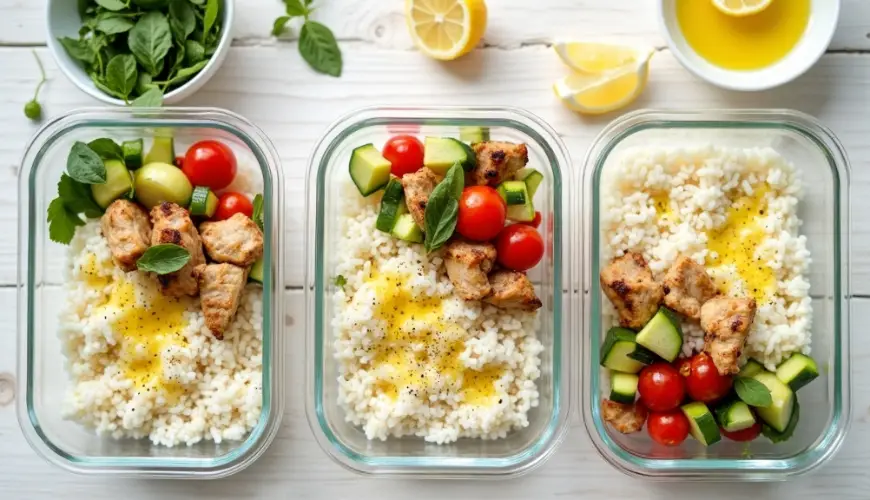
Let's look at a concrete example. Jana works full-time, has two school-age children, and goes to exercise twice a week in the evenings. Sunday is a day she wants to spend with her family, not standing in the kitchen for four hours. So on Sunday evening – or Wednesday for that matter, because meal prep doesn't have to be done only on Sundays – she sets aside 45 minutes. During that time, she does three things simultaneously. On one burner, a big pot of jasmine rice is cooking; on another, pieces of chicken thigh with seasoning are roasting on a tray in the oven; and on the cutting board, she's chopping vegetables – peppers, cucumbers, cherry tomatoes, carrots. While the rice and chicken are practically preparing themselves, Jana also mixes up a simple dressing of olive oil, lemon, and mustard. After 45 minutes, she has a supply in the fridge from which she can assemble three different meals: day one, rice with chicken and fresh vegetables; day two, a tortilla filled with chicken, vegetables, and dressing; day three, a bowl with rice, the remaining vegetables, and perhaps a can of chickpeas that she simply opens and drains. Three days, three different lunches, one cooking session.
This is the foundation you can build on. The key to success isn't the complexity of recipes but the smart choice of ingredients that last several days in the fridge and can be easily combined. Cooked rice, pasta, roasted vegetables, grilled meat, or legumes – these are all building blocks that can be used very flexibly.
It's also important to mention the practical side of storage. Meal prep only works if the food stays fresh and tasty. Quality sealable containers are therefore an absolute essential. Glass ones are ideal, as they don't absorb odours and can be used in the microwave and dishwasher. Fresh vegetables are better stored separately from warm components so they don't go soft. And the general rule is that most pre-prepared meals will keep safely in the fridge at temperatures up to 4°C for three to four days, as stated in the recommendations from the United States Department of Agriculture (USDA).
Incidentally, one of the most common reasons people give up on meal prep isn't a lack of time but boredom. Eating the same thing three days in a row really isn't for everyone. That's why the principle of variation we mentioned above is so important. All you need is a few different spices, dressings, or extras on hand – nuts, seeds, fresh herbs, feta cheese, hummus – and even from the same base, you can create a slightly different experience each time.
Tips and recipes for quick meals suited to meal prep
Not every dish is suitable for meal prep. Some lose their texture after a few hours in the fridge, others their flavour. But there's a whole range of dishes that literally improve with time – as one well-known chef used to say: "The best goulash is yesterday's." And even if you don't have to make goulash specifically, the principle holds. Here are some tried-and-tested tips for meals that keep beautifully in the fridge and can be prepared quickly.
Roasted vegetables with seasoning are an absolute classic. Simply chop sweet potatoes, courgettes, onions, and peppers, drizzle with olive oil, sprinkle with a spice mix – such as smoked paprika, garlic powder, and thyme – and roast for twenty minutes at 200°C. The result is a universal side dish that works with meat, in a wrap, or as the base of a warm salad.
One-pot legume dishes are another excellent choice. Lentil soup, bean chilli, or chickpea curry – all these recipes require minimal active effort, practically cook themselves, and taste even better after a day in the fridge. Moreover, they're rich in protein and fibre, so they keep you full for a long time.
Overnight oats – oat flakes soaked overnight in yoghurt or plant-based milk – solve the breakfast problem. You prepare three jars at once, add different fruit or nuts to each, and you have three mornings sorted without any morning cooking.
For those who prefer lighter lunches, mason jar salads – salads layered in a jar – work wonderfully. The trick is to put the dressing at the bottom, then layer harder ingredients like legumes and vegetables, with leafy greens on top. As long as you don't tip the jar over, the salad stays fresh and crunchy for up to two days.
And then there's one more category that's often overlooked – snacks. Meal prep isn't just about lunches and dinners. Chopped vegetables with hummus, homemade energy balls made from dates and nuts, or simple muffins with banana and oat flakes – all of this can be prepared within those same 45 minutes and significantly reduces the temptation to reach for unhealthy snacks during the day.
One more aspect worth mentioning that's discussed less often but is crucial for long-term success: meal prep doesn't have to be perfect. Social media creates pressure for aesthetically flawless containers with precisely measured portions, but the reality is that even a haphazardly packed lunch in an ordinary plastic container is incomparably better than a desperate fast-food purchase at noon when your stomach is already protesting. As nutritional therapist and author of the book Jídlo jako životní styl (Food as a Lifestyle), PhDr. Margit Slimáková, notes: more important than perfection is regularity and balance. Meal prep is a tool, not a dogma.
A practical tip to round off the whole process concerns shopping. Before you start cooking, make a short list of what you'll need and shop purposefully. Ideally, choose two to three recipes that share some ingredients – for example, onion, garlic, olive oil, or rice – and you'll minimise both waste and expenses. Seasonal vegetables are cheaper, tastier, and more environmentally friendly, which is a value that goes hand in hand with a sustainable approach to cooking and eating.
Meal prep is essentially nothing more than a return to common sense in the kitchen. It's not a diet, it's not a trend that will disappear in a year, and it's certainly not an activity reserved only for fitness enthusiasts with six containers a day. It's simply a smart way to take care of yourself and your family during a hectic week without it taking more time than one episode of your favourite series. And that's definitely worth trying.