

# How to Deal with Scratches and Stains on Furniture Without Expensive Chemicals
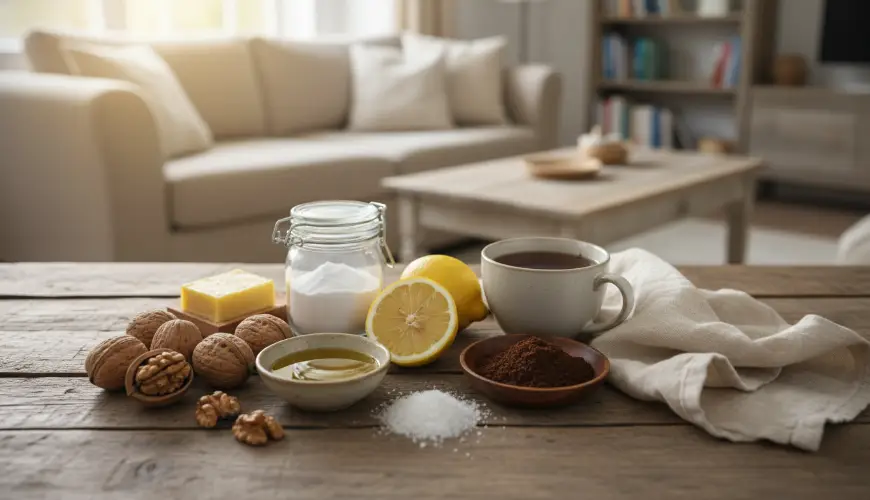
When something goes wrong at home, you don't have to reach for chemicals right away. Scratches on furniture, stains on the couch, and other minor household mishaps can be handled surprisingly easily using ingredients you probably already have in the kitchen or bathroom. And the best part – natural solutions are gentler not only on your furniture but also on you and the environment.
Imagine a typical Sunday afternoon. Kids are running around the living room, the dog is jumping on the couch, someone trips over the coffee table and knocks over a glass of red wine. A scratch remains on the wooden tabletop, a purple stain on the light-colored sofa, and a wet puddle on the carpet. Panic? Not at all. It's precisely for situations like these that there are tried-and-true natural tricks that have worked for generations and deserve far more attention than we usually give them.
Try our natural products
How to Fix Furniture Scratches the Natural Way
Wooden furniture is beautiful but also vulnerable. All it takes is sliding a vase across the table, setting down keys a little too forcefully, or letting the cat "play" with the back of a chair – and there's a scratch. But before you head to the store for an expensive repair kit, try looking in the pantry.
Walnuts are among the best-known and most effective natural remedies for minor scratches on wood. Simply take a walnut kernel, break it in half, and gently rub it into the scratched area. The oil contained in the nut penetrates the wood, darkens the surface, and makes the scratch visually disappear. It works surprisingly well, especially on darker woods like walnut, mahogany, or dark oak. The same principle applies to olive oil mixed with a little vinegar – apply a mixture of approximately two-thirds oil and one-third vinegar with a soft cloth in the direction of the wood grain. The oil nourishes and hydrates the wood, while the vinegar gently cleans the surface.
For deeper scratches on dark furniture, the coffee grounds trick has proven effective. Mix them with a little olive oil into a thick paste, apply to the damaged area, and let it sit for a few minutes. Then wipe off with a soft cloth. The coffee grounds naturally stain the exposed wood, making the scratch practically invisible. For lighter wood, however, it's better to use other methods – for example, a mixture of lemon juice and olive oil, which gently treats the surface without darkening it.
Interestingly, even ordinary black tea can help. Steep a tea bag strongly, let it cool, and apply to the scratch with a cotton pad. The tannins in the tea naturally color the wood. This trick was actually known to cabinetmakers in the 19th century, who regularly treated furniture with tea infusions, as noted on the Furniture Restoration Blog on The Spruce.
And what about laminate or lacquered furniture? The situation is a bit different there, because the scratch doesn't expose raw wood but damages the protective layer. For minor scuffs on laminate, coconut oil applied in a thin layer can help – it won't fill deep grooves, but it will visually smooth out surface scratches and add shine. For lacquered wood, beeswax works well, filling the scratch while also protecting the surface from further moisture and damage.
Of course, it's important to mention that natural methods have their limits. A deep gouge that penetrates several millimeters into the wood won't be completely removed with a home trick. But for everyday scratches from regular use – and those are the vast majority – these methods are perfectly sufficient.
Stains on the Couch and Other Textile Catastrophes
The couch is the centerpiece of the home. People sit on it, lie on it, eat, drink, and let's be honest – sometimes fall asleep on it with a cup of ice cream in hand. It's no wonder that the couch is often the most frequent victim of household accidents. And stains on the couch can be a real headache, especially when the upholstery is light-colored.
The basic rule that applies to any stain on fabric is: act quickly. A fresh stain is incomparably easier to remove than a dried one. And the second, equally important rule – never rub, always blot. Rubbing only spreads the stain and pushes it deeper into the fibers.
Red wine on the couch is the nightmare of many hosts. But a surprisingly effective first responder is ordinary kitchen salt. Immediately after the spill, pour a generous layer of salt onto the stain – it will absorb the moisture along with the pigment. Let it sit for at least fifteen minutes, then vacuum and treat the area with a solution of baking soda and water. Baking soda is truly a universal natural cleaner, sometimes nicknamed the "white miracle of the household." Its mildly abrasive and alkaline properties make it ideal for removing a wide range of stains.
Coffee and tea leave typical brownish stains on light upholstery. Here, a mixture of white vinegar and water in a one-to-one ratio works well. Apply to a cloth, gently blot, and repeat until the stain disappears. If the upholstery is made of natural fabric like cotton or linen, you can also add a little lemon juice – it has natural bleaching properties. Be more cautious with lemon on synthetic materials, as the acid could damage the fibers.
Parents of small children know the battle with stains from markers, crayons, and paints all too well. For water-soluble paints, a damp cloth and a little soap usually suffice. Permanent marker is a tougher nut to crack, but there's a natural recipe for that too – pure alcohol (such as spirit vinegar or isopropyl alcohol) applied to a cotton pad can dissolve marker pigments without damaging most fabrics. However, always test on an inconspicuous spot first.
Greasy stains are a category of their own – from food, hand creams, or even from a household pet. Cornstarch or baking soda sprinkled on a greasy stain can absorb the fat within a few hours. Then simply vacuum and, if needed, blot with a vinegar solution. As noted in a study published on the American Cleaning Institute website, natural absorbents like starch or baking soda are just as effective for removing greasy stains as many commercial products, while not polluting the air with volatile organic compounds.
One Ferwer e-shop reader recently shared her experience: her two-year-old son spilled an entire bowl of blueberry porridge on a beige couch. Instead of panicking, she reached for salt, baking soda, and white vinegar – and after thirty minutes of patient blotting, the couch was as good as new. No chemicals, no strong fumes, no worries about the child touching the treated surface.
By the way, if you're thinking about prevention, a quality natural impregnation based on beeswax or lanolin can create a protective layer on fabric that repels liquids and gives you precious extra seconds to catch a stain before it penetrates deep.
The transition from the couch to the carpet is seamless – literally, because spilled liquids tend to flow downward. Carpet stains are addressed using similar principles as upholstery stains, with the difference that you usually can't remove the carpet and wash it. Speed and blotting still apply. For organic stains (food, drinks, blood), the most effective combination is cold water, baking soda, and white vinegar. For oil stains, cornstarch followed by vacuuming.
But not every household mishap involves stains. What about scratches on the floor? Wooden floors suffer similarly to furniture, and the same tricks apply – walnuts, olive oil, tea infusion. For scratches on leather sofas, a mixture of olive oil and white vinegar in a two-to-one ratio works excellently, applied with a soft cloth in circular motions. The oil hydrates the leather and the vinegar gently cleans, visually minimizing the scratch. For deeper leather damage, there are natural balms based on beeswax and shea butter.
"The best chemical is the one you don't have to use," says ecological consultant and green household book author Bea Johnson. And she's right – most common household mishaps can be resolved with a handful of basic natural ingredients: baking soda, white vinegar, olive oil, lemon, and salt. These ingredients are inexpensive, versatile, safe for children and pets, and don't burden the environment.
It's worth realizing that switching to natural cleaning methods isn't just a trendy fad or a marketing gimmick. It's a return to roots – to methods that our grandmothers and great-grandmothers used for decades before supermarkets filled their shelves with dozens of specialized products in plastic bottles. Every such product you don't have to buy means one less plastic bottle in the trash and one less chemical mixture in the air of your home.
For those who want to go even further, there's the option of making a homemade all-purpose cleaner – simply fill a jar with citrus peels, cover with white vinegar, and let it steep for two weeks. The result is a pleasantly scented, highly effective cleaner that can handle stains on the couch, greasy fingerprints on furniture, and everyday kitchen cleaning. You can find dozens of variations of this recipe online, for example on the Zero Waste Home website, which is one of the pioneers of the zero-waste lifestyle.
Household mishaps happen to everyone, and there's no reason to be embarrassed or panic about them. A scratch on a favorite table, a stain on a new couch, or a spot on the carpet – all of this is part of life in a home that's actually being used. What matters is knowing that solutions exist and that they don't have to be expensive, complicated, or harmful to the planet. Just open the kitchen cabinet, grab a soft cloth, and get to work. The results might surprise you more than anything offered by advertising slogans on the labels of industrial cleaners.