

Women caught between two generations
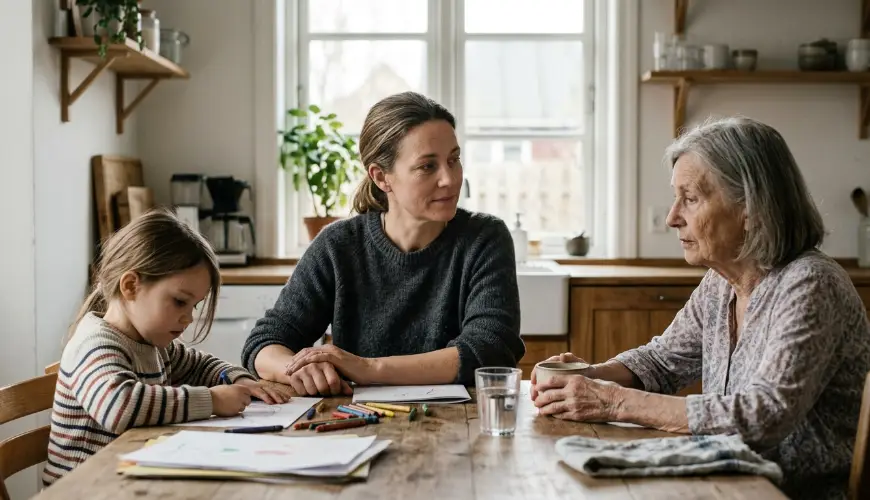
There is a life situation that has no established name in Czech, but millions of people know it well from their own experience. In English, it is called the sandwich generation – and it refers to people who find themselves squeezed between two groups of loved ones they must care for simultaneously: on one side, their own young children, and on the other, their ageing parents. And although men suffer from this pressure too, research repeatedly shows that women bear the brunt of it.
Consider Lucie, a forty-two-year-old accountant from Brno. In the morning she takes her seven-year-old son to school, after work she picks up her four-year-old daughter from nursery, and in the evening she calls her mother, who needs help with shopping and accompaniment to the doctor following hip surgery. At weekends she visits her partner's parents, whose father is suffering from early-stage dementia. Lucie doesn't get enough sleep, has almost no time for herself, and the word "rest" has become nearly an abstract concept for her. Her story is not exceptional – it is the reality of hundreds of thousands of women in the Czech Republic and around the world.
Try our natural products




Why it is women who bear the greatest burden
The sandwich generation phenomenon is not new. It was first described by American sociologist Dorothy Miller back in 1981, but in recent decades it has been growing in intensity. The reason is simple: people are living longer, while at the same time delaying parenthood until later in life, meaning both waves of caregiving overlap precisely at the moment when people are themselves in their productive middle years, facing both professional and personal demands.
According to data from the Pew Research Center, approximately one in eight Americans aged 40 to 60 belongs to the sandwich generation, with women making up a clear majority of those who actually carry out the caregiving. The situation in Europe, including the Czech Republic, is comparable. Women in this age group devote on average two to three times more hours per week to unpaid care for others than men of the same age. This is not merely a statistic – it is an everyday reality with concrete impacts on health, career and psychological wellbeing.
Why is this the case? The answer lies deep in cultural expectations that change only slowly. Women have traditionally been expected to be the ones who care – for children, for the household, for sick relatives. Men are perceived in these roles as helpers, not as primary caregivers. Even in households where both partners consider themselves equals, research repeatedly shows that the organisation of care – planning medical appointments, coordinating childcare, monitoring the needs of grandparents – falls on the woman's shoulders. This invisible yet exhausting mental burden is known as mental load, and it is one of the key reasons why women in the sandwich generation burn out more quickly.
The Czech Republic is among the countries where these inequalities are particularly pronounced. According to data from the Czech Statistical Office, Czech women spend on average more than two hours per day more than men on unpaid domestic work and caregiving. Add to this the care of ageing parents, which in middle age is layered on top of childcare, and we get a picture of a woman whose day simply does not have enough hours.
As American journalist and author Anne-Marie Slaughter aptly noted: "Care is the most important work in the world. And yet it is systematically undervalued, unpaid, and left to those with the least power to refuse."
Impacts on health, career and relationships
Long-term caregiving without adequate support and rest has demonstrable effects on both physical and mental health. Women in the sandwich generation suffer significantly higher rates of chronic stress, anxiety and depression than their peers who do not face such a dual burden. The World Health Organization repeatedly warns that informal caregivers – and women in particular – are a high-risk group for burnout syndrome, which manifests not only as psychological exhaustion but also as physical complaints: sleep disorders, weakened immunity and cardiovascular problems.
To this is added a career dimension. Many women in middle age are at precisely the stage where they could be growing professionally, taking on greater responsibility or pursuing their own projects. Instead, they reduce their working hours, turn down promotions or leave the labour market entirely in order to manage the care of their parents. Economists call this phenomenon the "caregiver penalty", and its consequences are lifelong: lower earnings, a lower pension, and less financial independence in old age. A woman who interrupts her career at forty-five to care for her parents may still be paying the price twenty years later.
Relationships suffer no less. Partnership life comes under pressure when one partner – typically the woman – bears the overwhelming majority of the caregiving burden while the other perceives it merely as the backdrop to daily life. Friendships fade away because there is simply no time or energy for them. And paradoxically, even the relationships with those being cared for suffer: an overburdened daughter who visits her mother out of obligation, her mind full of worries, provides nowhere near the support of a daughter who has the time, space and capacity to be truly present.
It is not without irony that women who spend their whole lives caring for others thereby worsen the conditions for their own old age – in terms of health, finances and social connections alike.
What can be done – and where to find support
There is no simple solution, because the problem has both structural and personal dimensions. At a societal level, greater recognition and support for informal caregivers would help – accessible respite services, flexible working conditions, and care allowances that would genuinely cover costs. Czech legislation in the area of elderly care has been evolving in recent years, but the capacity of outreach and residential social services still falls short of demand. Information on available options can be found, for example, on the website of the Czech Ministry of Labour and Social Affairs, which maintains an overview of social services and allowances for carers.
At a personal level, it is essential to accept that self-care is not selfishness – it is a precondition without which caring for others cannot function sustainably. The aeroplane analogy of the oxygen mask is not a cliché but a pragmatic truth: an exhausted, unwell, psychologically depleted woman cannot help her children or her parents. Regular rest, time for oneself, personal hobbies and social contacts are not a luxury but a necessity.
An important step is also open communication within the family – with a partner, with siblings, with teenage children. The care of ageing parents should not automatically fall to one person simply because she is a woman or lives closest. Dividing up tasks, even if not always equally, can significantly reduce the burden. It is equally beneficial to speak directly with ageing parents about their needs and wishes – many older people allow their children to be burdened for longer than necessary because they are too embarrassed to say what they truly need, or conversely, what they do not need.
Professional help – whether in the form of psychotherapy, counselling for carers or self-help groups – is another resource that tends to be underestimated. Organisations such as Elpida and the Czech Alzheimer's Society offer support not only to older people but also to their caring relatives. The awareness of not being alone, and meeting people in similar situations, can have a surprisingly powerful therapeutic effect.
Last but not least, it is worth reconsidering what "good care" actually means. The cultural pressure towards perfection – being a perfect mother, a self-sacrificing daughter, a reliable colleague, while looking great and keeping a tidy home – is unachievable and toxic. Good care does not mean being constantly available and sacrificing everything else. It means being present in quality, not merely in quantity. Sometimes that means accepting help from a professional care service instead of driving hundreds of kilometres every weekend. Sometimes it means saying "no" to one obligation in order to be able to fulfil another.
The sandwich generation – women trapped between caring for young children and ageing parents – is not merely a personal challenge for individuals. It is a mirror of a society that has yet to find a way to fairly share and value care as a fundamental human value. Lucie from Brno and the thousands of women like her deserve more than admiration and sympathy. They deserve systemic support, shared responsibility, and above all, the space to sometimes simply be themselves.