

The Secret of Deeply Rich Vegetarian Cuisine
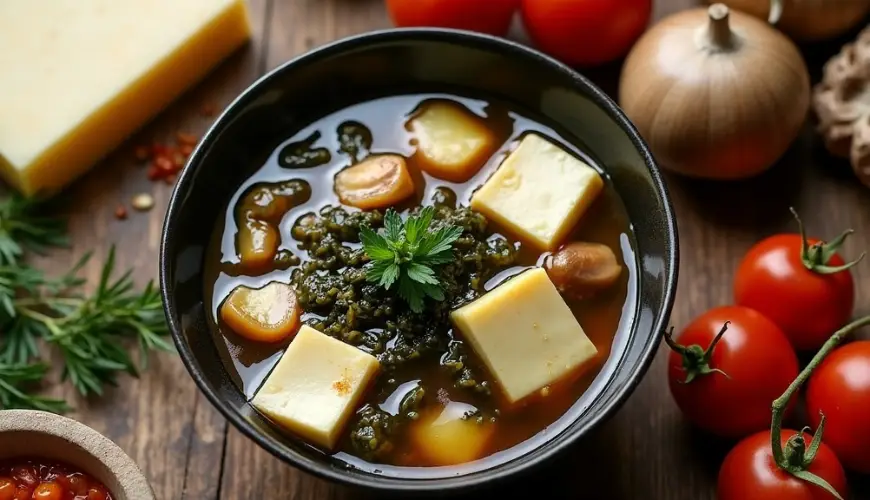
There is a persistent prejudice that vegetarian food is necessarily bland, light, and unsatisfying. That true depth of flavour belongs exclusively to bone broths, slow-braised meats, or grilled tenderloin. Yet anyone who has ever tasted well-prepared miso, slowly sautéed onions, or aged Parmesan knows that this claim simply doesn't hold up. Umami – that mysterious fifth taste, which leaves a feeling of fullness and depth in the mouth – occurs in the plant world in surprising abundance and variety. And it is precisely this that holds the key to deeply satisfying vegetarian cuisine that will win over even dedicated meat lovers.
Japanese scientist Kikunae Ikeda described umami as a distinct taste as far back as 1908, when he was studying kombu seaweed and its unusual ability to transform a simple broth into something extraordinarily satisfying. He discovered that this effect was due to glutamate – an amino acid naturally present in a wide range of foods. What is important, however, and what is often lost in the popular understanding of umami, is that glutamate is not found only in meat. Tomatoes, mushrooms, soy sauce, aged cheeses, and fermented foods contain it in quantities that can easily rival meat-based dishes – or even surpass them.
Try our natural products






Why vegetarian dishes sometimes taste "empty" – and how to change that
When a dish is described as tasting flat or bland, it usually doesn't mean it lacks seasoning. Rather, it signals the absence of that deep, rounded flavour that triggers a sense of satisfaction in the brain even before you push back from the table. Umami operates on precisely this level – it's not a taste one can easily name, but its absence is immediately noticeable.
A classic mistake when cooking vegetarian food is to simply "de-meat" a dish – take a traditional recipe, remove the meat, and leave everything else the same. The result can indeed feel like something is missing its centre of gravity. The solution, however, lies not in meat substitutes, but in understanding which ingredients bring depth and using them intentionally. Vegetarian cuisine that aims to be truly satisfying and complex needs to approach flavours differently – more actively, more deliberately, and with greater attention to fermentation, ageing, and heat treatment.
Consider a specific example: Italian tomato sauce. Made from just tinned tomatoes, olive oil, and garlic, it will be good but fairly straightforward. Add a teaspoon of miso paste to the base, a splash of soy sauce, or a handful of dried porcini mushrooms soaked in water (and don't discard that water – it's liquid gold) – and the sauce suddenly acquires a dimension that's hard to describe but immediately recognisable. It's not the taste of soy or mushrooms as such; it's their combined contribution to the overall character of the dish.
A similar transformation can happen to a simple lentil soup, the kind many may remember from childhood as "that boring one". But if the onions are first fried to a deep golden-brown, some tomato paste is added and allowed to caramelise briefly, seaweed or a little smoked paprika is thrown in, and the whole thing is finished with a dash of Worcestershire sauce (a vegetarian version without meat exists) – the result has an unexpected depth and richness that didn't come from any "mysterious" ingredient, but simply from handling the ones that were there from the start in the right way.
Ingredients that give vegetarian cuisine real depth
The world of plant-based umami sources is richer than it might first appear. Fermented foods rank among the absolute best – miso paste, tamari, soy sauce, tempeh, and kimchi contain glutamate in concentrated form while also bringing microbial complexity that adds layers of flavour to dishes. Japanese cuisine has known this for centuries: miso soup eaten at breakfast is not just a warm liquid – it is an entire flavour universe in a small bowl.
Mushrooms are another cornerstone. Shiitake, porcini, portobello, or even ordinary button mushrooms, when properly cooked, produce glutamate as well as guanylate – another compound that amplifies the perception of umami. Studies published in the journal Food Chemistry have repeatedly confirmed that dried mushrooms have a significantly higher content of these compounds than fresh ones, because drying concentrates them. This is why broth made from dried mushrooms is so powerful – and why professional chefs add it to sauces even when mushrooms themselves are not present in the dish.
Tomatoes, particularly in the form of concentrate or reduced through slow cooking, are a classic European source of umami. Italian cuisine is built on this – passata, concentrate, sun-dried tomatoes. Each form brings a slightly different character, but what they share is an intense concentration of glutamate. Aged cheeses such as Parmesan, pecorino, or mature cheddar are literally umami bombs – a small amount of Parmesan grated into pasta or risotto can elevate an entire dish to another level.
Seaweed, especially kombu, forms the basis of dashi stock in Japanese cuisine and is one of the richest natural sources of glutamate in existence. In a European context it remains somewhat exotic, but that is changing – according to data from the FAO, global interest in seaweed as a sustainable ingredient with exceptional nutritional properties is growing. Simply adding a small piece of kombu to a pot of beans or lentils gives the resulting broth a noticeably different weight.
Fermented sauces such as Worcestershire sauce, fish sauce (meat-free versions made from seaweed or mushrooms exist) or even quality balsamic vinegar bring that hard-to-name depth to dishes. The goal is not for their flavour contribution to be recognisable – on the contrary, the best work with umami ingredients is evident when someone thinks "this is somehow exceptionally good" without being able to say exactly why.
Caramelisation and the Maillard reaction are techniques rather than ingredients, but they deserve mention in any text about deep flavour. When onions are slowly sautéed over low heat for thirty to forty minutes, they transform into a dark brown, sweet, and deeply aromatic mass that is one of the most powerful flavour bases there is. The same principle applies to dry-frying mushrooms, roasting tomatoes in the oven, or grilling aubergine – heat transforms the structure of sugars and proteins, creating new flavour compounds that raw vegetables simply do not possess.
As American chef and writer Yotam Ottolenghi once aptly put it: "Vegetables are not a side dish – they are the main story." And this approach, treating vegetables seriously as carriers of flavour rather than mere accompaniments, is precisely what moves vegetarian cuisine from "healthy but dull" to "incredibly good".
A practical approach to cooking that truly satisfies
The satisfying quality of vegetarian food is not just a matter of taste, but also of texture and nutritional density. Legumes, wholegrains, nuts, and seeds form the foundation that provides the body with protein, complex carbohydrates, and fats – and therefore a genuine sense of fullness that lasts. Combining legumes with grains, such as rice with lentils or chickpeas with couscous, creates complete amino acid profiles and forms the basis of cuisines that have been vegetarian for thousands of years – Indian, Middle Eastern, and Ethiopian.
Textures play a surprisingly significant role in how satisfying a dish feels. Crunchy elements – toasted nuts, roasted chickpeas, wholegrain croutons – create contrast that the brain interprets as a richer and more satisfying meal. Creamy elements, such as tahini, avocado, or coconut milk, add a sense of fullness. And the umami components discussed above tie it all together into a coherent whole.
In practical terms, moving towards deeply satisfying vegetarian cuisine requires neither a revolution in the refrigerator nor the purchase of exotic ingredients. It is enough to start with a few basic changes:
- Miso paste in the fridge – add a spoonful to soups, sauces, or marinades
- Dried mushrooms in the pantry – never discard the soaking water
- Quality soy sauce or tamari instead of over-salting dishes with plain salt
- Tomato concentrate as the base of sauces, not merely as a seasoning
- Parmesan rind cooked in soups and stocks (don't throw the rind away – cook it)
Anyone who begins to apply these principles consciously will soon find that vegetarian cooking has ceased to be a compromise and has become a choice. Not out of conviction or necessity, but simply because the food tastes good – deeply, fully, and satisfyingly.
The sustainability of this approach to eating extends far beyond the plate. Reducing meat consumption, even partially, is one of the most significant individual steps towards lowering one's ecological footprint, as studies published in journals such as Nature Food have repeatedly confirmed. And when vegetarian cuisine is genuinely good – not merely "acceptable" or "healthy" – then the shift towards it ceases to be a sacrifice and becomes a pleasure.
Deeply satisfying vegetarian cuisine is therefore not about imitating meat or giving up on flavour. It is about understanding that nature offers an entire orchestra of flavour instruments, and umami is just one of them – albeit one of the most fascinating. All that remains is to learn how to play it.