
The Scandinavian way to get rid of things
The name itself sounds a little unsettling. Death cleaning – that can't be anything pleasant, let alone a fashionable trend that someone would voluntarily try. And yet this very concept from Sweden is spreading across the world like an avalanche, changing the way people think about their belongings, their space, and ultimately their own lives. Those who once immerse themselves in it usually find it to be one of the most relieving cleaning rituals they have ever tried.
In Swedish, this approach is called döstädning – dö means death, städning means cleaning. The term was popularised by Swedish author Margareta Magnusson in her book The Gentle Art of Swedish Death Cleaning, published in 2017, which quickly became an international bestseller. In it, Magnusson describes how she gradually sorted through the belongings of her deceased loved ones as well as her own collections of things, and came to realise what a burden the accumulation of possessions represents – not only for ourselves, but above all for those who will remain after us.
Try our natural products


What döstädning actually means and why it isn't just for seniors
Unlike what the name might suggest, this is not a gloomy ritual full of sorrow. It is rather a conscious and gentle clearing of one's surroundings with consideration for what would happen to your belongings if you were no longer here one day. It sounds stern, but in practice it is liberating. The idea is simple: what would your loved ones inherit if you died tomorrow? A pile of unnecessary things they wouldn't know what to do with? Or a well-organised space in which every item has its own story and meaning?
Magnusson herself says: "Döstädning does not mean that you should rid your home of all joy. It is about making sure your home is filled with things you love and getting rid of everything else." This idea resonates with many people across generations – and that is precisely why döstädning is not exclusively a matter for seniors, as it might seem. More and more people in their thirties and forties are adopting it as a preventive step towards a more conscious life.
Take a real-life example: Jana, a forty-four-year-old teacher from Brno, began her döstädning after helping her mother deal with the estate following her grandmother's death. She spent three weekends sorting through items whose existence she hadn't even known about – old furniture, boxes full of letters, clothing from the 1950s. "It was physically and emotionally exhausting," she says. "That's when I told myself I wouldn't do this to my children." She gradually began going through her own home, donated things she wasn't using, and found she felt lighter than she had in years.
There are thousands of stories like this. And it's not just about sentimental relief – it's about a real change in one's relationship to possessions, space, and ultimately one's own past.
How döstädning works in practice
One of the greatest strengths of this approach is that it has no strict rules or rigid system that must be followed to the letter. Unlike other popular decluttering methods – such as Marie Kondō's Japanese KonMari method, which asks whether an item "sparks joy" – döstädning asks a different question: Will this item be a burden to someone when I'm gone? This perspective is both clear-headed and deeply empathetic.
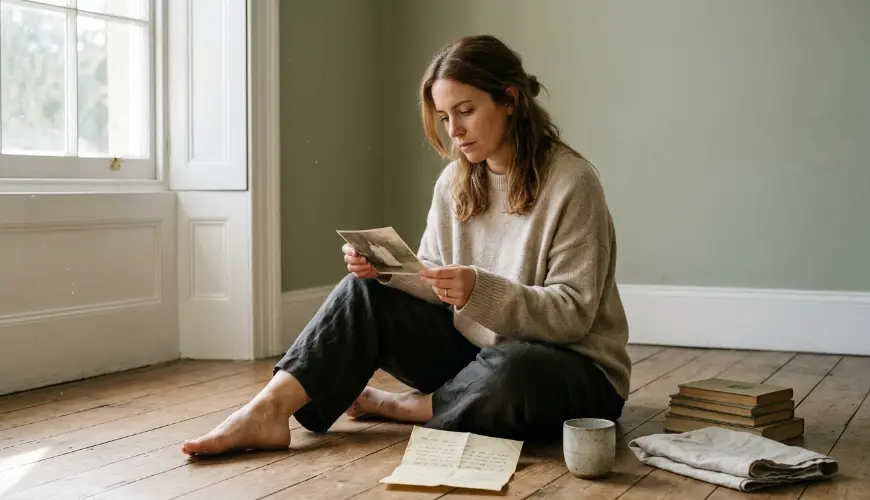
In practice, this means starting with the simplest things – clothing, kitchen utensils, books you never read, appliances with a questionable future. Only then do more sensitive items come into play – photographs, letters, personal records. Magnusson even recommends creating a so-called "secret drawer" – a place where items too personal for anyone else to see are stored, with a clear instruction that it be destroyed without being looked through after your death.
This process is not only about physical space. It is also a deeply psychological one. Research in environmental psychology shows that cluttered homes increase levels of cortisol – the stress hormone – and reduce the ability to concentrate. Getting rid of unnecessary things therefore literally reduces stress and improves mental wellbeing. It is not merely an aesthetic matter, but a health decision.
Döstädning is also entirely compatible with the principles of sustainability, which are increasingly important today. The items you sort through don't have to end up in the bin. Clothing you've outgrown or that simply no longer suits you can be donated to charities or exchanged at swap shops. Functional appliances can find a new home through second-hand platforms. Books make their way to second-hand bookshops or community book exchanges. Döstädning and a sustainable approach to life go hand in hand – both stem from respect for objects and a conscious approach to what we own.
Why this trend is arriving right now
It would be naive to think that döstädning emerged in a vacuum. Its popularity is no coincidence – it arrives at a time when society is increasingly struggling with an overload of consumerism, digital noise, and the feeling that things control us more than we control them. The statistics speak clearly: according to research by the UCLA Center on Everyday Lives of Families, American families own an average of over 300,000 items. Although these are American figures, the situation in Czech households is not much different – cellars, attics, and garages full of things "that might come in handy someday" are almost a tradition in our culture.
Today's generation of people in their forties and fifties also faces a specific pressure: they are the ones who inherit from their parents and grandparents while at the same time trying to pass as little burden as possible on to their own children. They stand literally between two waves of accumulation, and döstädning offers them a way to break free from this grip.
The trend's popularity is also aided by a growing interest in the Nordic lifestyle in general. Concepts such as hygge (the Danish feeling of cosiness and wellbeing) or lagom (the Swedish principle of "just enough") have gained enormous popularity outside Scandinavia – and döstädning naturally fits alongside them as their practical, tangible counterpart. It's not just about aesthetics, but about a philosophy: fewer things, more presence.
Interestingly, döstädning differs from minimalism, with which it is sometimes confused. Minimalism strives for the smallest possible number of possessions as an end in itself. Döstädning is not about asceticism – it is about conscious choice. You can own a collection of books, porcelain figurines, or vinyl records and still practise döstädning, as long as you know why you have these things, who you will one day pass them on to, and what will become of them.
Practising döstädning can also be an opportunity for conversations that we might otherwise never have. When you go through old photographs with parents or grandparents, you discover stories that would otherwise disappear along with the objects. Who was in that old photograph from 1962? Where did that old travel suitcase come from? These conversations have a value that no amount of tidying can erase – on the contrary, döstädning directly brings them about.
For those who want to start but don't know how, there are a few simple principles. There is no need to tackle the entire home at once – one drawer, one shelf, one box is enough to begin. The key is regularity and intentionality, not speed. And if sadness or nostalgia overtakes you while sorting, that is normal – döstädning is not about suppressing emotions, but about processing them through the things we have accumulated.
- Start practically – clothing, kitchen equipment, books
- Move on to items with a story – photographs, letters, mementos
- Leave the most sensitive things for last – personal records, items with deep emotional weight
- Donate, don't discard – consider charity, swapping, second-hand selling, or community sharing
- Involve the family – ask who would like what, while there is still time
Döstädning is ultimately not about death. It is about life – about living it more consciously, with less burden and greater lightness. It is about knowing that the things surrounding us are there because we consciously chose them, not because they simply accumulated. And perhaps it is one of the kindest gifts we can prepare both for ourselves and for those we love – a space cleared of the unnecessary, in which only what truly matters remains.