
Recipes from the air fryer will provide tips that you'll appreciate when you want healthier food and
The air fryer has quickly found a place in Czech kitchens over the past few years, much like the electric kettle once did. It's no wonder: it promises crispy fries without a liter of oil, a quick dinner, and a "rescue" when no one feels like standing by the stove. However, after the initial excitement, the question often arises, what's next? How to properly and effectively use the air fryer, so it doesn't end up as an expensive bread warmer? And how to get simple and tasty air fryer recipes that make sense health-wise?
The good news is that an air fryer is not just a "smaller oven." It can work with the circulation of hot air so intensely that it can handle some things faster and crispier than one might expect. And when combined with a few smart habits, it becomes a daily helper for healthy recipes and relaxed cooking after work.
How to Properly and Effectively Use the Air Fryer (and Why It Changes Taste and Results)
The basic magic lies in air circulation. Thanks to it, the surface of the food dries and caramelizes quickly, creating the well-known crust—often with significantly less fat. But that doesn't mean "no fat forever." For many ingredients, a small amount of quality oil is actually advantageous: it helps with color, crispiness, and the transfer of spice flavors. It's more about using 1–2 teaspoons or a light spray instead of frying in a layer of oil.
To make the fryer work at its best, it's worth following a few simple rules. Not overloading the basket is perhaps the most important. When there's too much food, the hot air has nowhere to flow, and the result is more steamed than baked. For fries, vegetables, or tofu, it often suffices to add a smaller batch and shake once or twice during the process. Likewise, preheating helps—not always necessary, but for things that should be really crispy (fries, falafel, breaded pieces), it makes a difference.
Moisture is also a big topic. Yogurt-based marinades or sauces with higher water content can behave unpredictably: instead of a nice surface, you get more of a "wet" layer. It's smarter to use drier spice mixes, or marinate and then lightly dry the surface. For breaded foods, breadcrumbs need a bit of oil to brown nicely—just a light drizzle or spray of oil.
When talking about healthier cooking, it's often simplified to "less fat = healthier." The reality is more nuanced. The air fryer can help reduce the amount of oil, but it still depends on what ends up in it. If only frozen semi-finished products are going around in the basket, the impact on the diet will be limited. But if you start working with vegetables, legumes, fish, or quality sides, you can get a lot out of it. The World Health Organization (WHO) provides general recommendations for healthy eating: https://www.who.int/news-room/fact-sheets/detail/healthy-diet — and the combination of more vegetables, reasonable portions, and fewer processed foods is something the fryer can support with its speed.
And now to what interests the most: air fryer recipes that are not just about fries.
Simple and Tasty Air Fryer Recipes Suitable for the Average Week
In practice, the best recipes are those that have three features: they are quick, can withstand slight variations, and taste good the next day. The air fryer is great for "small baking"—portions for two, quick vegetables for dinner, or crispy components for bowls and salads. And often for things that are otherwise done in the oven, just with less preheating and energy consumption.
Crispy Vegetables on a Tray... Just Without the Tray: Broccoli, Cauliflower, Carrots
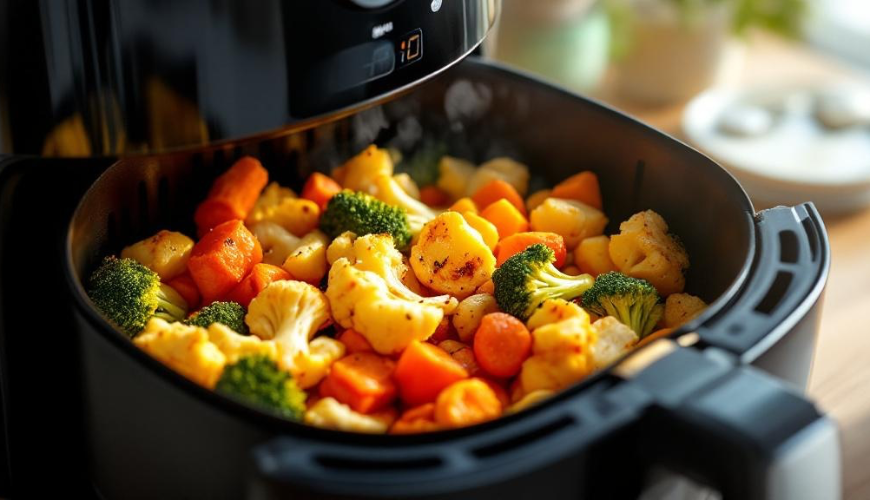
The basic process is almost ridiculously simple: cut the vegetables into similarly sized pieces, mix with a bit of oil, salt, and spices, and bake until the edges are golden. Broccoli is usually ready in about 8–12 minutes (depending on the size of the florets and the power of the fryer), cauliflower a few minutes longer. Carrots or sweet potatoes are best cut into thinner fries.
Flavor-wise, a combination of smoked paprika, garlic, and lemon juice added at the end works well. This vegetable can make a quick dinner: add cooked quinoa or couscous to the bowl, a handful of arugula, a spoonful of hummus, and top with crispy vegetables. Suddenly, there's a meal on the table that feels "restaurant-like," but was made without complicated cooking.
"The best recipe is one that can be repeated even on a Wednesday evening when you don't have the energy for experiments." For the air fryer, this is doubly true: once you find a few basic combinations of spices and ingredients, cooking almost does itself.
Salmon or Trout in 15 Minutes: Quick Protein Without the Mess
Fish are surprisingly rewarding in the air fryer. A filet just needs to be salted, peppered, add a bit of olive oil, and maybe some lemon zest. With salmon, often a higher temperature and shorter time work well to keep it juicy. Those afraid of drying it out can place the fish on parchment paper designed for the fryer (or a perforated insert), and especially not bake it unnecessarily long.
Next to the fish, asparagus, zucchini, or green beans can be quickly made. And it's done without a pan, without splattering, and with minimal dishes. For many households, this is precisely why the fryer becomes an everyday appliance.
Chickpea "Crunchies" for Salads or Movie Snacks
Chickpeas from a can (or cooked) can be turned into an addictive crunchy snack. The key is to dry them well, mix with a bit of oil and spices, and bake until they are golden and dry on the surface. Spices can be curry, cumin, paprika, or just salt and pepper. The result is great in salads instead of croutons, in soup, or just in a bowl.
This is one of those healthy recipes that help replace chips with something filling yet still a "crunchy pleasure." And it can easily be made in larger quantities.
Tofu That Finally Tastes Good: Quick Version Without Frying
Tofu has the reputation of a boring ingredient until you experience tofu crispy on the outside and juicy on the inside. The air fryer can do it, you just need to either press the tofu or at least wrap it in a towel and weigh it down for a few minutes to release water. Then cut it into cubes, mix with a bit of soy sauce, starch (corn or potato), and spices.
The starch creates a light crust that holds the sauce. Finished tofu can be added to stir-fry, rice, tortilla, or salad. And when you add a simple sauce of tahini, lemon, and water, you get a dish that tastes "grown-up," but the preparation is still simple.
Homemade Sweet Potato Fries: A Classic Done Smarter
Sweet potatoes can be tricky because they have more sugar and water than potatoes, so they sometimes turn mushy instead of crispy. It helps to cut them into thinner fries, dry them well, and add a bit of starch. It's also important to bake in smaller batches and shake occasionally.
Sweet potatoes pair well with a dip of Greek yogurt, lemon, and garlic, or an avocado cream. Here, it becomes clear that air fryer recipes don't have to be about compromise: the crispness remains, but the amount of fat can be kept under control.
Tips for Meals from the Air Fryer That Save Time, Energy, and Nerves
Once the basics are mastered, the second phase comes: coming up with "combinations" and smart planning. The air fryer is ideal for smaller batches and quick components, so it's worth thinking of meals as a kit. One day you bake vegetables, another day tofu, another day potatoes—and the rest is supplemented with what's already at home (salad, bread, legume spread, leftover rice).
In real life, it might look like this: on Thursday evening, you open the fridge and instead of complicated cooking, there's only half a broccoli, two carrots, and some leftover cooked lentils. Broccoli and carrots go into the fryer with a bit of oil and smoked paprika, the lentils are reheated with some tomato paste and garlic, topped with a spoonful of yogurt or https://www.ferwer.cz/blog/tahini. In twenty minutes, a meal is ready that seems thought-out, yet was made from what might have otherwise ended up forgotten in the drawer. This is where the practical side shines: how to properly and effectively use the air fryer isn't about "perfect recipes," but about simplifying everyday decision-making.
For the fryer to really help, it's good to think about details that often get lost online. For example, cleaning: if the basket is left standing, grease bakes on, and the next cooking session is less pleasant. Often, it's enough to briefly soak the basket after cooling and wash it with a gentle detergent. Those who want to be even more eco-friendly will appreciate more ecological cleaning agents and sponges that don't leave microplastics—a small thing, but it makes sense in the long run.
Similarly, it's worth knowing that some foods behave "wildly" in the air fryer. Lightweight cheese slices can fly around, leafy greens dry out quickly, and sauces can drip into the bottom. It's helpful to use appropriate containers (a small baking dish for the fryer), parchment with holes, or weigh down ingredients (like securing a filled toast with a toothpick).
If the article is to offer just one short list, then it would be this: three habits that improve almost every result.
Three Little Things That Make a Big Difference
- Dry and don't overload: dry ingredients (especially potatoes, chickpeas, tofu) and bake in two batches rather than one heap.
- Shake and turn: with fries, vegetables, and tofu pieces, shake the basket or turn the food once during baking.
- Season at the end: add lemon, herbs, parmesan, or quality olive oil after baking—the flavor stays fresh and doesn't get lost in the heat.
Into the "tips for meals from the air fryer" also belong small shortcuts that save money. For example, bread: older rolls or pita bread can be revitalized in a few minutes, just keep an eye on the time so they don't turn into toast. Leftover roasted vegetables can be quickly reheated and crisped again, which is often more pleasant than a microwave. And those who enjoy breakfasts can try baked oatmeal in a small dish or a quick baked toast with an egg—just choose a container that fits in the fryer and is suitable for high temperatures.
When discussing health, it's fair to mention a less pleasant thing: at very high temperatures and long baking of starchy foods (potatoes, bread), acrylamide can form, much like in baking and frying in general. The European Food Safety Authority (EFSA) provides context and recommendations for households: https://www.efsa.europa.eu/en/topics/topic/acrylamide. In practice, this means a simple rule: aim for a golden color, not dark brown, avoid overcooking, and alternate food types—which is easy with a fryer because it excels with vegetables and proteins, not just potatoes.
Perhaps the greatest advantage of the air fryer in the end is not crispiness, but that it shortens the path between idea and finished meal. When dinner is quick, it's easier to reach for quality ingredients and prepare them at home, rather than ending up with something random. And this is where simple and tasty air fryer recipes naturally meet a healthier lifestyle: less stress, less waste, more real food.
Next time when deciding what to put on the table, it's worth asking a simple question: what if instead of complicated cooking, just one crispy component is made in the fryer and the rest is put together from what's already at home? Often, it's a surprisingly good plan—and exactly the type of routine that lasts longer than the first wave of excitement over a new appliance.