
# How to Set Up a Functional Home Office in a Small Apartment ## Proč je to důležité Práce z domov
Working from home has become part of everyday life for millions of people over the past several years. And although many initially thought it was a temporary solution, reality has shown otherwise – the home office is here to stay. However, this brings with it one fundamental problem: not everyone has a whole room at home that they can transform into an office. What can you do when your flat measures thirty, forty or fifty square metres and every corner has its purpose? The answer is surprisingly simple – a functional workspace can be created in as little as two square metres, provided you approach the planning with care and a little creativity.
It's not just about aesthetics or having a nice-looking photo for social media. A well-equipped workspace has a direct impact on productivity, concentration and overall wellbeing. According to research published on sites such as Harvard Business Review, the physical environment in which we work influences our ability to concentrate and perform far more than most people realise. Noise from the living room, a distracting view of clutter, or an uncomfortable chair – all of these gradually take their toll on work results and mood.
Try our natural products






Where to start: choosing the right spot in your flat
Before you start buying furniture or moving things around, it's worth pausing and carefully considering which spot in your flat is best suited for a workspace. The ideal choice is usually a corner with natural daylight, preferably near a window, but positioned so that the monitor isn't facing directly into the light and causing reflections. Natural light not only reduces eye strain but also improves mood and helps maintain a natural biorhythm – this is confirmed by experts at the American Academy of Sleep Medicine, who highlight the influence of daylight on sleep quality and overall vitality.
Another important factor is separating the workspace from the rest area. Psychologists have long warned that if we work in the same place where we relax or sleep, the brain begins to associate these places and stops perceiving them as separate zones. The result is that we can't properly unwind in the bedroom, and at the work desk we find ourselves thinking about rest instead. Even a symbolic boundary – such as a shelf, a curtain, or simply a different rug – can make a big difference.
A practical real-life example is the situation of Markéta, a thirty-year-old graphic designer from Brno, who lives in a studio flat of thirty-five square metres. Initially, she worked from her bed or the dining table, where her personal and work belongings kept getting mixed up. She eventually decided to make use of the unused space by the front door – a narrow corner about one and a half metres wide – and got herself a folding desk that opens up during the day and folds flat against the wall in the evening. Today she says that this small change made an enormous difference in her ability to separate work time from leisure time.
Equipment that actually works
Once the spot has been chosen, it's time to think about the actual equipment. And this is precisely where many people make a fundamental mistake – they try to save money on the things that have the greatest impact on their health and comfort. Ergonomics is not a luxury; it is an investment in your health. An unsuitable desk height or a poorly adjusted chair can lead to back, neck and shoulder pain that over time becomes chronic.
The foundation of any workspace is a desk at the right height. The standard working desk height is around seventy-five centimetres, but the ideal is one at which your forearms are parallel to the floor when typing. If space is truly limited, fold-out or folding desks that can be tucked away after working hours are an excellent alternative. There is a wide range of solutions on the market that take up less than one square metre when unfolded, yet still provide sufficient workspace.
The chair is just as important as the desk. It's worth investing in an ergonomic office chair, but if space doesn't allow for one, a compromise can be found in an adjustable chair with lumbar support or a special lumbar cushion. There are also active seating aids, such as balance boards or ergonomic wedge cushions, which support correct posture even when sitting on a standard chair.
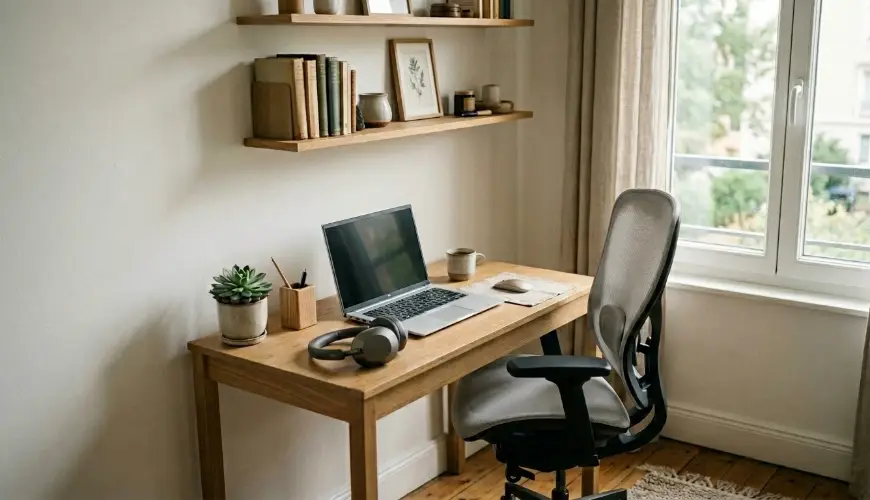
Vertical space is your best friend when floor space is limited. Instead of expanding the workspace sideways, simply make use of the wall above the desk – shelves, magnetic boards, hanging organisers or wall-mounted document pockets. Anything that can be hung or attached to the wall saves valuable desk space. The desk should serve exclusively for work, not as a dumping ground for various items.
Lighting is another key element that is often overlooked when setting up a workspace. Natural light is ideal, but it isn't sufficient during the afternoon hours or when working in low light. A desk lamp with adjustable brightness and colour temperature is an absolute necessity – warm light promotes relaxation, while cool, bluish light supports concentration and alertness. Modern LED lamps with adjustable colour temperature are now available at reasonable prices and contribute significantly to comfort while working.
Order, nature and wellbeing in the workplace
Keeping a small workspace tidy is a challenge in itself. Without a system, the desk quickly turns into chaos that distracts and causes stress. The key is to have a designated place for everything and to regularly – ideally every day after finishing work – return the workspace to its default state. Cable organisers, small boxes for odds and ends, or simple binders for documents can all help. A minimalist approach pays double dividends here: the fewer things on the workspace, the fewer things there are to distract you.
As designer and minimalism pioneer Dieter Rams once said: "Less, but better." This principle applies to a home workspace perhaps more than anywhere else.
Nature belongs in a workspace more than you might think. Houseplants not only improve the air in the room, but according to research from the NASA Clean Air Study, certain species can actually filter harmful substances from the air. Moreover, the sight of greenery naturally reduces stress levels and contributes to overall wellbeing. Compact varieties such as succulents, ZZ plants or pothos are well suited to a small workspace – they require little care and are visually pleasing.
The choice of materials and colours for the workspace also plays its part. Natural materials such as wood or bamboo bring warmth and a pleasant atmosphere to the space, while cold metals or plastic can feel sterile. Wall colours or accessories affect mood – calming green and blue tones support concentration, while bright colours such as yellow or orange can bring energy but may also cause distraction when used excessively. Soft, muted shades are generally the best choice for a workspace.
Sustainability and an ecological approach to setting up a workspace are increasingly important topics today. Rather than buying cheap furniture that falls apart within a year, it's worth investing in quality, durable pieces made from certified materials. Likewise, accessories such as organisers, baskets or storage boxes can be sourced from natural materials – bamboo, rattan or recycled plastic – thereby contributing to a smaller ecological footprint for the household. Such an approach is also in line with the values of a sustainable lifestyle, which is becoming the norm for a growing number of people.
The technical setup of a workspace must not be overlooked. A good router or Wi-Fi extender placed near the workspace will ensure a stable connection, which is the foundation of productive work. A power strip with surge protection and enough sockets allows all devices to be powered comfortably without having to reach behind the desk or trail cables across the room. And if at all possible, it's worth hiding cables in cable ducts or bundling them with cable ties – cable clutter is one of the biggest visual distractions in a small workspace.
Sound is the last but equally important element. If the workspace is not separated from the rest of the flat or house, noise from the surroundings can be a real obstacle to concentration. Acoustic wall panels, a heavy curtain, or even just a good pair of noise-cancelling headphones can help. Some people, on the other hand, work better with quiet ambient sound or nature sounds in the background – and for this, there is now a wide range of apps and platforms available.
Finally, it's worth bearing in mind that the perfect workspace doesn't come together overnight. It is a process in which you gradually discover what suits you and what doesn't, what distracts you and what supports your concentration. You can start with the bare minimum – a desk, a good chair and proper lighting – and gradually fine-tune the space according to your own needs and habits. The important thing is not to settle for a compromise that doesn't work, but to actively seek solutions that transform a small space into a place where work truly flourishes.