
# Why Your Apartment Still Looks Messy Even After Cleaning
Do you know that feeling? You spend Saturday morning cleaning — dusting, vacuuming the carpets, washing the floors — and yet a few hours later it looks as though you hadn't cleaned at all. The flat doesn't look fresh or tidy, just... different from before. A surprisingly large number of people experience this frustrating paradox, and yet few suspect where the real problem lies. It isn't laziness or poor cleaning technique. The cause tends to run deeper, hidden in the way the home is organised and in our relationship with the things around us.
Modern interior psychology and space organisation experts agree on one thing: visual clutter is not the same as dirt. A flat can be hygienically clean and yet still feel chaotic and untidy. Conversely, a space that hasn't been vacuumed all week can look surprisingly calm and orderly if everything is in its place. This distinction is key to understanding why cleaning alone is not enough.
Try our natural products
Real mess begins long before the mop and cloth come out
Let's look at a concrete example. Jana is a working mother of two children from Brno. Every weekend she carefully cleans the entire flat — floors, bathroom, kitchen worktop. Yet every time she comes home from work, she is greeted by a sight that stresses her out: shoes scattered by the door, post dumped on the dining table, chargers dangling from sockets, mugs on the coffee table. Cleaning as such does not solve this problem, because its cause is not dirty floors — it is the absence of a system defining where things belong and where they actually end up.
Home organisation experts, such as Marie Kondo or the professional organisers associated with NAPO, repeatedly point out that every item in a home must have a fixed place. If it doesn't, it lands anywhere — and that is the seed of visual chaos. It is not enough to occasionally "tidy" things, meaning move them from one place to another. True order arises when every object has a home to which it naturally returns.
Another greatly underestimated factor is the so-called flat surface syndrome — the phenomenon whereby every free horizontal surface in a flat inevitably attracts things. The dining table becomes a drop zone for bags, newspapers and keys. The kitchen worktop disappears under a pile of appliances that "might be used soon". The windowsill fills up with candles, ornaments and things that don't fit anywhere else. The more free surfaces there are, the more opportunities for mess — and no amount of mopping will solve this problem.
A study published in the journal Personality and Social Psychology Bulletin found that people living in chaotic spaces show higher levels of cortisol — the stress hormone — than those whose homes are orderly. Visual clutter literally burdens the brain, because every randomly placed object is, to our perception, an unresolved task. The brain registers it, processes it and expends energy on it — even when we are not consciously aware of this.
Where the feeling of perpetual mess comes from
One of the most common reasons a flat looks untidy even after cleaning is an excess of things. Simple mathematics: the more objects a home contains, the harder it is to maintain visual calm. It is not about being lazy or incapable — it is about the system simply lacking the capacity. Every extra mug, every decoration, every book that "might come in handy one day" adds another layer of visual noise to the space.
The so-called creeping normalcy works in a very similar way — a gradual habituation to a state that deteriorates so slowly we stop noticing it. One ring mark on a shelf. Then two. Then a pile of magazines that has been sitting there so long we stop seeing it. This adaptation is natural, but it has its price: a space that once looked tidy gradually becomes a backdrop of chronic disorder without our realising it.
The way we approach cleaning itself also plays a role. Most of us clean reactively — when the mess is too great to ignore. But this approach addresses the symptoms, not the causes. Regular, short maintenance is more effective than occasional big cleans. Ten minutes every evening spent returning things to their places does more for the appearance of a home than a three-hour Saturday session once a fortnight.
An interesting perspective is offered by the Japanese concept of kaizen — the philosophy of small, gradual improvements. In the context of the home, this means not creating a perfect system all at once, but gradually improving individual areas. Fix one drawer. Sort out one problematic corner. Get rid of one category of things that just accumulates in the flat. As the Japanese proverb says: "A journey of a thousand miles begins with a single step." This incremental approach tends to be more sustainable than the revolutionary one, where someone throws out half their flat over a weekend and a month later is back where they started.
How to stop cleaning and start organising
The change in approach begins with shifting attention from cleanliness to organisation. It is not about how carefully we wash the floors, but about what sits on the surfaces above them. The first step is an honest assessment of how many things the home actually contains and whether each of them has a logical place.
A practical tool is the so-called one-year rule: if you haven't used something in the past year, you probably don't need it. This rule applies to clothing, kitchen utensils, decorations and books alike. Letting go of excess is painful, but the result is worth it — fewer things means less visual noise and, paradoxically, less work when cleaning.
Another key principle is visible versus hidden storage. Things that are on display must be aesthetically arranged or put away. Open shelves look attractive on Pinterest, but in real life they require a significantly higher level of discipline than closed cupboards. If you know you don't have the time or energy to rearrange the items on a shelf every week, it is better to invest in quality storage furniture with doors.
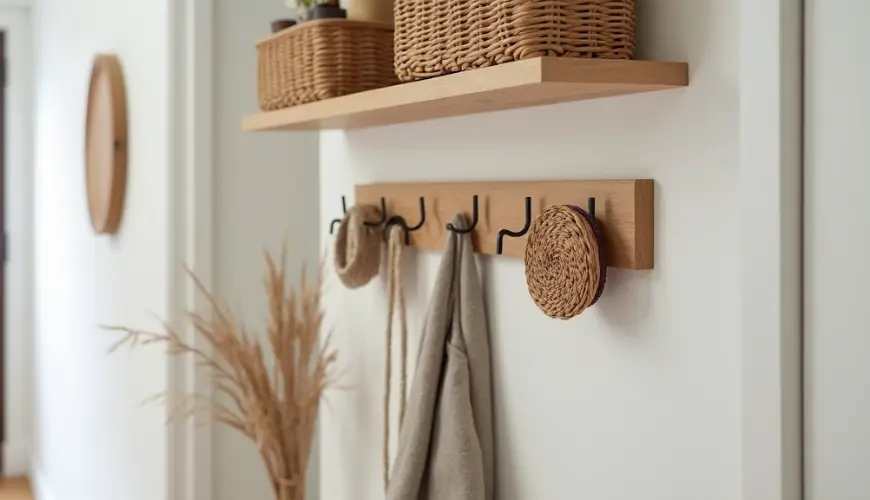
A greatly underestimated area is the so-called transition zones — places where things enter the flat and where their fate is decided. The entrance hallway, the kitchen worktop by the door, the coffee table in the living room. These surfaces tend to be the most cluttered, because they serve as the first landing pad for everything we bring home. The solution is the deliberate equipping of these spots — a hook for keys, a basket for post, a shelf for shoes. The system must be simple enough to use even when we come home tired and not thinking about tidiness.
Digital clutter, which spills over into physical space, is a chapter in itself. Chargers, cables, tablets, headphones — tech accessories have become the modern equivalent of old-fashioned mess. Cable management and a designated place for electronics are today just as important as keeping the kitchen worktop organised. A simple solution can be a cable organiser or a closed box into which everything is "put away" before bedtime.
It is also worth mentioning the role of materials and surfaces in the overall impression a flat makes. Glossy surfaces reveal every fingerprint, light-coloured carpets every stain, white shelves every layer of dust. Choosing more durable and practical materials — darker floors, matte surfaces, washable covers — can significantly reduce the amount of visible dirt and extend the time a flat looks tidy without the need for daily cleaning.
For those who want to go further, the concept of the capsule home may provide inspiration — an analogy to the capsule wardrobe, but for the entire home. It involves the deliberate reduction of possessions to those that are truly used, loved or necessary. The result is not a sterile, impersonal space, but rather a home filled with things that have a story and a purpose — and where cleaning is merely a brief routine rather than an all-day expedition.
A sustainable approach to the home, combining fewer things, better-quality materials and thoughtful organisation, goes hand in hand with the principles of an ecological lifestyle. Buying less, choosing more carefully, prioritising things that last and have real value — these are principles that benefit not only the planet, but also mental wellbeing and everyday life at home.
Let us return for a moment to Jana from Brno. After she stopped focusing on cleaning and started focusing on systems, her situation changed. She added a coat rack by the door, a basket for post, and agreed with her children on the rule "every thing goes back where it came from". It didn't happen overnight — but after a few weeks she found that the flat looked tidy even on a Tuesday evening, without any weekend effort. Cleaning was reduced to a fraction of the original time, because there was nothing to clean — things simply weren't in the wrong places.
And that is perhaps the most important insight of the whole matter: tidiness is not the result of cleaning, but the result of a system. Cleaning is merely a safety net for the moments when the system fails. If the system works, the safety net is rarely needed — and the flat looks the way it should, every day of the week.