

Feng shui of the dining room changes the way we eat
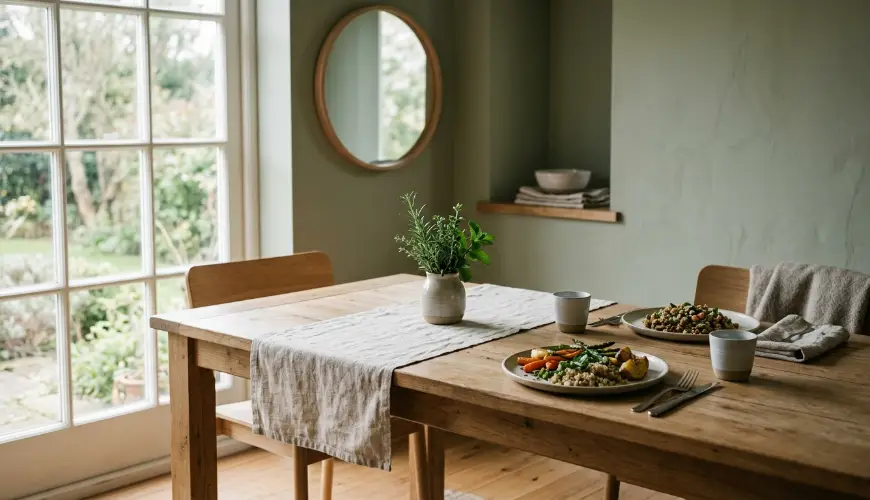
You may have never noticed that you sit differently at the table when eating alone versus when you have guests. Or that in some restaurants, food seems to disappear from the plate faster than it does at home. This is neither coincidence nor magic – it is about the space we move in, the light, the colors, the materials, and how things around us are arranged. Feng shui of the dining room and the broader topic of how environment influences our eating habits is an area that connects thousands of years of Chinese teaching with modern behavioral science. And the results are surprisingly consistent.
Feng shui – literally "wind and water" – is an ancient Chinese art of harmonious spatial arrangement, based on the belief that the flow of energy, known as chi, influences the wellbeing, health, and relationships of people living or working in a given place. Although skeptics dismiss this teaching as esoteric, many of its principles find support in modern environmental psychology. Research repeatedly shows that the physical environment has a demonstrable influence on how much we eat, how quickly we eat, and how satisfied we feel after a meal.
Try our natural products





Science and tradition speak the same language
Professor Brian Wansink of Cornell University spent decades studying how environment influences our eating behavior. His conclusions, summarized among other places in the book Mindless Eating, are straightforward: we eat more when there is clutter around us, noise, light that is too bright or too dim, and less when we feel relaxed and comfortable. Feng shui works precisely with these variables – with the arrangement of furniture, the flow of light, the colors of walls, and whether we have a view or have our backs to a wall while eating.
It is no coincidence that fast food restaurants traditionally rely on bright red and orange colors, hard plastic seats, and loud music. These elements deliberately shorten the time spent in the restaurant and encourage rapid consumption. In contrast, upscale restaurants choose subdued lighting, soft upholstery, warm earthy tones, and calm music – because they know that guests who feel comfortable will stay longer, order more, and return again. Feng shui of the dining room in a home setting works on the same principle – only with the difference that the goal is not to sell more, but to eat more mindfully, with greater enjoyment and in appropriate amounts.
Consider, for example, a family that moved their dining table from a dark corner of the room closer to the window, cleared away a pile of papers and unnecessary items from the table, and replaced a plastic tablecloth with simple linen placemats. The change seemed cosmetic, but the result was clear: meals lasted longer, conversation at the table was more lively, and the overall atmosphere transformed from a rushed obligation into a pleasant ritual. This is not theory – thousands of people who have consciously decided to pay attention to their space share such stories.
One of the key principles of feng shui is the so-called command position – the table or seating should be positioned so that a person sits with their back to the wall and has a view of the door or the entire room. This principle stems from an ancient instinct for safety: when we can see what is happening around us, we feel protected and relaxed. And a relaxed person eats more slowly, better perceives signals of fullness, and generally enjoys their meal more. Modern psychology confirms this – stress and a sense of threat activate the sympathetic nervous system, which among other things disrupts digestion and leads to more impulsive eating.
Colors, light, and materials are not merely aesthetics
Colors play a greater role in the context of eating than one might think. The color blue is associated in nature with poisonous or spoiled foods, and therefore naturally suppresses appetite – which is precisely why fast food chains do not use it. Red and orange, on the other hand, stimulate appetite and accelerate metabolism. Green and earthy tones evoke nature, freshness, and calm – and these are precisely the colors that feng shui most frequently recommends for the dining room. Warm yellow can encourage communication and joy, while overly saturated purple or dark gray can weigh down a space and make it unpleasant for regular dining.
Light is another key factor. Natural daylight is ideal for the dining room – not only because it improves mood and helps regulate the circadian rhythm, but also because it allows us to better perceive the colors and textures of food. Food that looks good tastes better – this is not a cliché, but a proven psychological phenomenon. In the evening, it is advisable to switch to warm, subdued lighting, which calms the nervous system and creates conditions for slow, mindful dining. A study published in the journal Environment and Behavior showed that people in spaces with subdued lighting consume food more slowly and also rate its taste as better.
The materials and textures that surround us while eating are likewise not negligible. Feng shui favors natural materials – wood, stone, ceramics, linen or cotton textiles. These materials have their own specific energy, but also an entirely practical dimension: they are pleasant to the touch, naturally dampen noise, and create a sense of warmth and safety. Hard glossy surfaces, synthetic plastics, and cold metals, on the other hand, cool a space and can contribute to a sense of unease. If you are therefore thinking about furnishing a dining room, choosing a wooden table, ceramic tableware, and natural textiles is not merely an aesthetic decision, but also a functional one.
The size of plates and dishes also plays an important role. Wansink's experiments repeatedly demonstrated that people consume significantly more food when it is served on larger plates – because the brain judges quantity relative to the size of the vessel. While feng shui does not speak directly about plate size, its emphasis on mindful table arrangement and the aesthetics of serving naturally leads to similar conclusions: a beautifully set table with appropriately sized tableware invites a more mindful approach to eating.
Sound is another factor that tends to be underestimated in the context of eating. Loud, fast music demonstrably accelerates the pace of eating, while slow, calm melodies or silence slow it down. Feng shui recommends separating the dining room from sources of noise and disruptive influences – television, loud conversations, or work laptops at the table are among the greatest enemies of mindful dining. This is not merely a matter of etiquette – it is a matter of health. When we eat while distracted, the brain does not perceive satiety signals quickly enough, and the result is overeating that we are not even aware of.
As writer Michael Pollan once said: "Eat food. Not too much. Mostly plants." This simple advice is more easily realized in a space that naturally encourages such an approach – where there is no chaos, where we feel safe, and where nothing pushes us toward speed or impulsive behavior.
Practical application of these principles need not be complicated or costly. It is enough to start with a few steps: remove everything from the table that does not belong to eating – phones, remote controls, magazines, work documents. Make sure the table is clean and tidy before each meal. If possible, add a living plant or a small vase with fresh flowers – nature brings vital energy to a space and also aesthetic calm. Invest in quality lighting that can be dimmed, and if the situation allows, move the table closer to the window or at least reorient it so that at least one of the diners sits with their back to the wall and facing the room.
Feng shui of the dining room also places emphasis on cleanliness and the flow of space. There should not be too much furniture – energy needs to flow freely, and so do the people in the room. An overcrowded dining room full of unnecessary decorations, large cabinets, or piles of things feels cramped and does not support relaxation. Simplicity and airiness are key. Fewer things in the space means less visual noise, and therefore more room for the genuine experience of eating.
Also interesting is the perspective on the placement of mirrors. Feng shui traditionally recommends mirrors in the dining room as a way to "double the abundance" on the table – both symbolically and practically, because a mirror optically enlarges the space and brings more light into the room. Modern research, however, adds nuance: a study published in the Journal of the Academy of Marketing Science found that people who can see themselves in a mirror while eating consume fewer unhealthy foods, because the mirror increases self-awareness and consciousness of choice. A mirror in the dining room can therefore be a tool for more mindful eating – if it is placed appropriately and does not create a distraction.
This entire approach – whether we call it feng shui, environmental psychology, or simply mindful living – stems from a simple idea: the environment we create, in turn, creates us. The dining room is not merely a functional space where we refuel. It is a place where every day we meet ourselves, the people we love, and the food that nourishes us. Giving this space attention, care, and intention is one of the simplest, yet most effective steps toward a healthier and more fulfilling life.