
How to Live Eco-Friendly on a Budget Without Immediately Buying New Eco Products

Living sustainably is often marketed as a lifestyle for those who can afford expensive “miracle” bottles, designer containers, and organic novelties at every turn. However, the reality for most households looks different: energy prices are rising, rents are increasing, and budgets are calculated down to the last hundred. It’s precisely at such a moment that it makes sense to ask the question people are whispering more and more loudly: Can you be eco-friendly on a smaller budget?
The good news is, yes – and often it even turns out cheaper. Not because ecology is a magical shortcut to savings, but because at its core, it stands on simple principles: buy less, use things longer, don’t waste, and repair. These aren’t Instagram trends; this is good old domestic economics. And when combined with modern options (second-hand, community sharing, quality reusable items), it creates an approach that addresses concerns like ecology and its impact on the budget.
Try our natural products




Ecology and Budget: Why “Eco” Doesn’t Have to Mean Expensive
Part of the misunderstanding arises from the idea that an ecological lifestyle primarily involves purchases: buying “green” products, replacing plastic with glass, conventional cosmetics with natural ones, fast fashion with sustainable fashion. Some of these changes are great, but if done all at once and without thought, they can really strain a budget. The greatest ecological benefit often doesn’t come from what is bought, but from what is not bought.
It’s good to remember a simple rule: the most eco-friendly thing is the one you already have at home. A new “eco” product might be great, but its production and transportation also cost something – both ecologically and financially. Therefore, it’s worthwhile to start where savings can be made immediately, without large investments: in reducing waste and using what already exists more wisely.
When someone seeks an answer to the question how to live ecologically on a small budget, a change of perspective often helps: ecology isn’t a shopping list, but a way of making decisions. It’s a “place” in the mind where one pauses before every purchase: Do I really need this? Can I borrow it? Can I buy it second-hand? Will it last? And if I’m buying it, is it worth paying extra for quality that will last for years?
A trustworthy framework for this mindset is offered by the waste management hierarchy long used by European institutions – first prevent waste, then reuse, only then recycle. This is clearly described on the European Commission’s waste hierarchy page. In practice, this means that the greatest “eco-performance” often comes from simple not buying and reusing.
And now the most practical part: how to do this when you need to save and still want to be considerate.
How to Live Eco When You Need to Save: The Biggest Savings Are in Everyday Life
Anyone wanting to know how to live eco when they need to save will appreciate steps that have a quick effect and don’t require large upfront costs. It’s not about perfection, but about small decisions that together can transform into tens to hundreds of crowns saved monthly, while also reducing environmental impact.
Very often, it starts in the kitchen, because that’s where the most waste occurs – food, packaging, and energy. According to the FAO (Food and Agriculture Organization of the United Nations), food waste is a huge global problem, and although the numbers vary by country, the principle is the same: wasted food is wasted money. And this is where you can start without a single “eco” purchase.
A simple routine is enough: a quick weekly overview of the fridge and pantry, a plan for two to three meals that use what’s already at home, and only then shopping. The rule “eat first, then shop” also works. Suddenly, it turns out that you can save just by not bringing home duplicates and using that yogurt before it expires. Meanwhile, this is exactly the type of change that has an ecological impact without financial stress.
Similarly, it works with energy and water. There’s no need to immediately change windows or buy a smart home. Even small things make a difference: washing at lower temperatures, running a full dishwasher, cooking with a lid, not leaving lights on unnecessarily in empty rooms. These steps aren’t an “eco pose”, but good old saving, which also reduces consumption. Information on how to reduce household consumption is long summarized by the International Energy Agency (IEA) in various energy-saving recommendations – and even though it’s a global institution, the principles are surprisingly domestic.
A big topic is also disposable items. It’s often said that ecological alternatives are more expensive – and sometimes that’s true if bought impulsively. But with reusable items, it’s fair to count “per use”. A water bottle, coffee cup, or fabric bag pays off quickly if used every day. And if you don’t want to buy anything new, you often already have something similar at home: an older bottle, a jar, a sturdy bag from before. Here, ecology meets not aesthetics, but practicality.
A great example from real life is a situation almost everyone has experienced: a quick post-work shopping trip, hungry, no plan. You grab packaged bread, something “on the go”, a drink, maybe a ready meal in plastic. The expense is higher, bags full of packaging, and nothing usable left at home. In contrast, a household that packs its own container and bottle in a backpack and bakes a tray of vegetables or cooks a larger pot of soup once a week often finds that it saves money and nerves. Not because it’s “better”, but because it has a system in place. And a system during times of high prices is the greatest relief.
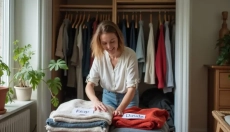
The same category includes clothing. Sustainable fashion sometimes presents itself as a luxury, but in reality, the cheapest way is often second-hand and caring for what already exists. When a shirt is washed on a gentler program, air-dried, and not ruined in the dryer, it lasts longer. When shoes are occasionally treated and laces replaced, their life is extended. And when instead of a quick purchase in a chain store, you try a local second-hand or online bazaar, you can get quality for a fraction of the price. Incidentally, the impacts of the textile industry are long informed by the United Nations Environment Programme (UNEP), which helps put “fashion” into a broader context.
Anyone can take away a simple sentence from all this, which is also useful in a store: “I’m not rich enough to buy cheap things over and over.” (It’s an old saying, but surprisingly ecological in practice.) A quality second-hand item or one well-chosen new item that lasts for years is often more beneficial for the budget and the planet than repeated “cheap solutions”.
And because concrete steps that make sense immediately are often sought, the whole thing can be simplified into several areas. There’s no need to do everything – just choose two or three that fit the current life.
Small Changes That Make Sense Even When Saving
- Reduce food waste (plan, use up supplies, freeze, process leftovers)
- Shop smartly (list, seasonality, fewer processed foods, more basics)
- Use second-hand and sharing (clothing, equipment, books, children’s items)
- Repair and maintain (clothes, shoes, small electronics, furniture)
- Save energy and water (full washer/dishwasher, lower temperatures, lid, turning off lights)
- Prefer reusable items (where they are truly utilized)
This is the only list in the text, but it’s worth it because it shows that “eco” isn’t one big change. It’s more like a mosaic of small things that can be added gradually – according to time, budget, and interest.
Can You Be Eco on a Smaller Budget? Yes, When Perfection Isn’t Sought
When someone says “ecological life”, many people automatically envision strict rules: no plastics, no car, only local food, perfect sorting, homemade everything. But such an ideal is often demotivating for everyday life. Especially for those who are already figuring out how to make ends meet.
A more sustainable life on a smaller budget is built on something else: realistic choices that don’t increase stress. If it pays to splurge somewhere, it makes sense to splurge. If not, it’s perfectly fine to stick with what works and just change small things. Someone might start by stopping buying bottled water. Another by tidying up their finances and discovering that the biggest money leak is impulsive purchases. Another might start with second-hand for kids, because they outgrow clothes in just a few months anyway.
The psychological aspect is also important. Ecology sometimes turns into a competition of who is “cleaner”. But in households where saving is a priority, the approach “a little better than yesterday” is much more useful. And that is surprisingly effective. When waste is gradually reduced, single-use purchases are limited, and planning improves, it reflects on the bills. Ecology and its impact on the budget don’t meet here as opponents, but as allies.
Interestingly, many “eco” steps actually mirror habits that were common just a few decades ago: things were repaired, clothes were passed down, leftovers were used in the kitchen, jars were saved. Today it’s called sustainability, back then it was simply a normal household. Modern times added the convenience of disposability – and also bills that can be unpleasantly surprising.
And what if someone really needs to start from scratch and asks: how to live ecologically on a small budget, when there’s already nothing to spare? Then it’s worth sticking to a simple order: first save by reducing waste (this costs nothing), then use second-hand and sharing (this often saves a lot), and only finally think about “nice” ecological replacements. Fabric bags are great, but the real difference is made just by taking the shopping in a bag you already have at home and not buying unnecessarily.
In the end, it leads to a surprisingly calming point: a more ecological life isn’t a luxury project, but a collection of ordinary decisions. Sometimes it’s enough to rush less, plan more, and give things a second chance. And the next time there’s a doubt if you can be eco on a smaller budget, it’s worth remembering that the biggest changes often don’t start in the wallet, but in that brief pause before the shelf – when you decide to buy less, but better, and let the rest be.