
Care for curly and wavy hair starts with proper washing, hydration, and gentle styling
Anyone who has ever looked in the mirror in the morning and seen an unpredictable tangle of curls on their head knows that curly and wavy hair has a personality of its own. Sometimes it cooperates, other times it decides to live by its own rules. And that's precisely where its charm and its challenge lie. Caring for curly and wavy hair requires a completely different approach than caring for straight hair – and the sooner a person understands this, the sooner their frustrating morning ritual becomes a pleasant routine, resulting in beautiful, defined waves or bouncy curls full of life.
Interestingly, just a few years ago, the specific needs of wavy and curly hair were practically never discussed. Most advice in magazines and online revolved around straight hair, and curly girls and women were often left with a flat iron as the only "solution." Fortunately, times have changed. Today, there is an entire movement – sometimes referred to as the curly girl movement – that celebrates natural curls and offers proven methods for caring for them. And it's the most important principles that we'll talk about today.
Try our natural products
Why Curly Hair Is So Demanding to Care For
To understand why curly and wavy hair needs special treatment, it helps to take a brief look under the microscope. The shape of a hair strand is determined by the shape of the hair follicle – while straight hair grows from round follicles, curly hair grows from oval or asymmetrical follicles that give the hair its spiral shape. This has one fundamental consequence: the natural sebum that the scalp produces slides easily down a straight hair strand to the tips, but travels much more slowly along the spiral of a curl. The result is that curly hair tends to be naturally drier, more prone to breakage and frizz.
Lorraine Massey, author of the cult book Curly Girl: The Handbook, once put it simply: "Curly hair isn't damaged straight hair. It's completely different hair that needs completely different care." And this very idea is the foundation of everything that follows.
Another factor is hair porosity, meaning the hair's ability to absorb and retain moisture. Curly hair often has increased porosity, which means that while it easily absorbs water, it loses it just as quickly. That's why hydration is the absolute foundation of curly hair care – and not just externally, but internally as well. Adequate water intake, a balanced diet rich in omega-3 fatty acids and B vitamins – all of this affects the quality of curls far more than one might expect.
The influence of the environment is also interesting. Air humidity, water hardness, wind, sun exposure – all of these can affect curly hair more dramatically than straight hair. Anyone with curls who has spent a vacation by the sea knows what we're talking about. Salt water can give waves a beautiful texture, but without follow-up care, drying out is inevitable. Similarly, hard water full of minerals can leave deposits on hair that weigh it down and rob it of its bounce. This is precisely why many curly hair experts recommend occasional use of a sulfate-free clarifying shampoo that gently removes these deposits without stripping the hair of its natural oils.
Speaking of shampoos, choosing the right cleansing product is one of the most common stumbling blocks. Regular shampoos containing strong sulfates – typically sodium lauryl sulfate or sodium laureth sulfate – are too aggressive for curly hair. They do remove impurities, but they also wash away the protective lipid layer that curly hair so desperately needs. That's why so-called co-wash products (conditioners designed for washing hair) or gentle sulfate-free shampoos have become popular in recent years. As the American Academy of Dermatology states, people with curly hair should wash their hair less frequently and always use a conditioner, ideally one rich in hydrating ingredients.
And that brings us to one of the most important steps in caring for curly and wavy hair – conditioning. If there is one single rule that every curl owner should remember, it's this: conditioner is not an optional extra, it's a necessity. And it's not just about the regular post-wash conditioner. Curly hair deserves regular deep conditioning masks – ideally once a week – that provide intense hydration and help restore elasticity. Ingredients like shea butter, coconut oil, argan oil, or glycerin are the true heroes in this regard.
Styling Curly Hair and How to Achieve Beautifully Defined Waves
Proper care is the foundation, but without suitable styling, beautiful curls won't fully show themselves. And curly hair styling is an area where many people make mistakes – often because they apply techniques designed for straight hair.
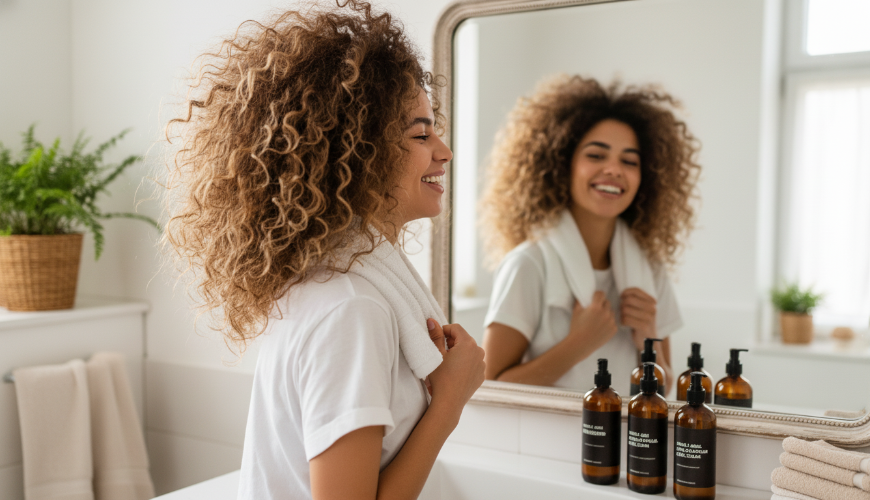
One of the most widespread myths is that curly hair needs to be thoroughly dried with a towel after washing. The opposite is true. A classic terry towel, with its rough texture, disrupts the hair cuticle, leading to frizz and loss of curl definition. It's much gentler to use a cotton T-shirt or microfiber towel, gently scrunching the hair rather than rubbing it. This simple change can make a surprising difference – and once you try it, you'll never go back to a terry towel.
Another key moment is the application of styling products. Curly hair should be styled wet or very damp, because that's when it best absorbs products and curls naturally form. Among the most popular styling products are gels, creams, and mousses specially designed for curly hair. It's important to apply them using a technique called "scrunching" – gently squeezing the hair upward from the tips to the roots. This encourages the natural shape of the curls and gives the hair volume.
Let's consider a specific example. Karolína, a thirty-year-old teacher from Brno, struggled with her wavy hair for years. Every morning she straightened it with a flat iron because she didn't know what else to do with it. "I thought I simply had bad hair," she says. Then she discovered a community of people with a similar hair type on social media and started experimenting. She stopped using sulfate shampoos, introduced regular deep conditioning masks, and learned to apply gel to wet hair. "Within three months, I had hair I didn't know I had," she laughs. Her story is not unique – thousands of people around the world have undergone a similar transformation when they understood that their hair wasn't the problem, it just needed the right care.
When it comes to drying, specific rules apply here as well. Air drying is the gentlest option for curly hair, but it's not always practical – especially in winter or when you're in a hurry. In that case, it's advisable to use a blow dryer with a diffuser, an attachment that disperses the airflow and prevents curls from being blown apart. The proper technique involves holding the diffuser up to the head from below and gently "loading" the hair into it, with the dryer set to medium heat and low airflow. High temperatures damage curly hair even more than straight hair, because its naturally drier structure makes it more vulnerable to heat stress.
An interesting technique that has gained enormous popularity in recent years is the so-called "plopping" method, in which wet hair is wrapped in a T-shirt or microfiber towel for twenty to thirty minutes. This allows the hair to dry in its natural shape, curls become beautifully defined, and volume at the roots is preserved. For many curly hair enthusiasts, plopping is an absolute revolution in their hair routine.
Nighttime care should not be overlooked either. Curly hair can tangle and break during sleep, so it's advisable to sleep on a satin or silk pillowcase, or to loosely tie the hair into a high bun – the so-called "pineapple" technique. Unlike cotton, satin doesn't create friction that would damage curls, so hair looks significantly better in the morning.
When it comes to specific ingredients that curly hair owners should avoid, water-insoluble silicones (such as dimethicone) top the list. While they give hair instant shine and smoothness, they gradually build up on the hair and create an impermeable layer that prevents moisture from penetrating. The result is hair that looks healthy but is actually drying out beneath the silicone layer. The alternative is lightweight, water-soluble silicones or natural oils that nourish the hair without weighing it down. Information about suitable and unsuitable ingredients can be found, for example, at Naturally Curly, one of the most comprehensive resources on curly hair care.
An important aspect of caring for wavy and curly hair is also regular trimming of the ends. Curly hair is more prone to splitting, and if damaged ends aren't removed in time, the damage progresses upward along the hair shaft. Experts recommend cutting approximately every eight to twelve weeks, with the ideal being to have hair cut dry – this way the hairdresser can see the natural shape of the curls and tailor the cut to their specific shape and volume.
The role of proteins in curly hair care also deserves mention. Hair is made of keratin, a protein, and regularly replenishing proteins through hair masks or treatments helps maintain its structural integrity. However, be careful – too much protein can actually make hair stiff and brittle. The key is finding a balance between hydration and protein, which everyone must discover individually based on how their hair responds. As a general guideline, if hair feels dry and rough, it needs hydration, and if it's too soft and shapeless, it needs protein.
The journey to beautiful curly or wavy hair is not a sprint but a marathon. It requires patience, a willingness to experiment, and above all a change in mindset – to stop seeing curls as something that needs to be tamed and start understanding them as something that deserves specific and loving care. Every curl is different, every head has its own needs, and what works for one person may not work for another. But the basic principles – gentle washing, intense hydration, proper styling, and protection from damage – are universal. And once a person starts following them, the results won't be long in coming. Curly hair isn't a problem that needs to be solved. It's hair that's just waiting for the right opportunity to shine.