
# Try Wall Exercises for Women with Back Pain --- Wall exercises are a gentle and safe way to stre
Back pain is one of the most widespread health problems of the modern era. According to data from the World Health Organization, up to 619 million people worldwide suffer from lower back pain, and this number continues to grow. Women are particularly at risk - hormonal changes, pregnancy, inappropriate footwear, or long hours spent at a computer all contribute to their backs carrying an enormous burden every day. Yet there is a surprisingly simple way to improve the situation without having to buy expensive equipment or spend hours at the gym. All you need is a wall, comfortable clothing, and ten minutes a day.
A wall as an exercise tool may sound too simple, but that is precisely where its strength lies. It provides stable support that allows you to safely activate the deep stabilising muscles of the trunk, straighten the spine into its natural position, and gradually strengthen the areas most commonly responsible for pain. It is no coincidence that physiotherapists around the world incorporate wall exercises into rehabilitation programmes for patients with chronic back pain.
Try our natural products
Why a wall, and why ten minutes?
Many women who suffer from back pain tend to avoid movement out of fear of hurting themselves. This approach is understandable, but unfortunately counterproductive. Muscles that do not move weaken, shorten, and lose their ability to support the spine. A vicious cycle emerges: pain leads to inactivity, inactivity leads to greater pain. Physiotherapist and movement therapy author Robin McKenzie expressed this aptly: "Movement is medicine - but it must be the right movement, in the right amount, at the right time."
Wall exercises break this cycle for several reasons. First, the wall provides immediate feedback - you can literally feel whether your back is straight or whether it is arching somewhere. Second, the support of the wall reduces the risk of overloading and allows even those who could not yet manage free exercises on a mat to work out. Third, a ten-minute block is psychologically manageable for everyone - it does not require reorganising your entire day, yet it produces results when repeated regularly.
Studies published in the academic journal Journal of Orthopaedic & Sports Physical Therapy repeatedly show that short but consistent movement intervention targeting the deep trunk muscles is more effective at relieving chronic back pain than sporadic intense exercise. In other words, ten minutes every day outperforms an hour once a week.
Let us consider a concrete real-life example. Jana, a forty-two-year-old accountant from Brno, spent years in a sedentary job and gradually developed chronic lower back pain. Doctors recommended movement, but every attempt at conventional exercise put her off - either it made the pain worse, or she simply could not find the time. When she began exercising regularly for ten minutes each morning against her kitchen wall, the change came quietly but surely. After three weeks she was sleeping better, after six weeks she was reaching for pain relief tablets less frequently, and after three months she described her condition as "normal back" - a feeling she had almost forgotten.
Which exercises work best and how to perform them correctly
Before starting the exercises themselves, it is important to understand the basic principle: it is not about how many exercises you complete, but whether you perform them mindfully and precisely. Every movement should be slow, controlled, and accompanied by regular breathing. Holding your breath is one of the most common mistakes, which unnecessarily increases tension in the trunk and can worsen pain.
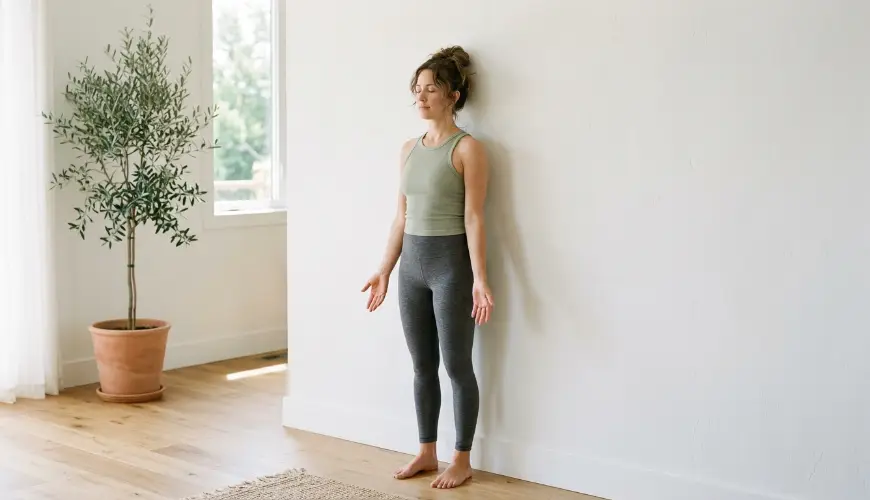
Standing against the wall with core activation is the fundamental building block of the entire practice. Stand with your back to the wall so that your heels, buttocks, shoulder blades, and the back of your head are all touching it - simultaneously. If this is not possible, do not worry about it; it is valuable information about the current state of your spine. The goal is to gradually approach this position. In this stance, activate your abdominal muscles by gently drawing your navel towards your spine, hold for ten seconds, and release. Repeat eight to ten times. This seemingly simple exercise teaches the body what the spine should look like in proper alignment and activates the deep transverse abdominal muscle, which is a key stabiliser of the lumbar spine.
Wall slides are another excellent exercise. Stand with your back to the wall, feet slightly in front of your body, and slowly lower yourself into a squat while keeping your back in contact with the wall. Descend only as far as feels comfortable - at first this may be just a slight bending of the knees. Hold for two to three seconds and slowly return to standing. This exercise strengthens the gluteal muscles and the front of the thighs, which are absolutely essential for a healthy back. Weak gluteal muscles are one of the most common causes of lower back pain in women with sedentary jobs.
The thoracic spine release exercise at the wall is also highly effective. Stand sideways to the wall, raise your arm and rest it against the wall. Slowly rotate your trunk away from the wall, as if trying to look over your shoulder. The thoracic spine, which tends to be significantly stiff in women with office jobs, needs rotational movements to maintain mobility. A stiff thoracic spine transfers load to the lumbar region, which then becomes painful - even though the actual problem lies higher up.
Arm raises at the wall target the area between the shoulder blades and the upper back. Stand with your back to the wall, arms at your sides, palms facing forward. Slowly raise both arms into a Y shape, trying to keep your entire back in contact with the wall. This is more challenging than it appears - most women find that when raising their arms, their lumbar spine naturally moves away from the wall. This awareness itself is the beginning of correction.
Knee pulls at the wall serve to release tension in the lumbar region. Lie on your back with your feet resting against the wall, knees bent at a right angle. Slowly draw one knee towards your chest, leaving the other foot resting against the wall. Hold for five seconds, then switch. This position gently stretches the deep hip muscles and lumbar fascia, which shorten considerably during prolonged sitting.
If you have ten minutes a day, the ideal distribution looks like this:
- Standing against the wall with core activation - 2 minutes
- Wall slides - 2 minutes
- Thoracic spine release - 2 minutes
- Y arm raises - 2 minutes
- Knee pulls - 2 minutes
This routine covers the entire spine from the lumbar region up to the cervical area, works on both strength and mobility, and does not strain the joints or cause pain when performed correctly.
It is important to mention when to exercise. In the morning after waking, the spine is slightly swollen from overnight rest and less mobile - the first few minutes should therefore be truly slow and gentle. In the evening the body tends to be more relaxed and exercise may come more easily. The ideal time is whichever time you will actually stick to every day, whether that is after your morning coffee, during a lunch break, or before your evening television series.
The question of breathing deserves special attention. Conscious breathing during wall exercises is not merely a supplement - it is a tool. Inhaling through the nose expands the chest sideways and activates the diaphragm; exhaling through the mouth should be accompanied by a gentle contraction of the abdominal muscles. This breathing pattern in itself helps stabilise the spine and reduces muscular tension in the back.
There are also situations that call for caution. If pain radiates into the leg, is accompanied by tingling or weakness, or arose following an injury, consulting a doctor or physiotherapist should always be the first step. Wall exercises are an excellent preventive and rehabilitative tool, but they do not replace professional care in cases where it is needed.
The world of movement therapy has advanced significantly in recent years. A growing number of specialists, including those affiliated with the Czech Physiotherapy Society, emphasise that an active approach to back pain - that is, movement and strengthening - produces better long-term outcomes than passive methods such as massage or heat therapy alone. Massage and heat can provide relief, but muscles will not strengthen on their own. That requires conscious, repeated exercise.
A wall in the living room, kitchen, or bedroom can thus become the cheapest and most accessible physiotherapy tool in existence. It requires no gym membership, no special equipment, and no prior exercise experience. It requires only the decision to try - and then to repeat that decision every day. For women seeking a way out of everyday back pain without dramatic lifestyle changes, it may be the simplest starting point imaginable.