
# Prepare Healthy School Snacks in Just a Few Minutes
Every morning, the same ritual plays out in thousands of Czech households. Parents open the fridge, stare into it, and wonder what to pack for their child's school snack today so that it comes back eaten – and not squished at the bottom of a backpack or shared with a friend who threw it away anyway. It's an eternal struggle familiar to anyone who has ever prepared food for a little critic with very particular tastes. Yet the solution doesn't have to be complicated or time-consuming. All it takes is understanding why kids simply ignore certain snacks and learning a few tricks that turn a boring lunchbox into something they'll actually look forward to.
Healthy school snacks are a topic that has troubled parents across generations, but in recent years more and more information has appeared around it – and unfortunately, more myths too. On one side stand the recommendations of children's nutrition experts; on the other, the reality of school cafeterias, where kids influence each other and where the "cool" factor of food plays a much bigger role than adults would like. The result is that even the most well-intentioned vitamin-packed snack ends up in the bin, while a bag of chips vanishes during the first break.
Why does this happen? The answer is surprisingly simple. Children eat with their eyes even more than adults do. A study published in the journal Appetite showed that the visual attractiveness of food significantly influences whether children aged 6–12 will even taste it. When a snack looks boring – brown bread, bland cheese, an apple that turns brown within an hour – a child's brain automatically evaluates it as uninteresting. It's not fussiness; it's simply the way a child's brain works. And this is precisely where there's room for creativity that doesn't have to mean hours spent in the kitchen.
Try our natural products
How to prepare snacks that kids will actually eat
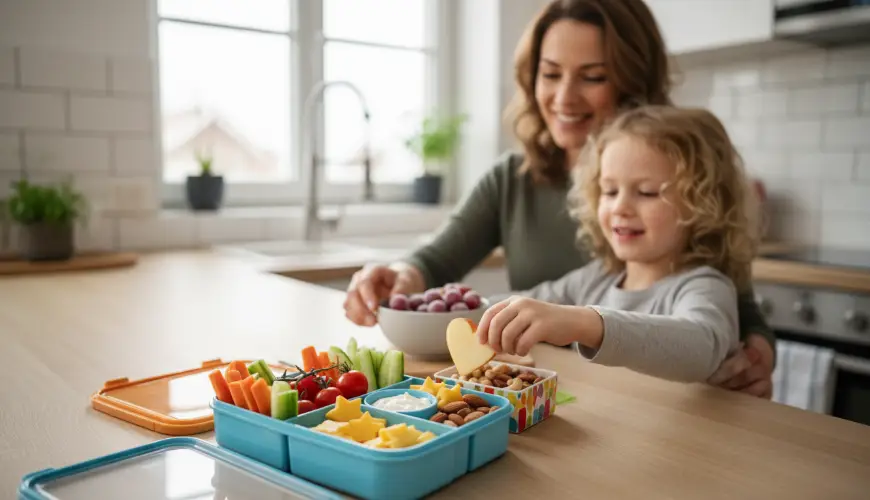
The key to success isn't just what you put in the lunchbox, but how you put it there. Imagine two scenarios. In the first, a child gets a whole carrot, a piece of whole-grain bread, and a handful of nuts loosely tossed in a bag. In the second, they get the same ingredients, but the carrot is cut into sticks with a small cup of hummus for dipping, the bread is cut into a star shape, and the nuts are in a small colorful container. The nutritional value is identical, but the second version has an incomparably greater chance of ending up in a child's stomach rather than in the trash.
This principle is also confirmed by parents' real-life experiences. One mum in a social media group described how her seven-year-old son refused any vegetables in his snack for months. Then she tried getting a bento box with compartments and started assembling snacks like little "platters" – a piece of cucumber next to cherry tomatoes, a few cubes of cheese, whole-grain crackers, and a small container of cottage cheese dip. Her son not only started eating his snacks but even began showing them off to his classmates. Visual presentation changed everything, without changing the actual composition of the food.
Another important factor is involving children in the preparation. Research from the University of Alberta suggests that children who participate in cooking or food preparation have a significantly higher tendency to actually eat it. It doesn't have to be anything complicated – just let the child choose between two types of fruit, spread their own bread, or arrange the ingredients in the lunchbox. The sense of control and ownership over their snack works wonders. Instead of "mum gave me boring bread," the story playing out in the child's head becomes "I made this myself."
Of course, there's also the practical side of things. A snack has to survive several hours in a backpack, ideally without refrigeration, and it mustn't fall apart, leak, or smell too much. Tips for kids' snacks therefore need to take into account not only nutritional value and attractiveness but also logistics. Soft fruit like a banana is a great choice nutritionally, but in a backpack next to a maths textbook, it quickly turns into brown mush. On the other hand, an apple sliced and drizzled with lemon juice (to prevent browning) in a sealed container stays beautifully fresh.
And then there's the question of sweets. Completely eliminating sweet flavors from snacks is a strategy that usually fails. Children are biologically programmed to prefer sweet tastes – it's an evolutionary mechanism that in the past helped them seek out energy-rich foods. Rather than fighting nature, it's wiser to offer healthier sweet alternatives that satisfy taste buds without delivering empty calories. Dates stuffed with peanut butter, homemade energy balls made from oats and honey, or frozen grapes that taste almost like candy – these are all options that pass muster with both parents and young food critics.
Recipes and ideas that work in practice
Let's look at some specific snack recipes for kids that have passed the strictest test – the test of real children in real schools.
Tortilla roll-ups are among the absolute winners. Simply take a whole-grain tortilla, spread it with a thin layer of cream cheese or hummus, add slices of ham or chicken, a bit of lettuce, and roll it up. Cut into rounds, they become colorful "pinwheels" that look appealing and are easy to eat with one hand during a break. The variations are endless – with tuna and sweetcorn, with avocado and tomato, or a sweet version with cottage cheese and blueberries.
Homemade granola bars are another classic with one huge advantage – they can be prepared on Sunday for the entire week. The base is oats mixed with honey, with added nuts, dried fruit, and optionally bits of dark chocolate. The mixture is spread on a baking tray, baked, and cut into bars. Compared to store-bought versions, they have incomparably less sugar and no artificial additives. Kids love them because they look like a "normal" bar from the shop, and parents love them because they know exactly what's in them.
Then there are vegetable muffins, which are a genius way to sneak vegetables into a child's diet. Courgette, carrot, or spinach can be beautifully disguised in batter with a bit of cheese. The result tastes like savory pastry, looks like a regular muffin, and yet contains a serving of vegetables that a child would otherwise refuse. A similar principle works with potato pancakes with broccoli or cauliflower nuggets, which taste surprisingly similar to chicken ones.
For parents looking for inspiration, a useful resource might be the healthy snacking guide from the Harvard T.H. Chan School of Public Health, which offers evidence-based advice on the composition and frequency of snacks – not just for children.
We mustn't forget about drinks either. Many children confuse the feeling of thirst with hunger and then leave their snack untouched because what they actually needed was water. Packing a bottle of water – perhaps flavored with slices of lemon, orange, or mint – is just as important as the snack itself. Sweet juices and flavored milks are something kids will happily drink, but they often contain as much sugar as a soft drink, and after consuming them, hunger paradoxically becomes even greater.
An interesting trend in recent years is the so-called "snack boards" or snack platters, which have gained popularity thanks to social media. The principle is simple: instead of one specific food, the child gets a selection of several small portions of different foods. Pieces of cheese, fruit slices, nuts, whole-grain crackers, vegetable pieces, hummus. The child chooses what to eat and combines according to their own taste. For school, this concept translates beautifully into a bento box with compartments, where each compartment hides a different treat.
As British nutritional therapist Charlotte Stirling-Reed said: "The best snack for a child is one they actually eat. Perfect nutritional value is useless if the food ends up in the bin." And this is exactly the point that parents should remind themselves of whenever they feel guilty that their child's snack doesn't look like something from an Instagram account about healthy eating.
It's also important to not stress about perfection. One day the snack might look like a masterpiece; another day it'll simply be a banana and a whole-grain roll with cheese. And that's absolutely fine. Nutrition isn't judged by a single meal but by the overall eating pattern over weeks and months. If a child gets a varied and balanced diet most of the time, an occasional concession in the form of a store-bought croissant or biscuit won't hurt anyone.
What can hurt, however, is excessive pressure around "healthy" eating, which can lead to a disturbed relationship with food in more sensitive children. Experts from the Academy of Nutrition and Dietetics repeatedly point out that categorizing food as "good" and "bad" is not appropriate for children. It's better to talk about foods that give us energy for the whole day and those that are more for special occasions – without moral judgment.
Finally, one practical tip that can save a lot of morning stress: preparing snacks the night before. Getting the lunchbox ready before bed, storing it in the fridge, and in the morning just grabbing it and tossing it into the backpack – that's a system that works even in the most chaotic households. Some families go even further and dedicate Sunday afternoon to batch-preparing snack components for the entire week. Chopped vegetables in containers with water, pre-made sandwiches in the freezer (which thaw by morning), baked muffins and energy balls in containers. A two-hour investment on Sunday pays off in the form of calmer mornings from Monday to Friday.
Healthy school snacks that kids will actually eat aren't about complicated recipes or expensive ingredients. They're about understanding what motivates children to eat, a bit of creativity in presentation, and a willingness to adapt to reality instead of chasing an unattainable ideal. Because the best snack in the world is simply the one that disappears from the lunchbox before the bell rings for the next lesson.