

# Herbal Medicine Cabinet You Can Make at Home
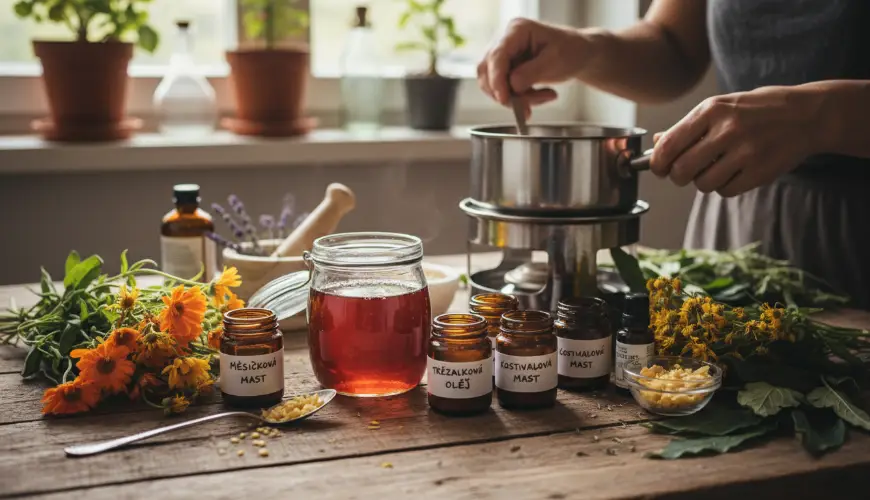
Anyone who has ever picked a ribwort plantain leaf and pressed it against a scraped knee has, without realizing it, reached into the oldest pharmacy in the world. Nature was healing for thousands of years before the first laboratories came into existence, and although modern medicine has pushed the boundaries of what's possible, interest in a natural home medicine cabinet has not waned in recent years – quite the opposite. Herbal salves, tinctures, and syrups that you make yourself are not just a nostalgic reminder of grandmother's garden. They are practical, accessible, and surprisingly effective remedies for everyday health care that deserve a place in every household.
There are many reasons why people are once again beginning to prepare their own herbal remedies. Some want to have control over the composition of what they apply to their skin or ingest. Others are looking for a gentler alternative to synthetic products for minor ailments such as colds, irritated skin, or poor digestion. And then there is the simple fact that the process itself – gathering herbs, drying, macerating, blending – has something meditative and satisfying about it. As herbalist author Stephen Harrod Buhner noted: "Plants are not just chemicals in a green package – they are living beings with whom we enter into a relationship." And it is precisely that relationship, that slow, attentive handling of natural ingredients, that gives home preparation of herbal remedies a special dimension that no pharmacy can offer.
Before diving into making your own salves and tinctures, however, it is good to understand a few basic principles. Herbalism is neither magic nor a substitute for medical care. It is a complement, a tradition supported by centuries of experience and, in many cases, by modern research as well. The World Health Organization estimates that approximately 80% of the world's population uses some form of traditional and natural medicine. This does not mean that herbs will replace antibiotics for pneumonia, but for minor everyday ailments – from chapped lips to coughs to nervousness – they can be the first thing a person reaches for before heading to the pharmacy.
Try our natural products
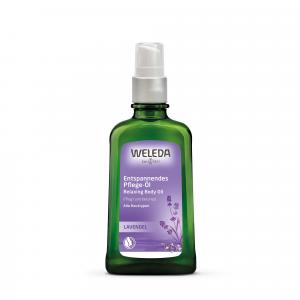
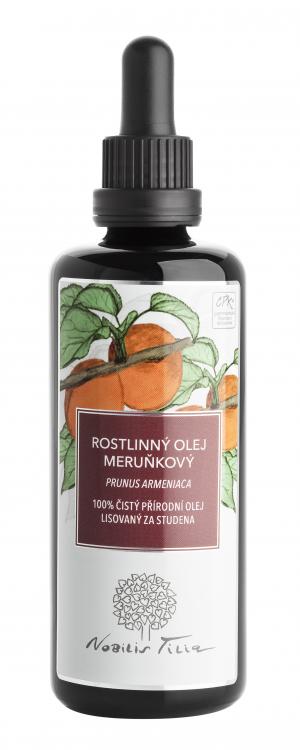
Herbal Salves and Oils as the Foundation of a Natural Medicine Cabinet
A salve is probably the most intuitive herbal preparation one can make at home. The principle is simple: the active compounds from the herb are first extracted into a vegetable oil, which is then thickened with beeswax to a consistency that is easy to apply to the skin. It sounds simple, and it truly is – all it takes is a bit of patience.
The foundation is a so-called herbal macerate, meaning an oil in which herbs have been steeping for several weeks. The most commonly used oils are olive, sunflower, or almond oil. The chosen herb – fresh or dried – is packed into a jar, covered with oil so that it is completely submerged, and the jar is placed in a warm spot, ideally on a sunny windowsill. After three to six weeks, the oil is strained and is ready for further processing. A classic example is St. John's wort oil, recognizable by its beautiful ruby-red color. St. John's wort is one of the most extensively studied medicinal herbs in Europe – its anti-inflammatory and healing effects are confirmed by clinical studies, as noted for example in the National Center for Complementary and Integrative Health database. St. John's wort oil is traditionally used for minor burns, scrapes, bruises, and sore muscles.
To make a salve, simply gently heat the herbal oil in a double boiler and add beeswax in a ratio of approximately one part wax to five to seven parts oil. Once the wax has melted, the mixture is poured into clean containers and left to solidify. The result is a smooth, pleasantly fragrant salve that can be enriched with a few drops of essential oil – for example, lavender to soothe the skin or tea tree for its antiseptic properties. The entire process takes barely half an hour of active work, and the finished product, when properly stored in a cool place, can last for several months.
Among the most popular herbs for making salves is calendula (pot marigold), which is quite literally the king of skin preparations. Calendula salve is a classic of Czech folk medicine – it is used for chapped lips, eczema, diaper rash in children, and minor injuries. Another excellent choice is comfrey, whose root contains allantoin that promotes tissue regeneration, or the already mentioned St. John's wort. Those who enjoy experimenting can try combinations – for instance, calendula with chamomile for an extra soothing effect, or plantain with lavender for an insect bite salve.
The practical experience of one family from the Vysočina region shows how naturally herbal salves can become part of everyday life. The Novák family started three years ago with a single jar of St. John's wort oil, prepared from dried flowers gathered in the meadow behind their house. Today they keep a permanent stock of three salves in their pantry – St. John's wort, calendula, and comfrey – and by their own account, they use them more often than commercial products from the drugstore. "It's not about being alternative at all costs," says Mrs. Nováková. "We simply know what's in the salve, and it works."
Tinctures and Syrups for Internal Use
While salves treat the body from the outside, herbal tinctures work from within. A tincture is essentially an alcoholic extract of an herb – the alcohol serves as a solvent that extracts the active compounds from the plant material, and at the same time as a preservative, thanks to which the preparation can last for several years. The preparation is comparably simple to that of a macerate: the herb is placed in a jar, covered with alcohol of at least 40% strength (most commonly vodka or pure spirits diluted to the desired concentration), and left to macerate for two to six weeks with occasional shaking. It is then strained and stored in dark bottles with droppers.
Tinctures have a fundamental advantage over teas – they are much more concentrated and the active compounds are absorbed more quickly. Just a few drops in a glass of water are enough, and the effect sets in within minutes. Among the most useful tinctures for a home medicine cabinet are echinacea (coneflower), which supports the immune system and is ideal at the first signs of a cold, valerian for calming and better sleep, dandelion for supporting digestion and liver function, or wild thyme as a natural cough remedy. Each of these herbs has a long tradition of use behind it, and for many of them modern studies confirming their efficacy also exist – for example, with echinacea, a meta-analysis published in The Lancet Infectious Diseases leans toward the conclusion that it can reduce the risk of catching a cold and shorten its duration.
Syrups then represent the tastiest form of herbal medicine and are especially popular with children, who understandably should not be taking alcohol-based tinctures. A herbal syrup is prepared by first making a strong decoction or infusion from the herb, straining it, and then stirring in honey or sugar at a ratio of approximately one to one while gently heating. The result is a thick, sweet syrup that can be stored in the refrigerator for several weeks to months.
The undisputed classic among homemade syrups is elderberry syrup. Elder flowers and berries contain flavonoids and antioxidants that support the immune system, and elderberry syrup is a traditional weapon against flu and colds in many Czech households. Another popular recipe is thyme cough syrup – thyme has natural antiseptic and expectorant properties and, combined with honey, creates a syrup that tastes surprisingly good and helps clear the airways. For those struggling with insomnia, a lemon balm and lavender syrup may be of interest, as its gentle flavor and calming effects help promote restful sleep.
When preparing both syrups and tinctures, it is important to follow basic hygiene principles – work with clean containers, use quality ingredients, and store finished preparations properly. Herbs are best gathered in clean locations far from roads and fields treated with pesticides, ideally in dry weather during the morning hours when the concentration of essential oils is highest. Those who do not have the opportunity to forage in nature can purchase quality dried herbs from herbalist shops or specialized online stores where their origin and proper processing are guaranteed.
It is worth mentioning that building a natural home medicine cabinet does not have to be an expensive endeavor. Most of the necessary herbs can be gathered in a meadow, in the forest, or grown on a balcony. Basic ingredients such as olive oil, beeswax, honey, and alcohol are readily available. And perhaps most importantly – knowledge once acquired does not spoil and can be passed on to children and grandchildren, exactly as generations before us have done.
However, a reminder of reasonable caution is also in order. Not every herb is safe for everyone. Some plants can interact with prescription medications, while others are not suitable during pregnancy or for small children. St. John's wort, for example, reduces the effectiveness of hormonal contraception and certain other medications. Comfrey is not recommended for use on open wounds or for internal use. Therefore, it is always wise to check contraindications before using a new herb, either in trustworthy herbalist literature – for example, in the books of Josef A. Zentrich or in the Herbarium of Pavel Váňa – or by consulting a doctor or qualified phytotherapist.
A natural home medicine cabinet is not about rejecting modern medicine. It is about expanding possibilities, about a conscious approach to health, and about connecting with a tradition that has deep roots in Czech culture. Every jar of calendula salve, every bottle of echinacea tincture, and every cup of elderberry syrup is a small act of self-sufficiency and care – for yourself, for your loved ones, and for the relationship with nature, which offers us the finest ingredients quite literally right outside our door. And anyone who once experiences that special joy of a handmade preparation that truly works will return to a nature-based medicine cabinet again and again.