

# How to Prepare Fermented Garlic Cloves in Honey Fermented garlic in honey is a simple and delicio
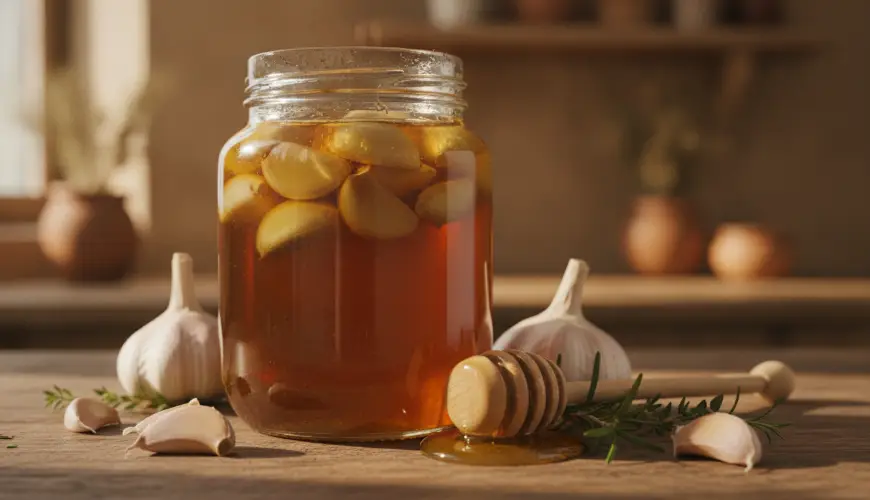
There are recipes that survive centuries not because they are fashionable, but because they simply work. Fermented garlic in honey is precisely such an example – a combination of two ingredients that humanity has known and used for thousands of years, and yet their combined effect can surprise even the greatest sceptics. It is not some invention by social media influencers, nor a marketing trick by supplement manufacturers. It is a living tradition that is returning to modern households – and for good reason.
Just imagine a simple scene: a grandmother in the kitchen, a jar of dark golden liquid on the windowsill and a scent drifting through the entire flat. That is exactly what childhood looked like for many people in various corners of the world, from Mediterranean countries through Asia to Central Europe. Today, that same jar is returning to the kitchen counters of young families, this time with an understanding of exactly what is happening inside and why it makes sense.
Try our natural products


What is actually happening inside the jar
Fermentation is a process that humanity has used since time immemorial – whether in the production of bread, cheese, or fermented vegetables. In the case of garlic in honey, it is a specific type of fermentation, in which the natural enzymes and sugars from the honey gradually penetrate the garlic cloves, while the garlic releases its juices and active compounds into the honey. The honey acts as a natural environment that enables fermentation, while at the same time preventing unwanted putrefaction – thanks to its low water content and natural antimicrobial properties.
The result is something that cannot simply be described as "garlic in honey". Over time, the cloves soften, lose some of their sharpness and develop a complex, slightly sweet flavour with a depth that fresh garlic never has. The honey, meanwhile, becomes noticeably more aromatic and acquires herbal, earthy notes. The entire process typically takes four weeks to three months, and the longer the fermentation continues, the more balanced and refined the resulting flavours become.
From a biochemical perspective, the sucrose in the honey is converted into glucose and fructose in the presence of the enzyme invertase, which comes from the garlic itself. This conversion is the key to the entire fermentation – it creates an environment in which beneficial microorganisms can work, but pathogens cannot multiply. It is therefore no surprise that studies published in academic databases such as PubMed repeatedly confirm the synergistic action of garlic and honey in terms of antimicrobial activity.
Health benefits worth noting
Garlic on its own is among the most extensively researched foods in the world. Its main active compound – allicin – is produced when cloves are crushed or cut, and is responsible for the characteristic aroma as well as many of its health effects. Allicin has proven antimicrobial, antiviral and anti-inflammatory properties, and the World Health Organization (WHO) lists garlic in its recommendations as a plant with scientifically supported beneficial effects on cardiovascular health.
Honey, meanwhile, is not merely a sweetener that masks the taste of garlic. Natural honey – ideally raw and unfiltered – contains flavonoids, organic acids and enzymes with antioxidant properties. The combination of both ingredients thus creates a natural synergistic effect that is greater than the sum of its individual parts.
Regular consumption of fermented garlic in honey is often associated with supporting immunity, particularly during the autumn and winter months. Many people incorporate it into their daily routine much like vitamin C – one or two cloves in the morning on an empty stomach, washed down with a glass of water. Others add a teaspoon of fermented honey to tea or use it as a base for salad dressings.
It is important to note that fermented garlic in honey is not a medicine in the clinical sense and does not replace medical care. It is a functional food – that is, one which, when incorporated regularly and sensibly into the diet, can contribute to overall health and wellbeing. As Hippocrates, the father of modern medicine, famously said: "Let food be thy medicine and medicine be thy food."
A natural question arises: how do the effects of fermented garlic differ from those of fresh garlic? Fermentation does reduce the allicin content, but it also increases the bioavailability of other sulphur compounds and creates new substances – for example S-allylcysteine, which is water-soluble and absorbed by the body more readily than allicin itself. Fermented garlic is therefore, for many people, easier to digest and less taxing on the digestive system than raw garlic.
The prebiotic effect is also worth noting. Garlic is a natural source of inulin and fructooligosaccharides, which serve as food for the beneficial bacteria in the gut microbiome. In combination with fermented honey, this delicacy thus indirectly supports gut health as well – something that experts increasingly associate with overall immunity and even mental wellbeing.
How to prepare and use fermented garlic in honey
Preparation is surprisingly simple and requires no special equipment. All you need is a clean jar with a lid, good-quality raw honey and fresh garlic – ideally from a local or organic source, where lower pesticide levels and higher concentrations of active compounds can be expected.
The garlic cloves are peeled and placed in the jar to approximately three-quarters of its capacity. They are then covered with honey so that all the cloves are completely submerged. The jar is loosely covered – not sealed hermetically – because carbon dioxide is produced during fermentation and needs to escape. During the first few days, it is important to turn the jar upside down or stir it once a day so that the honey coats the garlic evenly and to prevent oxidation of the top layer.
Fermentation takes place at room temperature, away from direct sunlight. During the first few days, the honey will become thinner – this is a normal and desirable phenomenon caused by the release of moisture from the garlic. Small bubbles will gradually begin to appear, signalling that fermentation is proceeding correctly. After four weeks the product is essentially ready, but it only develops its true depth of flavour after two to three months.
When it comes to choosing honey, quality matters. Industrially processed honey is typically heated and filtered, which destroys the enzymes essential for fermentation. It is therefore advisable to opt for raw, unfiltered honey from a local beekeeper or certified organic honey. The same applies to the garlic – the fresher and higher the quality, the more pronounced the final product will be.
As for use in the kitchen, the possibilities are surprisingly varied. Fermented cloves can be eaten on their own as a small daily dose, added to spreads and dips, sliced into salads, or served as an accompaniment to cheeses and cured meats. Fermented honey works wonderfully as a vegetable dressing, a base for meat marinades or an addition to herbal tea. Some chefs add it to Asian sauces instead of using fresh garlic and honey separately – the resulting flavour is more complex and less aggressive.
For those who do not have the time or inclination for home production, ready-made products from manufacturers specialising in fermented and functional foods are also available. When purchasing, it is worth checking the ingredients – an ideal product contains only garlic and honey, with no added preservatives, colourings or flavourings. BIO certification or the label "raw" (indicating raw honey) are good indicators of quality.
An interesting real-life example is the experience of Markéta, a thirty-year-old teacher from Brno, who two years ago began preparing fermented garlic in honey after a colleague drew her attention to the recipe. "At first I was sceptical – it seemed like an old wives' remedy with no scientific basis. But after the first winter, during which I had one clove every morning, I realised I hadn't had a single notable cold. I don't know whether it was specifically the garlic or an overall change in my lifestyle, but I'm definitely sticking with it," she says with a smile.
Her story illustrates something important: fermented garlic in honey is not a miracle cure, but it can be a meaningful part of a broader approach to a healthy lifestyle. It works best in combination with a balanced diet, sufficient exercise and sleep – as one piece of a larger picture.
Like many other fermented foods – kimchi, kefir, kombucha or fermented vegetables – fermented garlic in honey is finding its way back into the everyday lives of people seeking natural alternatives to industrially produced dietary supplements. It is not a trend that will come and go. It is a return to wisdom that our great-grandmothers knew long before science was able to explain why it actually works. And that is precisely where its greatest appeal lies – it brings together the best of tradition with what modern nutritional and health research tells us today.