

You will choose the right treadmill when you focus on stability, cushioning, and actual noise level.
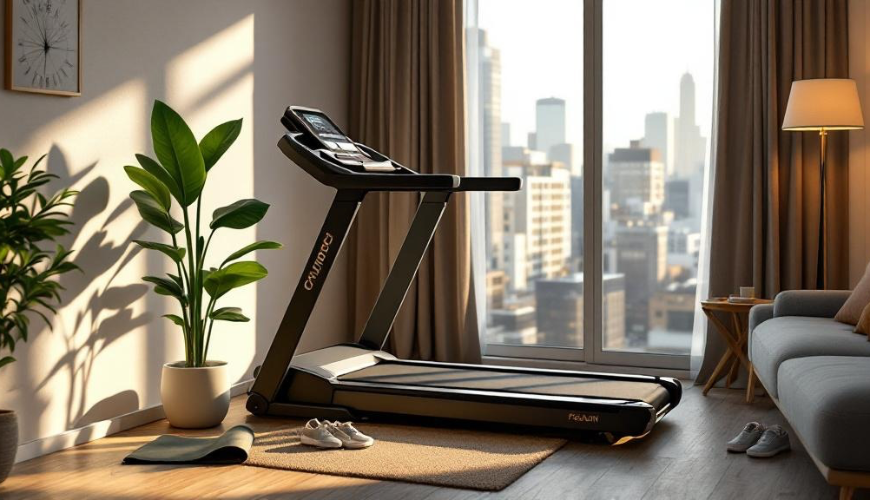
Home workouts are no longer just a temporary solution for winter or times when you don't want to go outside. Treadmills** have become a common part of apartments and smaller homes because they save time, allow you to run "anytime," and for many people, they are more pleasant than a crowded gym. However, with popularity come typical questions: is a treadmill worth it, or is it just an expensive clothes hanger? And if you're going for it, how to choose the right treadmill** so it doesn't feel like a foreign piece of furniture in your apartment, disturbing neighbors and taking up half the living room?
In practice, it's not just about motor power and the number of programs. Ergonomics of the step, stability, compactness, and especially what is often read between the lines in online shops are important: how the treadmill will sound in a real apartment, on a real floor, in a house with real neighbors.
When a treadmill is really worth it (and when it's less so)
The question "is a treadmill worth it?" is surprisingly similar to the question "is a bike worth it" – it depends on whether it's used. A home treadmill makes the most sense for people who want regularity and convenience: parents of small children, people with irregular work hours, those who don't feel safe running outside in the dark, or those returning to exercise after a long break and need a controlled environment.
At the same time, it's fair to say that for some runners, the outdoors is irreplaceable – due to the terrain's variability, fresh air, and the mental aspect. Yet even they often find that a treadmill is a great supplement: for light jogs, intervals with precise pace, or days when there's ice outside, and running would be more of a lottery than training.
It's useful to think economically, but without illusions. If someone pays gym entry fees just for the treadmill, the home version may gradually pay off – but the return isn't just calculated in money. Often, the return in time and energy is more valuable: no more traveling, changing clothes "on-site," or waiting for a machine. And sometimes, a tiny detail makes the decision: the option to go for a 25-minute run between two meetings. Isn't that the form of "sustainable" exercise that can be maintained long-term?
For a realistic picture, a simple example from everyday life can help. In a Prague apartment building, a young couple bought a treadmill with the intention of running "every day." The first weeks went well, then fatigue, work, and visits came – and the treadmill moved closer to the wall to not be in the way. It only helped when they set a rule: three times a week for 30 minutes, without heroics, and placed the treadmill in the same spot as the exercise bike by the window – so it was handy and not an obstacle. The result? Fewer ambitions, more regularity, and after two months, it was no longer a question of whether it was worth it. It simply became part of the household rhythm.
How to choose the right treadmill: what matters more than the number of programs
When discussing how to choose the right treadmill, people often start with the maximum speed. Yet most home users don't run sprints. More important is that the treadmill matches the user's body, step style, and how it will be used: walking, brisk walking, jogging, running, intervals? And will it be used by one person, or the whole family?
A big topic is the running surface. For walking, a shorter treadmill may suffice, but for running, a longer and wider one is usually more comfortable. It's not just about comfort – it's also about safety, as with fatigue, the stride length increases, and you need a reserve. When the surface is "just right," running often turns into cautious stepping, which paradoxically can increase the risk of poor technique.
Then there's cushioning and footfall. Some treadmills are harder and "faster," others softer. Better cushioning is usually more comfortable for the joints, but it's not universally best for everyone. It's also important to note that the footfall on a treadmill is different from outside: the treadmill "runs" under your feet, so part of the work is taken over by the motor, and running can feel lighter. Therefore, a slight incline (around 1%) is often recommended as an approximation to outdoor conditions, although it's not a rule and depends on the training goal.
When it comes to the motor, it's good not to succumb to marketing. Yes, performance matters – especially for heavier users, longer runs, and higher speeds. But equally important is the stability of the construction, weight capacity with a margin, and the quality of the treadmill as a whole. For an apartment, it's crucial that the machine doesn't act like a vibrating trampoline. A stable frame and good cushioning often mean not only a more pleasant run but also less noise transmitted to the floor.
Folding and handling are a chapter in themselves, especially when considering which treadmill is suitable for an apartment. A folding treadmill might make sense, but only if it will actually be folded. Some models are "compact," but in practice, heavy and awkward to move. Here, a simple question helps: will the treadmill stay in one place, or will it be stored away after each workout? If it's the latter, it's worth examining the wheels, folding system, and actual dimensions when folded.
Finally, there are details that add up: easy controls, readable display, safety key, bottle holder, the ability to set incline, and also service and availability of spare parts. A home treadmill isn't a one-time thing – it's a device that moves, shakes, heats up, and requires maintenance over time.
If it's helpful to rely on authoritative sources, it's worth reading general recommendations for exercise and health, for example, from the World Health Organization (WHO): https://www.who.int/news-room/fact-sheets/detail/physical-activity. It doesn't say "buy a treadmill," but it reminds us that regularity is key – and that's exactly what home equipment can facilitate.
Which treadmill for an apartment: space, floor, and neighbors decide
The choice of "which treadmill for an apartment" is often more about building and neighbors than sports. First, it's worth measuring the space not just for length and width but also for what's happening around: door openings, passage, window, heating. A treadmill needs to "breathe," and you need safe space around it. It's useful to think about where it will face – some prefer to look at the TV, others at the window, some find it helpful to have a blank wall in front of them without visual chaos.
A big topic is the floor. On concrete in a new building, a treadmill behaves differently than on old wooden floors that have play and can transmit vibrations. In a panel building, the sound travels through the structure and can surprise even those who think they have a "quiet" device. Therefore, it's good to consider not only noise for your ears but also vibrations for the neighbors below.
This is where sustainable and considerate thinking makes sense: not just "to make it work," but to make it work in a house where other people live too. Running at 10:30 PM might be the only free time for someone, but for the neighbor below, it might be regular thumping on the ceiling. Sometimes an agreement and shifting the training time help, other times a technical solution.
How to reduce treadmill noise without big magic
The question "how to reduce treadmill noise" has two aspects: the sound the runner hears (motor, friction, squeaking) and the vibrations the neighbors hear (thumping and floor resonance). Each aspect is addressed slightly differently, but they often overlap.
First and foremost, it's good to remember a simple truth: the quietest treadmill is the one that is properly assembled, adjusted, and maintained. Squeaking is often caused by a poorly tensioned or dry treadmill belt, creaking can occur in loose joints. Regular maintenance according to the manual (typically lubrication and tension check) isn't about being pedantic, but about ensuring the machine doesn't run "against resistance." And resistance means noise.
For floor vibrations, a mat is essential. It's not about a thin yoga mat but a material that absorbs impacts and reduces vibration transmission. In an apartment, a more robust rubber mat under fitness equipment often works well. Leveling the treadmill helps too – if it wobbles, noise increases, and floor transmission worsens.
Shoes and technique also make a big difference. A heel-strike run with a hard impact will sound louder than a lighter footfall. Of course, technique can't be changed overnight, but even small adjustments (slower speed at the start, shorter steps, gradual load increase) can quiet the workout and improve the running experience. And sometimes, a surprisingly practical thing helps: not setting an unnecessarily high speed when the goal is just brisk walking. The motor then doesn't run at the edge, and the entire device is calmer.
A quick checklist that comes in handy can look like this:
Quick check for quieter home running
- Mat under the treadmill, ideally thicker and designed to dampen vibrations
- Level floor and correctly adjusted feet to prevent wobbling
- Maintenance: lubricating and tensioning the treadmill belt according to the manufacturer's instructions
- Placement: if possible, away from common walls and not above neighbors' bedrooms
- Considerate workout time and potential agreement in the building if it's a sensitive issue
All this includes a psychological aspect. A home treadmill is a great servant but a bad master. If it's used only occasionally because of noise concerns, it loses its purpose. Conversely, if a realistic routine is set and steps are taken to reduce noise, it often becomes a natural part of the day – similar to a dishwasher or washing machine, which no one runs at night unless they want to wake the neighbors.
And what if, despite all efforts, noise is still an issue? Then it's good not to take it as a personal failure, but as a signal that the apartment has its limits. Sometimes it's wiser to opt for walking instead of running, supplement the workout with bodyweight exercises, or move some runs outside and use the treadmill for shorter, controlled sessions. That's also a form of sustainability – adapting the plan to reality, not reality to the plan.
In addition, home running fits nicely into a broader view of a healthy lifestyle: less pressure on performance, more emphasis on regularity, recovery, and quality sleep. As the often-quoted saying goes: "The best workout is the one that can be done long-term." In an apartment, this is doubly true – because longevity is measured not only by motivation but also by whether one feels at home well and at ease.
So when the question arises again, how to choose the right treadmill, the answer is: choose based on how you'll live with it, not just run on it. And when it comes to which treadmill makes sense for an apartment, often the one that is stable, reasonably quiet, easy to operate, and doesn't act as a daily obstacle wins. Because at that point, it's no longer just a piece of exercise equipment but a small home habit – and that sometimes has more value than all the programs on the display.