
Macarons that you can succeed with at home can be mastered thanks to a proven method and a few trick
Macarons have a special talent: they look like a small luxury that belongs in the display case of a French patisserie, yet they are talked about at home almost as often as a traditional cake. They are crisp on the outside, delicately moist inside, and when done right, they have the typical "feet"—a thin lace-like edge at the bottom of the shell. It's no wonder people keep asking how to make delicious macarons so that they are both beautiful and tasty, and above all, not just a one-time experiment. The good news is that macarons can indeed be made at home simply. Not always on the first try, but with an understanding of a few principles, they become less of a daunting task and more of a sweet challenge.
And because the internet is full of abbreviated guides promising "ready in 30 minutes," which often leave one with cracked circles and a runny mass, it's better to approach it like a journalist on a good report: find out what's important, what's just a myth, and what can be done at home to achieve a result that tastes great even without a confectionery course.
Why Macarons Are So Sensitive (and What It Means for Home Baking)
Macarons are fundamentally simple: egg whites, sugar, ground almonds. Yet, it's precisely in their simplicity that their "trickiness" lies. Every ingredient has its role, and when the ratio, temperature, or consistency is slightly off, it shows in the result. The recipe for macarons is therefore not just a list of ingredients but also a way of working.
Egg whites are beaten into a firm meringue—this is where the first common mistake occurs. Too weak a meringue results in flat and spread shapes, while overbeaten meringue leads to a mass that doesn't bind well and can cause hollows. Sugar (usually granulated or caster sugar, or hot syrup in the Italian method) adds stability to the meringue and helps create a smooth surface. Ground almonds and powdered sugar (typically in the form of tant pour tant—a mixture in equal proportions) form the base "body" of the macaron.
Humidity is also important. On a rainy day, it may take longer for macarons to form a dry shell on the surface. And the shell is crucial: without it, the surface tears easily during baking. It sounds like a small detail, but it often determines whether the macarons will be smooth or cracked.
In practice, this means one thing: anyone who wants macarons simply at home doesn't need a professional oven but does need patience and a few repeatable steps. And ideally, a kitchen scale—when it comes to macarons, measuring "by eye" is more likely a recipe for surprises.
"Macarons are a small test of patience: when given time, they repay with taste and appearance."
To ensure this article isn't just theoretical, let's go straight to a method that works in a typical home kitchen. The French method is often recommended (sugar is whipped directly into the egg whites) because it doesn't require a sugar thermometer or syrup. It's a good compromise between accessibility and reliability.
Macaron Recipe: A Proven Base That Can Be Repeated
Below is the basic recipe for macarons (about 25–35 sandwiched pieces, depending on size). It's written to be manageable at home while allowing room for small adjustments based on the type of oven.
Ingredients for the Shells
- 100 g egg whites (ideally "aged" 24 hours in the fridge, then brought to room temperature)
- 90 g granulated sugar
- 120 g almond flour (finely ground almonds)
- 120 g powdered sugar
- a pinch of salt
- optional food coloring (preferably gel)
Ingredients for a Simple Cream (Ganache)
- 150 g quality chocolate (dark or milk, depending on taste)
- 120 ml heavy cream (33%)
- 20–30 g butter (for smoothness, optional)
Macarons can also be filled with jam, lemon curd, or pistachio filling, but ganache is beginner-friendly: it holds well, is easy to portion, and tastes "patisserie-like."
Process That Helps When Solving "How to Make Delicious Macarons"
First, it's worth preparing a baking sheet with parchment paper or a macaron mat. It's good to preheat the oven in advance and ideally check how it bakes—many home ovens have a variance of up to 10–20 °C. For macarons, a range of 140–160 °C often works well (convection ovens are generally lower, top/bottom heat is generally higher), but the specific number is always "somewhat your own."
It's good to sift the almond flour and powdered sugar together. It's not just a "confectioner's whim"—sifting removes lumps and larger pieces of almonds that would make a bumpy surface. If the almond flour is coarser, it helps to briefly blend it with powdered sugar in a food processor and then sift. The result should be a fine, powdery mixture that incorporates evenly into the meringue.
Egg whites are whipped with a pinch of salt. Once foam forms, granulated sugar is gradually added, and the mixture is whipped into a firm, glossy meringue. At this stage, color is added—carefully, as the color often lightens after baking. Properly whipped meringue holds a point but doesn't appear dry.
Then comes macaronage—the blending of the almond mixture with the meringue. This is where it can all go wrong. The goal is a batter that flows slowly like lava: when the spatula is lifted, the batter falls in a continuous ribbon and "disappears" into the rest within 10–20 seconds. If the batter is too stiff, the macarons will be pointy and cracked. If it's too runny, they will spread into a pancake.
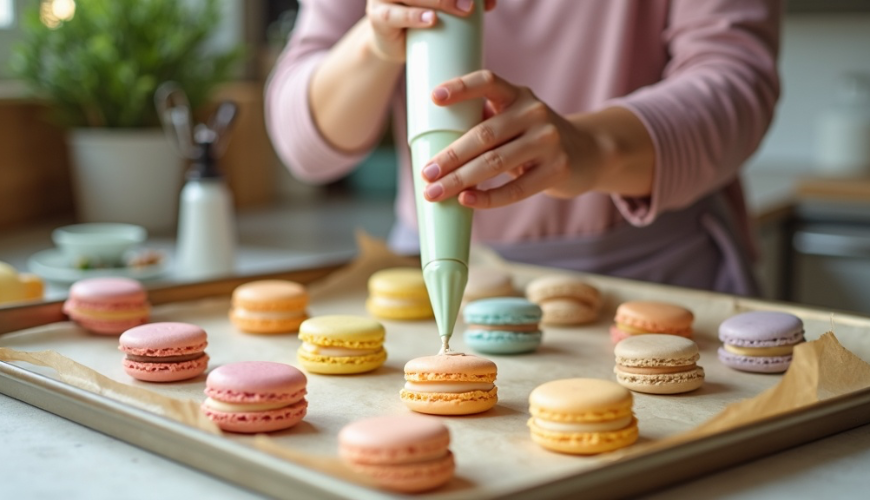
The batter is best transferred to a piping bag with a plain tip and piped into evenly-sized circles on the baking sheet. The tray is then gently tapped on the work surface a few times—this pushes out air bubbles. If a bubble appears on the surface, it can be pierced with a toothpick.
Now comes a moment that is often underestimated: allowing the macarons to dry. Depending on the air humidity, this can take 20 to 60 minutes. The surface should be dry to the touch, and the finger shouldn't stick. This is precisely the "shell" that helps form feet and a smooth top.
Baking usually takes 12–16 minutes, depending on size and oven. The tray can be rotated halfway through if the oven bakes unevenly. The finished shell should easily peel off once cooled, with the bottom firm, not wet. If it tears, it's often due to either too short baking time or a low temperature.
Ganache is made simply: cream is heated just below boiling point, poured over chopped chocolate, left to stand for a minute, and then stirred until smooth. Butter is added and stirred again. The cream needs to cool and firm up—it firms faster in the fridge, but it's good to stir it occasionally to keep it smooth.
Macarons are sandwiched only after the shells are completely cooled. Just enough filling is added so that when sandwiched, it reaches the edge but doesn't spill out. And then comes perhaps the biggest secret to great taste: letting them rest. Sandwiched macarons are left in the fridge for 12–24 hours, allowing the moisture from the cream to gently absorb into the shell. Only then do they taste as people know them from patisseries—a crunch followed by softness.
For those who want to delve deeper, they can check out explanations of principles on Serious Eats (they have understandable articles on confectionery techniques) or general safety and technological connections around eggs and baking, for example, through the USDA. For the Czech context and basic food handling rules, it makes sense to follow recommendations from SZÚ (State Health Institute) on kitchen hygiene. It's not about turning baking into a lab discipline, but rather ensuring that the process is based on solid foundations.
Macarons Simply at Home: Common Problems and How to Fix Them in Practice
When someone says "they didn't turn out," with macarons, it usually means a few recurring scenarios. The good news is that they are usually not "for the bin"—often they just don't look catalog-perfect, but they still taste great.
A cracked surface is most commonly a combination of insufficient drying or too high a temperature. If the macarons were put into the oven before a shell formed, steam will find its way out and crack the top. Extending drying time or baking slightly lower and slightly longer can help. In some ovens, switching to convection makes a huge difference.
Hollow shells often relate to meringue being over-whipped or, conversely, the batter being "over-mixed" during macaronage. A hollow can also form from too rapid a rise in the oven. Sometimes it helps to whip the meringue to a firm but still flexible state and stop macaronage a few strokes earlier. The batter should flow, not be soupy.
Too spread-out shapes typically indicate a runny batter: it was either over-mixed, the almond flour was too oily, or the egg whites were too liquid and the meringue weak. Here it's worth returning to weighing and sifting. With almond flour, the difference between brands can be surprising—some are fine and dry, others coarser and "moist." Sometimes the biggest improvement in home conditions is simply trying a different supplier.
Then there's a problem that sounds trivial but is very real: macarons sticking and not coming off. It's often underbaking (the bottom is still wet), or poor-quality paper or cold tray. Letting the tray cool slightly, or gently steaming with hot water under the paper (steam sometimes helps release the bottoms) can help. For the future, quality baking paper or a silicone mat is proven.
Into all this enters another "soft" variable: expectations. Macarons from a home oven may be a bit more rustic, but if they have a good surface, pleasant feet, and most importantly, taste, they've won. And taste is often what ultimately decides whether they will be baked again.
For a better sense of real life: it's Saturday afternoon, preparing for a celebration at home, there's a bowl of fruit on the table, and next to it, a tray with the first batch of macarons. It looks great until it's discovered that it's raining outside and the air is heavy in the apartment. The macarons just won't dry, and time is running out. In the end, a simple trick helps: turning on the range hood, slightly opening the window for "micro-ventilation," and putting the tray in a room without steam from pots. In half an hour, the surface is dry, and baking goes well. At the celebration, no one cares that two circles are slightly oval—they only care that the salted caramel in the ganache disappeared faster than the sandwiches.
That's the magic: once you understand what macarons need, they stop being a delicate legend and become something that can be repeated. Then it's easy to add your own ideas—lemon zest in the cream, a teaspoon of matcha in the shells, or perhaps a filling from quality jam with a high fruit content and less sugar.
Macarons also fit quite naturally into a more sustainable household if approached smartly: buying ingredients in bulk, using egg whites from other baking (and yolks perhaps for homemade mayonnaise or dough), storing finished macarons in a container, and planning baking to avoid wasting oven energy. Isn't it this pleasant connection—good taste, nice results, and a reasonable approach—that makes home baking a joy that doesn’t get old?
For those who want to simplify the journey, they can start with a single goal: make delicious macarons that can be nicely sandwiched and soften just right after resting. Aesthetic details will be refined over time. Macarons are not about perfection but about rhythm: sift, whip, gently combine, let dry, bake, fill, and give them time. And once that rhythm is caught, it suddenly makes sense why they have become a sweet that can create the atmosphere of a small patisserie at an ordinary kitchen table.