

# Nut Butters Worth Making at Home
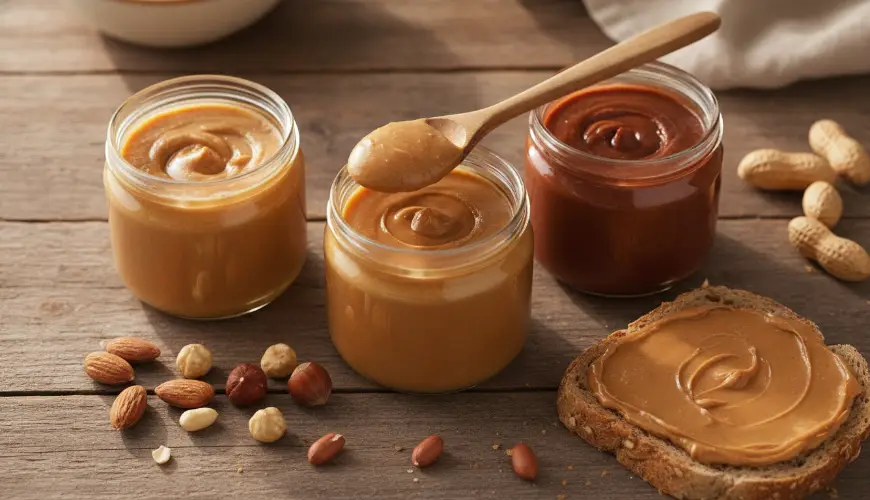
Nut butters have been experiencing a real boom in recent years. Just a decade ago, practically only peanut butter was available in shops, but today you can choose from dozens of varieties – almond, cashew, hazelnut, sesame tahini, or even Brazil nut butter. And it is precisely this diversity that raises a natural question: when is it worth reaching for a ready-made product from the shop, and when is it better to pick up a blender and make your own?
The answer is not as straightforward as it might seem. It depends on the type of nut, your kitchen equipment, the time you are willing to invest, and also on what you actually expect from the butter in question. Let's take a closer look at the whole matter.
Try our natural products
What nut butters actually are and why they deserve attention
Nut butter is fundamentally simple: blended nuts or seeds until a smooth or coarser paste forms. Yet behind this plain description lies an immense nutritional wealth. Nut butters are an excellent source of healthy unsaturated fats, proteins, magnesium, vitamin E, and a whole range of antioxidants. A study published in the scientific journal New England Journal of Medicine confirmed that regular consumption of nuts is associated with a lower risk of cardiovascular disease and overall lower mortality. Nut butters offer all these benefits in a compact and easy-to-use form.
Today we find them not only in organic shops and specialist online stores, but also in regular supermarkets. But it is precisely this availability that brings one pitfall – the quality of products varies significantly. While some butters contain truly only nuts, others are full of added sugar, palm oil, emulsifiers, and preservatives. Reading labels is therefore definitely worthwhile.
Take Petra, a thirty-three-year-old mother from the Central Bohemian Region, who began incorporating nut butters into her family's diet as a healthier alternative to traditional spreads. At first, she bought whatever came to hand first in the supermarket. Only after reading the ingredients did she discover that her favourite "almond cream" contained rapeseed oil and sugar as the second most abundant ingredient. She began looking for higher-quality alternatives – and eventually took part of the production into her own hands.
Which nut butters are worth buying
Not every butter is advantageous to make at home. There are types where buying a ready-made product makes more sense – whether due to the complexity of preparation, the availability of ingredients, or the resulting quality.
Tahini, a paste made from sesame seeds, is among the butters that most people would rather buy than make at home. The reason is simple: sesame seeds need to be toasted to a precise temperature before blending, so that the tahini does not turn bitter. This is a process that requires experience and a feel for it, and even a small imprecision can ruin an entire batch. Quality tahini made from organic sesame, produced without additives, is available in a number of health food shops, and its price reflects the effort of the producers.
The situation is similar with macadamia nut butter. Macadamia nuts are among the most expensive in the world, and their availability in the Czech Republic is limited. If you manage to obtain fresh, unsalted macadamia nuts in sufficient quantity, home production makes sense. Otherwise, it is better to rely on a trusted producer who has access to quality raw materials in bulk.
The same applies to Brazil nut butter or special mixed varieties combining several types of nuts at once. These products require precise ratios, and while making them at home is possible, it is time-consuming and costly. When selecting a ready-made product, it is crucial to watch for several things: the ingredients list should contain as few items as possible, ideally just the nuts themselves and perhaps a pinch of salt. Added sugar, palm fat, or hydrogenated oils are a clear signal that the product is not what it appears to be.
In recent times, producers have been appearing on the Czech market who place emphasis on transparency and simplicity of ingredients. Their products can be found, for example, in the Ferwer online shop, where the focus is on natural composition without unnecessary additives. Such butters are more expensive than the industrial varieties from the supermarket, but the difference in quality is noticeable.
Another important factor when purchasing is the packaging. Glass jars are always a better choice than plastic containers – they do not absorb odours or substances from the plastic, and the butter stays fresher in them for longer. They are also more environmentally friendly and easily recyclable, which is appreciated by anyone trying to reduce their ecological footprint.
Which nut butters you can easily make at home
On the other side stand butters whose home preparation is surprisingly simple, inexpensive, and the result often surpasses anything available in shops. Here, home preparation clearly wins.
Peanut butter is a classic that is easiest to prepare at home. All you need is unsalted, optionally lightly roasted peanuts and a powerful blender or food processor. After a few minutes of blending, a crumbly mass forms first, which gradually transforms into a smooth, creamy paste. The whole process takes approximately ten minutes, and the result is a butter free of preservatives, free of added sugar, and with exactly the texture you prefer. The taste of homemade peanut butter is more intense and fresher than industrial varieties – and the financial saving with regular consumption is not negligible.
Almond butter is prepared in a very similar way, and is currently perhaps the most popular nut butter of all. It is advantageous to briefly roast the almonds in the oven before blending – this enhances their natural sweetness and the flavour of the butter will be fuller. Almond butter is somewhat firmer than peanut butter, so the blender needs more time, but the result is worth it. Homemade almond butter without additives naturally contains vitamin E, magnesium, and calcium, with all these substances remaining intact, as the butter does not undergo industrial processing.
Hazelnut butter is also an excellent choice for home production. Hazelnuts are readily available in the Czech Republic, relatively inexpensive, and their butter tastes vaguely reminiscent of the famous chocolate-hazelnut spread – just without the sugar, palm fat, and artificial flavourings. Simply roast the nuts, peel off the thin skins, and blend. For a sweeter version, a little honey or dates can be added, but even the pure version is excellent.
As a general rule, the more accessible and affordable the nut, the more worthwhile home production becomes. For basic orientation, the following overview may be useful:
- Peanut butter – home production clearly wins, inexpensive and quick
- Almond butter – home production recommended, significant saving compared to quality organic varieties
- Hazelnut butter – home production easy, the result will surprise you
- Cashew butter – home production possible, but cashew nuts are more expensive and the butter tends to be less durable
- Tahini – better to buy, production requires experience
- Macadamia nut butter – better to buy, nuts are expensive and hard to obtain
Whether you opt for home production or purchasing, the key to success is always the quality of the starting ingredients. Fresh, unsalted, and ideally organic nuts free of pesticides are the foundation of a tasty and healthy butter. Research by the Environmental Working Group has repeatedly pointed out that conventionally grown nuts may contain pesticide residues, and therefore organic certification for nuts is genuinely worthwhile.
Home production has one more advantage that is rarely talked about: the possibility to experiment. Almond butter with cardamom and vanilla, peanut butter with a touch of chilli, hazelnut butter with cocoa and cinnamon – the combinations are practically limitless. As British cook Nigella Lawson says: "Cooking at home is not about perfection, but about the joy of the process and knowing what you eat." And it is precisely this freedom that is perhaps the most valuable thing homemade nut butters have to offer.
When it comes to storage, the same rules apply to both homemade and purchased butters. Butters without additives are best kept in the refrigerator, where they will keep comfortably for a month or more. At room temperature, fats can go rancid more quickly, especially in varieties with a higher content of unsaturated fatty acids, such as almond or hazelnut butter. A glass jar with a tight-fitting lid is the ideal choice – it protects the contents from atmospheric moisture and light, which accelerate oxidation.
The world of nut butters is more varied than it appears at first glance. There is no need to choose between home production and purchasing as though it were a matter of dogma – a sensible approach is to combine both depending on the situation, availability, and one's own inclination to experiment. Peanut or almond butter can easily be prepared at home with a little practice, saving not only money but also giving you control over what you eat. For more demanding types such as tahini or exotic butters, reach for a trusted producer who prides themselves on a clean ingredient list. The result on the plate – or on a slice of bread – speaks for itself.