

Kettlebell is the ideal piece of equipment for home strength training that can replace an entire gym
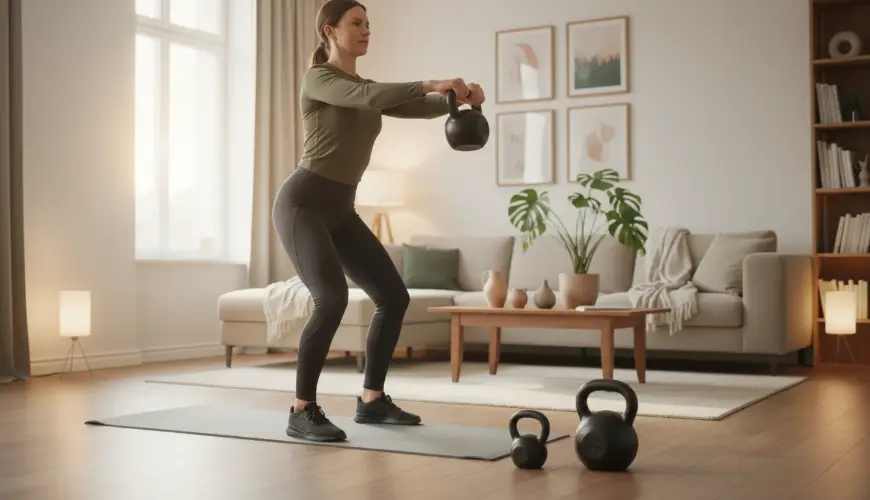
Few pieces of training equipment have gained as many fans in recent years as the kettlebell. This unmistakable ball with a handle may look simple, but it can replace an entire gym – literally in the corner of your living room. Can you actually strength train at home with a kettlebell in a way that delivers real results? The answer is a resounding yes, and in this article, we'll look at how to approach it correctly, what weight to choose, and which exercises are truly worth including in your training.
The kettlebell is no modern invention. Its roots reach back to 18th-century Russia, where it originally served as a counterweight at marketplaces. Over time, however, people noticed that lifting and manipulating this implement built remarkable strength and endurance. Today, the kettlebell is recommended by physiotherapists, conditioning coaches, and functional training experts around the world. And for good reason – kettlebell training engages the body as a whole, not isolated muscle groups, which is exactly the way the human body naturally functions.
Unlike traditional dumbbells, where the weight is evenly distributed on both sides, the kettlebell's center of gravity is shifted below the handle. This means that with every movement, the body must actively stabilize the entire kinetic chain – from the feet through the core to the shoulders. The result is effective training that simultaneously builds strength, improves coordination, strengthens the deep stabilization system, and increases cardiovascular fitness. According to a study published in the Journal of Strength and Conditioning Research, a twenty-minute kettlebell workout can burn a comparable number of calories to running at a moderate pace, while simultaneously developing muscular strength in a way that running simply cannot offer.
Try our natural products
How to Choose the Right Kettlebell Weight
One of the most common mistakes beginners make is choosing a kettlebell that is either too light or too heavy. Both lead to either an insufficient training stimulus or dangerous technique and potential injuries. So how do you get it right?
The general recommendation for women starting out with a kettlebell is 8 kilograms. For men, the typical recommendation is to start at 12 or 16 kilograms. However, these are guideline values – it depends on current physical fitness, previous experience with strength training, and which exercises one plans to perform. For example, the kettlebell swing, which is a dynamic movement utilizing momentum, can be handled by most people at a higher weight than, say, the Turkish get-up, where the load needs to be controlled in a slow, deliberate movement overhead.
A practical piece of advice: if you're unsure, it's worth visiting a sporting goods store or gym to try out different weights. The kettlebell should be heavy enough to present a challenge, but at the same time should allow execution of the exercise with clean technique throughout the entire set. Once technique starts to break down – the back rounds, the shoulders creep up toward the ears, or the movement becomes jerky – that's a clear signal the weight is too high.
A quality kettlebell should have a smooth handle without sharp edges that sits comfortably in the palm. Cast iron kettlebells are a proven classic, while rubber-coated kettlebells protect the floor and reduce noise, which is especially appreciated by those who train in an apartment. Investing in one or two kettlebells of different weights is a fraction of the cost of an annual gym membership, yet offers nearly unlimited training possibilities.
Tips for Specific Kettlebell Exercises
Let's take a look at the exercises that form the foundation of strength training at home with a kettlebell and that everyone who is serious about this tool should know.
The kettlebell swing is without a doubt the king of all kettlebell exercises. It's based on the principle of the hip hinge – a powerful extension of the hips – and engages the entire posterior chain from the calves through the hamstrings and glutes to the spinal erectors. At the same time, it's a fantastic cardio exercise. Proper execution begins in a slightly wider than shoulder-width stance, the kettlebell is gripped with both hands, the back stays straight, and the movement originates exclusively from the hips, not the arms. The hands serve merely as "hooks" holding the weight – all the power comes from the lower body. A common mistake is trying to lift the kettlebell with the arms or rounding the lower back, which can lead to lower back pain.
The goblet squat, or squat with a kettlebell held at the chest, is another excellent exercise that teaches the proper squat pattern while strengthening the quadriceps, glutes, and core. The kettlebell is held with both hands by the "horns" of the handle close to the chest, with elbows pointing down. This position naturally promotes an upright torso and prevents forward leaning, which is a problem many people struggle with during a traditional back squat with a barbell. The goblet squat is therefore an ideal choice for beginners, but even advanced exercisers appreciate it as a warm-up exercise or as part of a high-volume training session.
The Turkish get-up is among the most complex exercises of all. It involves standing up from a supine position to a full standing position while holding a kettlebell in an extended arm overhead the entire time. It sounds simple, but in reality, it's a series of precisely defined positions that require strength, shoulder stability, hip mobility, and extraordinary core control. It's worth learning this exercise first without any load or with a light object – such as a shoe balanced on the back of the hand, as recommended by StrongFirst system instructors – and only then adding a kettlebell.
The kettlebell press, or pressing the kettlebell overhead with one hand, is an excellent exercise for building shoulder and tricep strength. Unlike pressing with a dumbbell, the kettlebell press requires greater wrist and forearm stabilization because the ball hangs on the outer side of the hand. The key is to keep the forearm in a vertical position, actively engage the glutes and abs, and not push the weight to the side but straight up.
The kettlebell row, or bent-over row, is the path to a strong back and healthy posture. One hand rests on a bench or stable surface while the other pulls the kettlebell toward the hip. At the top of the movement, the shoulder blade retracts toward the spine, which activates the middle and lower portions of the trapezius muscle – areas that tend to be chronically weakened in people with sedentary jobs.
Other exercises worth mentioning include the kettlebell clean (cleaning to the chest), kettlebell snatch, and farmer's walk (loaded carry). Each brings something different to the training, and together they create a comprehensive program that covers virtually all movement patterns.
But what does a specific training session look like in practice? Let's imagine Petr, a man in his thirties working from home, who has neither the time nor the desire to commute to a gym. Petr bought a 16-kilogram kettlebell and started training three times a week with a simple program: five sets of ten swings, three sets of eight goblet squats, three sets of five presses on each arm, and to finish, two sets of Turkish get-ups on each side. The entire workout takes him about twenty-five minutes. After two months, he noticed significant improvements – not just more visible muscles, but above all better posture, the disappearance of chronic lower back pain, and surprisingly, better endurance on weekend hikes in nature. Stories like Petr's are not the exception but the rule.
How should you properly train with a kettlebell so that the workout delivers results while remaining safe? Several principles apply universally. Always start with a warm-up that includes joint mobilization and core activation – five minutes of circular movements in the hips, shoulders, and thoracic spine, supplemented with a plank and a few bodyweight squats, is sufficient. Never jump straight into swings with a cold body.
Furthermore, technique always takes priority over weight and speed. As legendary coach Dan John, one of the greatest advocates of kettlebell training, says: "First learn to do the movement correctly, then do it often, and only then do it heavy." This progression protects against injury while building a solid foundation that can be built upon for years.
Breathing is another often overlooked aspect. During the kettlebell swing, the exhale should come at the moment of hip extension – that is, at the point of maximum effort. During the squat, we inhale on the descent and exhale on the ascent. Proper breathing not only increases performance but also helps stabilize the spine by increasing intra-abdominal pressure.
And finally – rest is part of training. Muscles don't grow during exercise but during recovery. Three to four kettlebell workouts per week is the ideal frequency for most people, allowing sufficient training volume as well as space for recovery. Between sets, it's advisable to rest one to two minutes, and for heavier exercises like the Turkish get-up, even longer.
The kettlebell is simply a tool that deserves the attention of anyone looking for an effective way to strength train at home without the need to invest in expensive equipment or a spacious home gym. All you need is one piece of iron with a handle, a bit of free space, and the willingness to learn proper technique. The results – whether it's strength, conditioning, better posture, or fat loss – won't be long in coming. And perhaps that's where the greatest magic of the kettlebell lies: in its plain simplicity, which conceals nearly infinite depth.