
Hollandaise Sauce for Everyone as an Easy Recipe for Gourmets
The Secret of Hollandaise Sauce - Mastering One of the Most Feared Classics of French Cuisine
In the world of cooking, there are sauces that command respect even among experienced chefs. One of these is undoubtedly hollandaise sauce – a delicate, rich, and velvety emulsion of butter, egg yolks, and lemon juice, which is not only an icon of French haute cuisine but also a versatile companion to many dishes from asparagus to salmon. Although its name might be misleading, it has little to do with Holland. Hollandaise sauce, also known as sauce hollandaise, is one of the five mother sauces of French cuisine as described by the famous culinary master Auguste Escoffier.
The reputation of this sauce is twofold. On one hand, it is an incredibly delicious and elegant component that can elevate even a simple meal to a festive experience. On the other hand, it is feared for its technical difficulty – a minor lapse can cause the sauce to split or lose its silky texture. This is why many people search for a simple recipe for hollandaise sauce or take inspiration from renowned chefs like Zdeněk Pohlreich, who often emphasizes that simplicity is beauty – and that the key to success is patience, quality ingredients, and the right technique.
Why Not to Fear Hollandaise Sauce?
The experience of preparing hollandaise sauce is often an initiation into the higher culinary world. It is not uncommon for the first attempt to end in failure – the sauce splits, is too acidic, or conversely bland. But when it succeeds, it’s like a small miracle. The smooth, shiny, yellow emulsion melts on the tongue, revealing layers of flavors with each bite – buttery fullness, citrus freshness, and a gentle egg undertone.
In reality, there is no need to fear this sauce. Simple hollandaise sauce is achievable even for home cooks if a few principles are followed: ingredients must be at room temperature, the temperature during preparation must not be too high, and the emulsification or combining of ingredients must proceed slowly and patiently. Those searching for a recipe for hollandaise sauce will find countless options – from classic variants to modern interpretations.
One popular approach, especially in Czech kitchens, is the recipe introduced by Zdeněk Pohlreich. His hollandaise sauce according to Pohlreich is simple, well-explained, and adapted to home conditions. Many cooks appreciate that this method of preparation is understandable while preserving the authenticity of the traditional recipe.
Beyond Asparagus - Hollandaise Sauce and Salmon
Traditional French cuisine primarily associates hollandaise sauce with asparagus, eggs Benedict, or boiled vegetables. However, in Czech households, it is increasingly used as an accompaniment to grilled or poached fish. Hollandaise sauce with salmon is one of the most sought-after recipes ever – and it’s no wonder. The buttery taste of the sauce perfectly complements the tender texture of the fish, creating a harmonious combination suitable for both a regular lunch and a festive dinner.
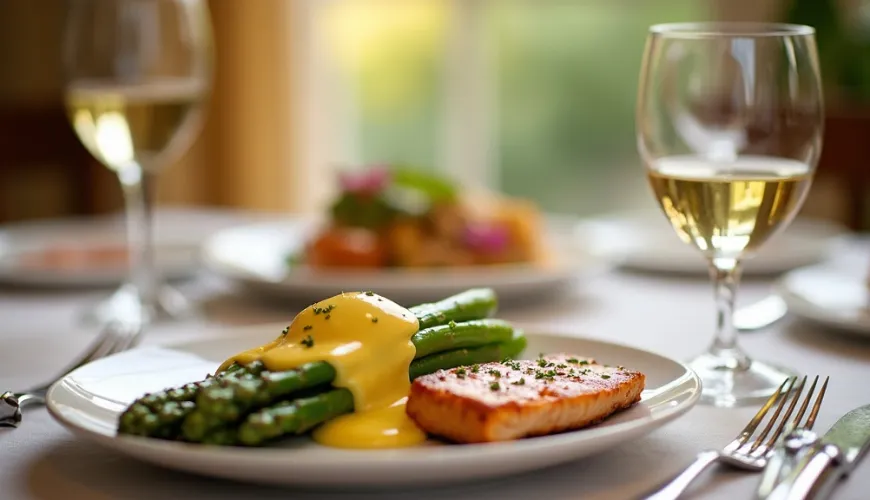
Imagine the following scenario. In spring, when fresh asparagus and quality fish are available, many people prepare a light dinner: a butter-seared salmon fillet, served with boiled green asparagus and topped with a spoonful of delicate hollandaise sauce. A glass of white wine, the light of the setting sun, and a taste that combines the best of nature with perfect technique.
How to Make Simple Hollandaise Sauce?
There are several ways to prepare hollandaise sauce, and each has its advocates. Traditionally, the sauce is whisked by hand over a water bath, allowing better control over the temperature. Modern cooks often use a blender or immersion blender, simplifying the entire process. The foundation of every recipe is three main ingredients: egg yolks, butter, and lemon juice. Some variants enhance the sauce with white wine, vinegar, or even a pinch of cayenne pepper.
Here is an example of a simple hollandaise sauce recipe that even a beginner can manage:
- Separate 3 egg yolks and place them in a stainless steel bowl or smaller pot.
- Add a tablespoon of lemon juice and a pinch of salt.
- Place the bowl over a pot of gently simmering water (the water with yolks must not boil).
- While constantly whisking, gradually add 100–120 g of melted butter.
- Continue whisking until the sauce thickens and gains a glossy texture.
- Season with more salt or lemon juice to taste.
This recipe requires only a few minutes, but the key to success is carefulness. If the butter is added too quickly or the yolks are overheated, the sauce may split. In such a case, sometimes the sauce can be saved by adding a teaspoon of cold water and carefully whisking again.
Tricks from Cooking Shows - What Do Pros Advise?
Chefs, such as the mentioned Zdeněk Pohlreich, often point out that hollandaise sauce requires patience and focus. In one episode of his culinary show, he reminds: “It’s not complicated, but you have to stand there and pay attention. This is not the time to check emails or scroll through Instagram."
Another trick that has proven successful for many home cooks is using clarified butter instead of regular butter. Clarified butter has a higher melting point and places less water load on the sauce, helping to stabilize the emulsion. Additionally, it is recommended to use fresh lemon juice instead of concentrates – the taste is fresher and more natural.
And what if the sauce doesn’t turn out after all? There’s no need to despair. Hollandaise sauce is challenging, but it’s also a great opportunity to learn something new about cooking and food chemistry. Every failure is a step towards mastery.
Hollandaise Sauce in 21st-Century Kitchens
Interestingly, in recent years, hollandaise sauce has also seen modern, vegetarian, and vegan versions. Instead of egg yolks, plant-based alternatives are used, such as aquafaba (liquid from chickpeas), and butter is replaced with plant-based fats. The result is a version that tastes surprisingly authentic, although it naturally doesn’t mimic the original’s velvety texture.
Still, it holds true that classic hollandaise sauce is one of those recipes worth mastering. Not just for the taste, but also for what it represents – the connection of technique, ingredients, and attention. With each preparation, one learns how important it is to perceive details, respond to temperature changes, and be patient.
And that’s exactly why hollandaise sauce becomes more than just a sauce. It’s a small lesson that in the kitchen – just like in life – nothing is better than the combination of simple things that together create something truly extraordinary.