
# How to Travel Eco-Friendly and Guilt-Free with Kids
Every parent knows it – that moment when summer vacation planning begins and suddenly there's a pile of questions on the table. Where to go? How to get there? What to pack? And in recent years, one more question keeps coming up, ever more urgently: can the whole thing be managed in a way that doesn't burden our planet more than necessary? Eco-friendly travel with kids sounds like a contradiction to many – after all, just the volume of luggage a family with small children produces can fill an entire car trunk. Yet there are plenty of ways to enjoy a vacation to the fullest while leaving a significantly smaller ecological footprint. And best of all, children learn something in the process that no textbook can give them.
Imagine the Novák family from Brno. Two adults, two children aged five and eight. Just three years ago, their typical vacation looked like flights to Turkey, an all-inclusive resort, and a pool with water slides. Nothing wrong with that – except one day the older son came home from school with a project about carbon footprints and started asking how much CO₂ they actually produced on their last flight. Dad calculated it, and the number surprised him. According to the calculator from Atmosfair, a round-trip flight from Prague to Antalya produces approximately 1.2 tons of CO₂ per person. For a family of four, that's nearly five tons – roughly as much as one person's annual carbon budget should be according to climate targets. The Nováks decided to try a different approach. And they discovered that different doesn't mean worse.
Try our natural products





How to Plan a Vacation with Kids and a Smaller Ecological Footprint
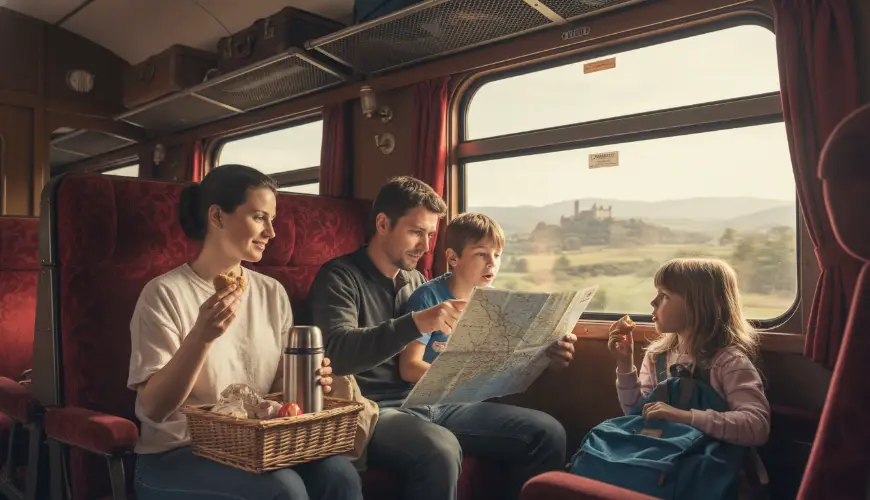
The foundation of any greener trip is the choice of transportation. Flying is undoubtedly the fastest way to cover large distances, but also the one with the highest carbon footprint. For families with children, train or bus travel has one unexpected advantage – the journey itself becomes part of the experience. Children sitting on a plane usually stare at a tablet screen. Children on a train watch the landscape, play board games on the fold-down table, snack on homemade sandwiches, and ask what river that is outside the window. A train journey transforms the transfer from point A to point B into an adventure that the family remembers just as well as the stay itself.
The Czech Republic has a huge advantage in this regard. The rail network covers practically the entire country, and international connections comfortably take you to Vienna, Dresden, Krakow, or the Baltic coast. The European rail network is more sophisticated today than most people realize – the organization The Man in Seat 61 offers detailed guides on how to get virtually anywhere in Europe by train, including tips on transfer stations and overnight trains that children love.
If a car is the only realistic option – and let's be honest, with small children and mountain gear, sometimes there's no other way – there are ways to make driving more eco-friendly too. Sharing a car with another family, filling all seats, maintaining a smooth driving style, and keeping proper tire pressure can reduce fuel consumption by a surprising 15 to 20 percent. And of course, the closer you travel, the smaller your footprint. Sometimes it's enough to discover the beauty that lies fifty kilometers from home. Bohemian Paradise, Šumava, Jeseníky, Podyjí – these are all places that many foreign tourists would envy, and yet they're right on our doorstep.
The choice of accommodation is another key decision. Large hotel resorts with air conditioning, heated pools, and endless buffets logically have higher energy demands than smaller guesthouses, eco-farms, or campsites. In recent years, the offering of so-called eco-accommodation has been growing both in the Czech Republic and abroad – places that actively work on reducing their ecological footprint. They use renewable energy sources, offer local food, minimize waste, and often involve guests in nature-related activities. Platforms like BioHotels bring together certified ecological accommodations across Europe and can be an excellent starting point for planning.
But you don't need to look only for specialized eco-places. Simply choosing a smaller family-run guesthouse that cooks with local ingredients is already a step in the right direction. Camping in nature, whether in a tent or a camper van, is among the most ecological forms of vacation – as long as you follow the rules and leave the place as you found it. For children, sleeping under the stars is also one of those experiences they remember well into adulthood.
Food on the road is a topic that families often underestimate, yet it has a fundamental impact on the overall ecological footprint of a vacation. All-inclusive buffets, where tons of food are thrown away daily, are problematic from an environmental standpoint. In contrast, shopping at local markets, cooking with local ingredients, and visiting small family-run restaurants not only reduces waste but also supports the local economy and gives the family a more authentic experience of the destination. When you buy fresh tomatoes, basil, and mozzarella at an Italian market with your kids and prepare a simple lunch together, it's a lesson in geography, gastronomy, and sustainability all in one.
And what to bring on the trip? This opens up space for one of the most important lessons we can give our children. Packing without single-use plastics isn't just an eco trend – it's a practical habit that saves money and teaches children to think about what they truly need. A stainless steel water bottle, snack boxes instead of plastic bags, cloth napkins, your own travel cutlery – these are all small things that add up to a big difference. The Novák family we mentioned at the beginning got themselves a set of travel boxes and bottles and estimates that over a single two-week vacation they save approximately one hundred to one hundred fifty single-use plastic packages.
Tips for an Eco-Friendly Vacation with Kids That Actually Work in Practice
Theory is one thing, but what does it all look like in practice? Here are several concrete tips that families actually use and that don't require any dramatic sacrifices:
- Choose a destination reachable by train or car within five hours – you'll reduce not only your carbon footprint but also the stress of traveling with small children.
- Select accommodation with a kitchenette so you can prepare at least some meals from local ingredients.
- Pack reusable dishes, bottles, and bags – you'll save dozens of single-use packages on the road.
- Plan outdoor activities instead of amusement parks – hikes, swimming in rivers, wildlife watching, or geocaching are free and have zero ecological footprint.
- Involve the kids in planning – let them choose a route on the map, suggest activities, or come up with an "eco challenge" for each day of the vacation.
- Offset emissions that can't be eliminated – for example, through certified programs like Gold Standard.
Involving children in the entire process is perhaps the most important thing you can do. It's not just about them learning to sort waste or save water. It's about them understanding the connection between their decisions and the state of the world around them. A child who helps plan an eco-friendly vacation naturally learns to think critically, seek alternatives, and consider something greater than their immediate wishes. As British naturalist and conservationist Jane Goodall said: "Every individual matters. Every individual has a role to play. Every individual makes a difference."
It's also important to let go of the illusion that eco-friendly travel has to be ascetic or boring. Quite the opposite – it often leads to more intense experiences. When instead of a resort with an entertainment program you spend a week on a farm where children feed goats, pick herbs, and learn to bake bread in a wood-fired oven, they go home with stories they'll tell all year. When instead of a taxi from the airport you take a regional train through picturesque towns, you see the country the way tourists from a plane never will. Slower travel doesn't mean fewer experiences – it means deeper experiences.
Preparation and education before the trip also play a role. There is a whole range of books and online resources that help families plan more sustainable vacations. The Czech website Na Zelenou regularly offers tips on an ecological lifestyle including travel and can be a good starting point for those just beginning with this approach. For international inspiration, the initiative Green Destinations is worth mentioning, as it evaluates and certifies sustainable tourist destinations around the world.
Let's return one last time to the Nováks. This summer they took the train to the Austrian Alps. They stayed at a small guesthouse with a farm where the children helped with the animals. They went on hikes, swam in mountain lakes, and ate homemade cheeses. The older son kept a journal where he recorded how many plastics they "saved" each day. The younger daughter declared it was the best vacation she had ever had. And the carbon footprint? Approximately one-fifth of what the family produced on their previous flight to Turkey.
Of course, no one is claiming you need to immediately stop flying or give up all comfort. Eco-friendly travel isn't about perfection, but about conscious decisions. Every family has different options, a different budget, and different needs. But even small steps count. Choosing a train instead of a plane once every two years. Bringing your own water bottle. Picking a guesthouse instead of a resort. Buying fruit at the local market instead of at the hotel buffet. Each such decision is a signal – to yourself, to your children, and to the world around you – that it matters.
And perhaps this is the greatest gift we can give our children on vacation. Not another stuffed toy from the airport shop, but the understanding that the world is beautiful, fragile, and worth caring for. That travel doesn't have to be about consuming places, but about truly encountering them. And that even a family vacation can be a step toward a better future – not despite the fact that we're traveling with children, but precisely because of it.