
When siblings argue and you don't want to be the judge
Every parent with more than one child at home knows that moment. You've just sat down with a cup of tea, there's a crash from the living room, followed by a piercing scream, and moments later two upset little beings come running in, each claiming the other one started it. Sibling arguments are as inseparable a part of family life as uneaten snacks and lost socks. Yet few aspects of parenting touch parents as sensitively. Should we intervene? Should we judge who's right? And is it even possible to support the relationship between children without becoming referees who inevitably hurt one of the children?
The answer isn't simple, but it exists. And it begins with understanding what truly lies behind sibling rivalry.
Try our natural products



Why siblings argue – and why it's actually normal
The term "sibling rivalry" sounds dramatic, but in reality it's one of the most natural developmental phenomena in childhood. Children differ from each other in temperament, needs, developmental stage, and how they perceive the world around them. When they share space, toys, and above all their parents' attention, clashes are inevitable. The American Academy of Pediatrics (AAP) in its materials for parents repeatedly emphasizes that mild rivalry between siblings is healthy and helps children develop social skills – negotiation, compromise, empathy, and the ability to manage frustration.
The problem arises when conflicts escalate, when one child consistently feels less loved, or when parents unknowingly take on the role of judge, which only worsens the entire dynamic. Psychologist Adele Faber, co-author of the book Siblings Without Rivalry, once wrote: "When parents constantly decide who's right and who's wrong, children stop arguing about the toy and start competing for love." And this is precisely where the heart of the whole problem lies.
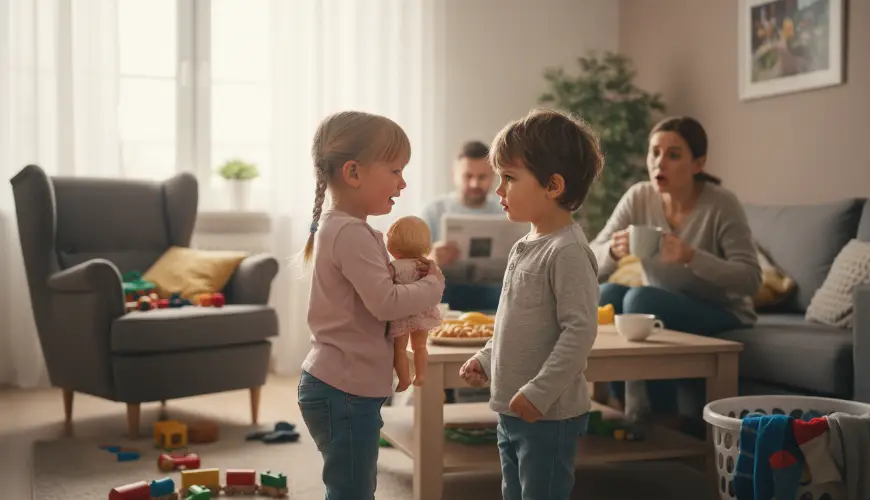
Let's think for a moment about how a typical sibling argument plays out in many households. Six-year-old Anička is playing with a doll. Four-year-old Tomáš wants it too. Anička refuses, Tomáš snatches the doll, Anička bursts into tears. Mom runs in, sees her crying daughter, and says: "Tomáš, give it back! She had it first." Tomáš feels unfairly punished, Anička feels confirmed as "the good one." Next time, Tomáš takes the doll when no one is looking, and the vicious cycle continues. The parent judged, but didn't resolve the cause of the conflict – and worse, unknowingly fueled a dynamic where one child is the winner and the other the loser.
This is precisely the pattern that can be avoided. Not by ignoring conflicts, but by changing our role. Instead of a judge, we become a guide.
What does this mean in practice? First and foremost, we need to resist the urge to immediately find out who started it. Most sibling arguments don't have a clear culprit – both sides contributed their share, even if it doesn't look that way at first glance. Instead of the question "Who did it?" it's much more effective to name what we see and feel: "I can see you're both upset. Anička, you're sad that someone took your toy. Tomáš, you wanted to play too and didn't know how to ask for it." With this simple step, we're doing several things at once. We're acknowledging both children's emotions, we're not casting anyone in the role of the guilty party, and at the same time we're naming what actually happened – that is, a need that wasn't met. And it's precisely from this point that we can move forward, toward finding a solution that works for both.
Does this sound idealistic? Perhaps a little. But research confirms it. A study published in the journal Child Development in 2019 showed that children whose parents named emotions during conflicts and guided them toward mutual listening instead of immediate punishment demonstrated significantly better relationships with siblings after two years, as well as better ability to resolve conflicts with peers at school.
How to support the relationship between children without judging
Supporting a healthy sibling relationship isn't a one-time action, but a long-term approach that permeates the family's everyday life. It's not just about how we react to arguments, but also about how we talk with children, how we organize family time, and how we handle the natural differences between siblings.
One of the most common – and most harmful – habits parents fall into is comparing. "Look at your sister, she's already finished her homework." "Why can't you be good like your brother?" These sentences, though intended as motivation, have precisely the opposite effect. A child who is constantly compared doesn't feel motivated – they feel inadequate. And they often direct their anger and frustration precisely at the sibling who is held up as a model. This creates a paradoxical situation where a parent who wants to motivate children toward better behavior is actually deepening the rivalry between them.
Instead of comparing, it's much more effective to notice each child individually, in their own context. "I can see you really put effort into that assignment." "I noticed you helped your little sister with her shoes today – that was really nice of you." Every child needs to know they are seen and appreciated for who they are, not for how they measure up compared to someone else.
Another important aspect is individual time with each child. It doesn't have to be anything grand – ten minutes before bedtime when a parent focuses on just one child, asks about their day, reads to them, or simply chats is enough. These moments have enormous power. A child who knows they have their own, unshared space with a parent doesn't need to fight for attention as much. And when they don't need to fight for attention, the intensity of sibling conflicts decreases as well.
It's also worth mentioning how important it is to let children resolve some conflicts on their own. Parents have a natural instinct to intervene in every argument, but not every dispute requires adult intervention. If there's no risk of physical harm, it can be very beneficial to let children find a solution themselves. Of course, this doesn't mean walking away and leaving them to fend for themselves – it's more about being nearby, observing, and stepping in only when it's truly needed. Children learn incredibly valuable life skills this way: negotiating, yielding, seeking compromise, and managing the frustration of not always getting what they want.
An important role is also played by how the family as a whole talks about emotions. In households where naming feelings is commonplace – where people say "I'm angry," "I'm sad," "I feel it's unfair" – children have much better tools for managing conflicts. It's not about children never arguing, but about them arguing fairly. About them knowing they can be angry, but they can't hit. That they can disagree, but they can express it with words.
A practical tool that many families appreciate is what's known as family meetings. These are regular, perhaps weekly gatherings of the whole family where everyone gets space to say what's bothering them, what they'd like to change, and what they enjoyed that week. At these meetings, children learn to listen, articulate their needs, and find solutions together. It's not a therapy session – more of a pleasant ritual that can last fifteen minutes and strengthens a sense of belonging and mutual respect.
While we're on practical tips, we can't overlook the influence of environment either. Children who have enough physical space and the opportunity to be alone for a while argue less. This doesn't mean every child needs their own room – but even in a small apartment, you can create a "quiet corner" where a child can retreat when they need to be alone. It also helps when children have at least some things that are only theirs and don't have to be shared. Sharing is a beautiful value, but forced sharing often leads to greater rivalry, not greater generosity.
The perspective on birth order and its influence on sibling dynamics is also interesting. Firstborn children often carry the burden of expectations – they should be responsible, sensible, they should set an example. Younger siblings, on the other hand, may feel they can never measure up to what the older sibling can already do. And middle children? They sometimes feel invisible. Being aware of these dynamics helps parents better understand why their children behave the way they do – and respond with greater understanding instead of automatic judgment.
Perhaps most important of all, though, is the realization that the sibling relationship is a marathon, not a sprint. The fact that children at five and seven argue about every little thing doesn't mean they won't love each other in adulthood. On the contrary – many adult siblings who went through intense rivalry in childhood describe their relationship as one of the deepest and most important in their lives. What's key is the foundation their parents give them. If they learn that conflicts can be resolved with respect, that everyone has the right to their emotions, and that parental love isn't a pie that has to be sliced up – then they have an excellent starting position for a lifelong close relationship.
For parents who want to dive deeper into the topic, the already mentioned book Siblings Without Rivalry by Adele Faber and Elaine Mazlish may be useful – it's also available in Czech translation. It offers concrete examples, dialogues, and strategies that can be applied immediately. Another excellent resource is the website Aha! Parenting by psychologist Laura Markham, where you'll find dozens of articles on sibling dynamics based on current research.
Raising multiple children is one of the most challenging, yet also most enriching experiences that parenthood offers. Sibling arguments won't disappear – nor should they. They're a natural part of growth and learning. What can change, however, is the way we respond to them. When we set aside the role of judge and take on the role of guide, we give our children a gift that transcends childhood: the ability to build relationships based on respect, empathy, and mutual understanding. And that is something no toy, no compromise over a doll, and no verdict of "who started it" can ever replace.