

Postpartum depression also affects men
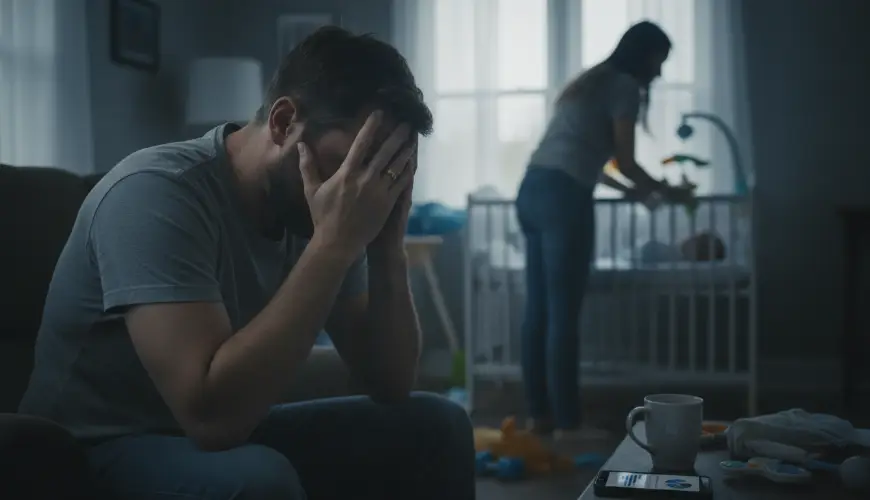
When people hear "postpartum depression," most immediately picture a mother struggling with emotional exhaustion after the birth of a child. That makes sense – postpartum depression in women is discussed more and more frequently, with support programs, awareness campaigns, and professional counseling services being established. Few people realize, however, that exactly the same problem can affect a new father. Postpartum depression in fathers is a topic that has long remained in the shadows, and although experts have been drawing attention to it for years, a kind of silence still persists in society. As if a man had no right to be affected by the arrival of a new human being in any way other than joy and pride.
Yet the numbers speak quite clearly. According to a meta-analysis published in the Journal of the American Medical Association (JAMA), postpartum depression affects approximately 8 to 10 percent of fathers in the first year after a child's birth. Some newer studies, such as research published in the journal Frontiers in Psychiatry, suggest that the real numbers may be even higher, as many men never report their difficulties. The reasons vary – shame, lack of awareness, but also the deeply rooted notion that a "real man" doesn't cry and can handle everything on his own.
The story of Tomáš, a thirty-three-year-old programmer from Brno, illustrates how easily postpartum depression in a man can go unnoticed. When his daughter was born two years ago, he initially felt immense joy. But within a few weeks, he began to withdraw into himself. He stopped going to lunches with colleagues, couldn't sleep at night even when his daughter was already sleeping, and gradually lost interest in things he used to enjoy. "I kept telling myself I was just tired, that it would pass. My wife had enough worries of her own – I didn't want to burden her," he recalls. It took nearly half a year before a friend, himself a father of two, said the sentence that prompted him to seek help: "Look, what you're describing – that's not normal tiredness." Tomáš eventually started seeing a psychologist and today says that it probably saved not only his mental health but also his relationship.
Tomáš's story is not unique, but it is one of the few that make it to the surface. The majority of men with postpartum depression never seek professional help. And this brings us to the heart of the problem – why postpartum depression in fathers is still taboo.
Try our natural products





Why postpartum depression in men is not talked about
Society has a peculiar relationship with male emotions. On one hand, there are increasingly loud calls for men to be more open and not afraid to talk about their feelings. On the other hand, stereotypes persist that say a man should be the support, the pillar of the family, the one who holds things together. When a baby is born, all attention naturally focuses on the mother and the newborn. The father is the one who is supposed to help, support, and be strong. And it is precisely in this pressure that the seed of the problem can be hidden.
Postpartum depression in men often manifests differently than in women, which complicates its recognition. While women more frequently describe sadness, crying, and feelings of helplessness, men tend to react with irritability, withdrawal, increased alcohol consumption, or workaholism. Some studies, such as research by Paulson and Bazemore from 2010, show that depressed fathers read less to their children, play with them less, and more frequently use physical punishment. In other words – untreated postpartum depression in a father impacts not just him alone, but the entire family.
Interestingly, the risk of postpartum depression in a father rises significantly if the child's mother is also suffering from it. According to experts, this is due to the mutual emotional interconnectedness of partners and the overall burden that the arrival of a child into the family represents. Sleep deprivation, changing roles, financial concerns, transformation of the partner relationship – all of these are factors that spare neither parent. Hormonal changes, moreover, are not exclusive to women. Research has shown that men experience a decline in testosterone levels and changes in cortisol and estrogen levels around the time of childbirth, which can contribute to the development of depressive states.
Another reason why postpartum depression in fathers remains invisible is systemic – the healthcare system in most countries, including the Czech Republic, simply does not screen fathers for postpartum depression. Mothers are at least broadly asked about their mental state during postpartum check-ups, although even that is not always sufficient. Fathers, however, typically do not visit the gynecologist's or pediatrician's office as patients, and if they do, no one asks them about their mental well-being. There is no system in place to catch them.
As British psychologist Mark Williams, founder of the organization Fathers Reaching Out and himself someone who went through postpartum depression, once remarked: "Nobody asked me how I was feeling. All the questions were directed at my wife and the baby. I was invisible." Williams's story became one of the catalysts for a discussion about the fact that mental health care in the postpartum period must include both parents.
How to recognize warning signs and where to seek help
Recognizing postpartum depression in a man can be difficult precisely because it often masquerades as something else. Nevertheless, there are warning signs that fathers themselves, as well as their partners and loved ones, should be alert to. The most common symptoms include:
- Prolonged irritability or outbursts of anger without an apparent reason
- Loss of interest in the child or, conversely, excessive anxiety about the child's health
- Withdrawal from family and friends
- Sleep problems unrelated to caring for the newborn
- Increased consumption of alcohol or other addictive substances
- Feelings of inadequacy, failure, or worthlessness
- Physical complaints such as headaches, stomach pain, or chronic fatigue
It is crucial to understand that these symptoms are not a sign of weakness. They are manifestations of a real health condition that deserves the same attention as any other illness. Postpartum depression is not about a man not being strong enough, masculine enough, or a good enough father. It is a condition that has biological, psychological, and social causes and that can be treated.
In the Czech Republic, there are several options where fathers can turn. The basic step is to visit a general practitioner or psychiatrist who can assess the severity of the condition and recommend treatment – whether in the form of psychotherapy, pharmacotherapy, or a combination of both. Organizations such as Centrum Anabell or Linka bezpečí provide anonymous counseling and can serve as a first point of contact for those who are unsure whether their difficulties require professional help. Moreover, an increasing number of psychologists and therapists specialize in perinatal mental health and work with both parents simultaneously.
Partner communication also plays an important role. Many couples find that after the birth of a child, they actually stopped talking to each other about anything other than practical matters – who will buy diapers, who will get up with the baby at night, who will call the pediatrician. Emotions, needs, and concerns are postponed indefinitely. Yet it is precisely an open conversation about how both partners are feeling that can be the first step toward naming the problem and beginning to address it. It is not about the man "confessing" or the partner playing the role of therapist. It is about creating a space where it is okay to admit that not everything is okay.
Media and public figures also play a role in breaking this taboo. When in 2017 former American Olympic athlete Michael Phelps publicly spoke about his experiences with depression and anxiety after the birth of his son, it resonated with thousands of men around the world. Similar stories show that depression does not discriminate based on strength, success, or social status. And the more such stories are heard, the easier it will be for "ordinary" fathers to admit that they need help.
It is also interesting to look at how different cultures approach the topic. While in Scandinavian countries, where equal parenting is deeply rooted and fathers routinely take parental leave, postpartum depression in men is discussed relatively openly, in many other parts of the world the topic remains completely unknown. The Czech Republic falls somewhere in the middle in this regard – awareness is growing, but systemic support is still lacking. A positive sign is that the topic is beginning to appear at professional conferences, in the media, and on social networks where Czech fathers share their experiences.
It must be emphasized that caring for parents' mental health is ultimately caring for the child. Children who grow up with a depressed parent – whether mother or father – have a higher risk of emotional and behavioral problems, according to the World Health Organization. Investing in fathers' mental health is therefore not just a matter of one individual's well-being, but a matter of the healthy functioning of the entire family.
Postpartum depression in fathers exists. It is not an excuse, it is not a weakness, and it is certainly not something anyone should be ashamed of. It is a real health problem that deserves attention, understanding, and systemic support. The sooner it is talked about openly – in doctors' offices, in families, in the media, and over coffee – the more fathers will have the chance to experience the first months and years with their child as they deserve. Not in silent suffering, but with the knowledge that asking for help is the most courageous thing they can do.