

How to Talk to Kids About Money From an Early Age
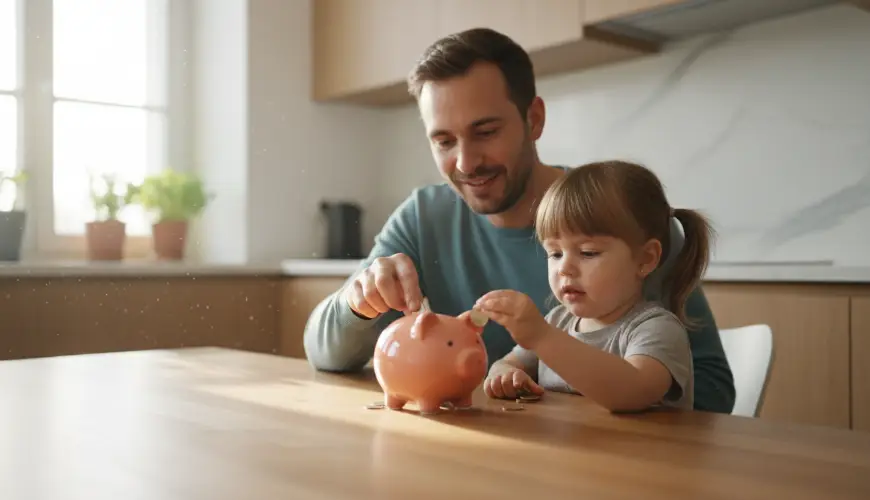
Most parents agree that they want the best education for their children. They invest in extracurricular activities, languages, sports – and yet there is one key topic that is still too often skipped in families. We're talking about money. Not because parents don't want to address it, but because they often don't know where to start themselves. Yet financial literacy built from an early age is among the most valuable life skills we can pass on to a child. And what's important – it doesn't have to be complicated or unpleasant.
A survey by the Czech Banking Association from 2023 showed that nearly 40% of adult Czechs struggle to understand basic financial terms such as interest rate or inflation. When you think about it, it's clear that the roots of this problem reach deep into childhood. If money isn't discussed at home, a child enters adulthood without any compass. And the world that awaits them – full of advertisements, subscription services, consumer loans, and cryptocurrencies – certainly doesn't plan to be forgiving.
---group-76--
Why it's important to talk to children about money as early as preschool age
Many parents instinctively feel that the topic of money is "too adult" and that children should have a carefree childhood. But talking to children about money doesn't mean burdening them with worries about the mortgage or the family budget. It means gradually and naturally introducing them to how the world works. Children are naturally curious – and they see money all around them. In the store, when a parent pays with a card. On the playground, when a friend buys ice cream. In advertisements that promise them the latest toy.
According to research by the University of Cambridge, commissioned by the British government, basic financial habits are formed around the age of seven. This means that waiting for "the right moment" may mean that the moment has long since passed. There's no need to reach for economics textbooks – it's enough to use situations that everyday life brings. A trip to the store can become the first lesson about the fact that money is a limited resource and that one has to make choices. Comparing the prices of two yogurts can be just as exciting for a five-year-old as a treasure hunt, if presented the right way.
Let's imagine an everyday situation. A family is standing in a supermarket and four-year-old Adélka wants candy, chocolate, and a stuffed bear at the checkout. The classic reaction is "no, we're not buying that" – followed by a scene every parent knows. But what if instead the parent said: "We have a hundred crowns for something extra. Look, the candy costs thirty crowns, the chocolate fifty, and the bear two hundred. What can you choose from that?" Suddenly the child is learning to compare, make decisions, and accept the fact that she can't have everything at once. And that is a fundamental building block of financial literacy – understanding that resources are limited and that every choice has its cost.
This approach works with older children too, just on a different scale. A seven-year-old can receive a small allowance and learn to manage it. A ten-year-old can have a piggy bank divided into three parts – one for spending, one for saving, and one for giving (for example, to charity or a gift for a friend). This simple method, promoted by numerous financial educators around the world, teaches children not only to save but also to think about money in a broader context.
As American investor Warren Buffett, who among other things created an animated series for children about finance, once said: "The biggest mistake parents make is waiting to talk about money until their kids are teenagers. By then, habits are already ingrained." And even though Buffett's world of billion-dollar investments is far from Czech reality, the essence of his message applies universally.
How to talk to children about money at different ages
The key to success is adapting the conversation to the child's age and not using abstract concepts where the child needs concrete examples. For preschoolers, games work well – a toy shop where you pay with paper money is a classic that never gets old. Through it, children learn the basic principle of exchange: I give something, I get something. It's important that they see physical money too, not just a payment card. In the era of cashless payments, many children don't understand at all that money is something real and limited. When a parent taps a card on the terminal, it looks like magic – things just appear.
For children in the lower years of primary school, it's the ideal time to introduce a regular allowance. The amount doesn't matter – even twenty crowns a week can be a great tool if the child is given the freedom to handle it and at the same time bears the consequences of their decisions. When they spend their entire allowance on chewing gum on the first day and then have nothing left for the rest of the week, they learn more than from any lecture. It's important to resist the temptation to "rescue" the situation – it's precisely in that small disappointment that financial responsibility is born.
In the upper years of primary school and in secondary school, there's room for deeper topics. How does a bank account work? What is interest, and why is there a difference between interest working for us (savings) and against us (debt)? What does it mean when we buy something in installments? A teenager who understands the principle of compound interest gains an enormous advantage. If a sixteen-year-old starts setting aside even a small amount monthly, they can have significantly higher savings at fifty than someone who starts at thirty with double the amount. This simple mathematical fact can make an impression even on a teenager who otherwise has no interest in finance.
Practical tools for older children and teenagers can also include children's bank accounts, which most Czech banks offer today. Some of them have clear mobile apps where the child can see their income and expenses in real time. This is much more effective than theoretical lecturing. And when a parent adds an open conversation about the family budget – not in details that would stress the child, but in principles such as "this amount is for food, this for housing, this we're setting aside" – the child begins to understand that money isn't infinite and that adults have to actively manage it.
Interestingly, one of the most effective ways to teach children financial literacy is to let them make mistakes. A study published in the Journal of Financial Planning showed that children who had the opportunity in childhood to handle their own (even small) amounts of money and experience the consequences of their decisions displayed significantly better financial habits in adulthood than those who were completely shielded from money. A twenty-crown mistake at age eight is an incomparably cheaper lesson than a mistake costing hundreds of thousands at thirty.
Another aspect worth mentioning is the influence of advertising and social media. Today's children are exposed to enormous pressure from consumer culture. Influencers promote products, games lure with microtransactions, and algorithms know exactly how to target children's desire for the new and shiny. Critical thinking about advertising should therefore be an integral part of financial education. It's enough to occasionally stop while watching TV or scrolling on a tablet and ask: "What do you think, why are they showing you this? Who profits from it?" Children are smarter than we think, and these questions lead them to become not passive consumers but active and aware ones.
In the Czech Republic, financial education is slowly making its way into schools – for example, through programs by the Czech National Bank or non-profit organizations like AISIS. However, school can only provide a foundation. True financial literacy is built at home, in everyday situations, in conversations at dinner, and during shopping trips together. And what's essential – children learn far more from what they see than from what they hear. A parent who impulsively shops and then complains about having no money sends a stronger signal than any lecture on saving.
There is one story that beautifully illustrates how simple financial education can be. A Czech family from Brno introduced a system of "practice family finances" for their two children aged eight and eleven. Each month the children received a fictitious budget on paper and had to decide how much would go to food, how much to entertainment, and how much would be saved. From time to time, an "unexpected event" came along – a broken washing machine, illness, a school trip – and the children had to redistribute the money. After a year of this "exercise," the older son spontaneously started comparing prices in the store, and the younger daughter set up a piggy bank for a book she dreamed of. No theory, no complicated lessons – just a game that reflected reality.
It's also important to mention that financial literacy isn't just about saving. It's also about the art of spending meaningfully, about understanding the value of things, and about the ability to distinguish a need from a want. A child who learns to think about whether they truly need a given item or want it only because a friend has it gains a skill that will serve them for life. And in the context of a sustainable lifestyle, where it's not just about money but also about the impact on the planet, this is doubly important. Every purchasing decision is also a decision about what kind of world we want to build.
In conclusion, it's worth remembering that the best time to start talking to children about money was yesterday. The second best time is today. It doesn't have to be a grand gesture or a perfectly prepared lesson. Next time at the checkout in the store, just say: "Come on, let's count it up together." Just give the child a coin for their piggy bank and ask what they'd like to save for. Just be honest that even adults sometimes struggle with money – and that's precisely why it's good to start learning as early as possible. Because financial literacy from an early age isn't a luxury. It's the foundation on which a calmer and freer life is built.