
How to Prepare Galette des Rois and Why You Should Try It This Year
French Cake Galette des Rois - A Festive Tradition That Tastes Like a Fairy Tale
The first weeks of the new year in France are dedicated to one delightful treat. Galette des Rois, or the King's Cake, is a sweet pastry associated with the celebration of Epiphany, which falls on January 6th. This aromatic, golden delight with crispy puff pastry and a delicate almond filling has captured the hearts of gourmets worldwide — although in the Czech Republic, it remains a relatively undiscovered treasure.
Those who have tasted it easily fall in love with it. It's not just about the taste — la Galette des Rois is associated with family tradition, play, and surprise, which unites households across France every year.
What is the King's Cake Galette des Rois?
Literally translated, "galette des rois" means "cake of kings". This cake is traditionally prepared to celebrate Epiphany, the Christian feast day. The Christian tradition associates this day with the arrival of the Three Kings in Bethlehem, and the cake symbolizes their gift and journey. However, in its modern form, it is more of a social and family ritual than a religious act.
The cake is round, resembling a royal crown. Its golden color is meant to evoke wealth and nobility. Inside is a filling called frangipane, which is a cream made of almonds, butter, sugar, and eggs. In some regions of France, such as Provence, a brioche with candied fruit is prepared instead — a variant known as gâteau des rois.
And what makes this cake truly special? Inside hides a small figurine, called a fève. Whoever finds it in their piece becomes the king or queen of the day and wears a paper crown, which is usually included in the packaging. This element gives the cake a sense of play, surprise, and joy, motivating even the youngest to finish their piece — just to be sure.
How to Make Galette des Rois - A Classic Recipe Step by Step
Thinking about trying to make a French King's Cake at home this year? The good news is that it's not as complicated as it might seem. The foundation is quality puff pastry and a genuine almond filling. Keywords like "galette des rois recipe" or "recipe for galette des rois" on the internet reveal dozens of variations, but if you want to stick to the classic, here's a simple and proven version.
Ingredients:
- 2 packages of quality puff pastry (preferably without palm oil, ideally organic)
- 100 g softened butter
- 100 g finely ground almonds
- 80 g sugar
- 2 eggs + 1 for brushing
- a few drops of rum or almond essence (optional)
- 1 fève (ceramic figurine, bean, or almond)
- 1 paper crown (for effect)
Instructions:
- In a bowl, beat the butter with sugar until creamy. Add eggs, then almond flour. If desired, add a bit of rum or almond essence. This creates the frangipane cream.
- Roll out the first sheet of puff pastry and place it on a baking sheet lined with parchment paper. Spread the almond cream in the center, leaving about 2 cm of edges free.
- Insert the fève into the filling — ideally close to the edge, so the cutter doesn't find it.
- Cover with the second sheet of pastry, press the edges well and decorate them with a fork if desired.
- Brush the surface with beaten egg and place in the refrigerator for at least 30 minutes.
- Then remove the cake, brush with egg again, and lightly decorate the surface with a sharp knife (for example, diagonal lines into a spiral).
- Bake at 180 °C for about 30–40 minutes until golden. Serve warm or cooled.
When the cake is baked, it's time for the festive ritual. The youngest family member hides under the table and decides who gets which piece — to ensure fair distribution. Then it's just a matter of finding the fève and celebrating the "royal" moment.
Galette des Rois in the Context of French Culture and Modern Variants
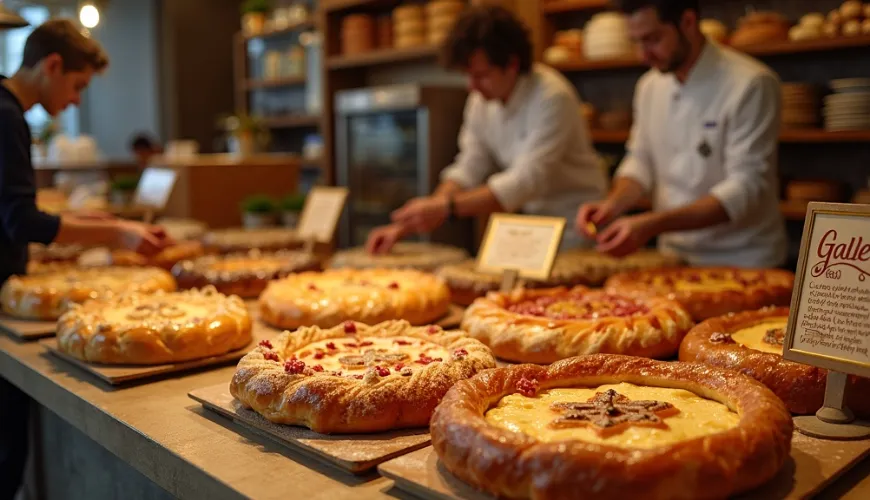
This tradition, although old, remains strong not only in French households but also in bakeries. Throughout January, galette des rois is literally everywhere — in shop windows, on tables, and in advertisements. The renowned French bakery Poilâne offers it in an organic version with local almonds, while Michelin-starred restaurants compete in original versions with pistachios, chocolate, or even salted caramel.
Interestingly, the French President receives a giant galette from the bakers' association every year. However, it regularly contains zero fèves — because the president cannot become a king!
Stories like this show how deeply the cake is rooted in local culture. Yet, it retains its accessibility and playfulness. It's not just a recipe, but an opportunity to slow down, sit at the table, and share a piece of sweet tradition.
And how does galette des rois look outside France? This treat has been gaining an international audience in recent years. In Belgium, Switzerland, and Canada, it's a common part of the January menu. In the USA, a similar "King Cake" is celebrated during Mardi Gras. And in the Czech Republic? It's slowly gaining awareness here too — mainly thanks to social media, where food bloggers compete in January to bake the most enticing version.
Why Include Galette des Rois in the Czech Repertoire?
You might wonder why a Czech home baker should try a French cake when we have so many traditional recipes of our own? The answer is simple: galette des rois is an exceptional combination of taste, appearance, and ritual that unites. In a time when we seek meaningful and joyful moments, such a sweet is a symbol of sharing.
One family from Brno started baking galette every year after their daughter spent half a year in France. "When she first told us about it, it sounded like a fairy tale. But when we baked the cake ourselves, it suddenly became a real tradition that we brought home," says Mrs. Jana, the mother of three. The family now bakes the cake together every January, and the small porcelain figurine has become a beloved souvenir.
Moreover, it’s a dessert relatively simple to prepare — no rising, no complicated ingredients. Yet, the result looks and tastes like it's from a French pâtisserie.
Perhaps galette des rois is not yet a common part of Czech households, but its charm is undeniable. It combines simplicity with elegance, a traditional recipe with playfulness, and an ordinary January day with a sense of specialness. And in the winter season, that might be exactly what we need.