
# How to Choose Children's Clothing Sustainably and Smartly
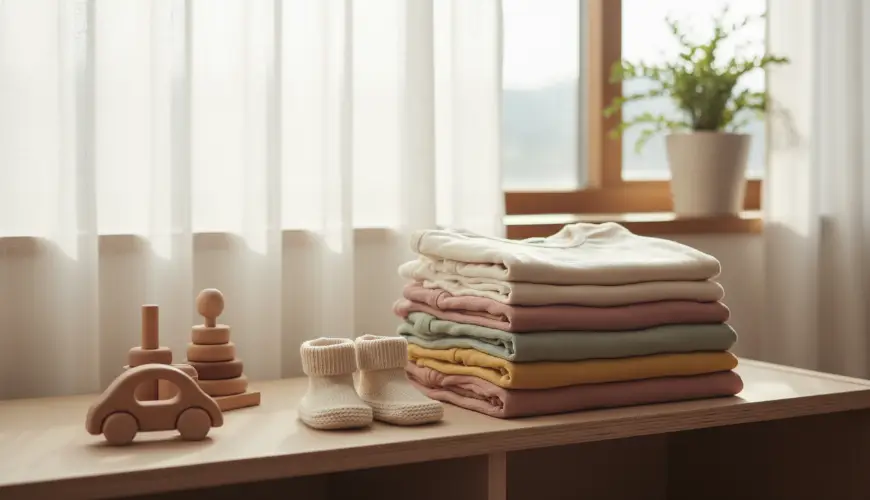
Children grow at a pace that can catch even the most prepared parents off guard. A new onesie that fit perfectly just last week is suddenly too short in the legs, and a t-shirt bought only two months ago won't pull down over that little belly anymore. According to pediatricians' estimates, the average child goes through up to seven clothing sizes during the first three years of life. That's an enormous amount of clothing – and with it, an enormous amount of resources, energy, and waste. That's exactly why it's worth pausing to think about how to choose children's clothing sustainably without sacrificing quality, comfort, or the family budget.
Sustainable fashion for adults has become a common topic in recent years, but when it comes to children's clothing, there's a peculiar paradox. Parents intuitively feel that it makes no sense to buy a newborn premium pieces at full price when they'll only wear them three times – yet instead, they often reach for the cheapest chain-store goods, which fall apart after a few washes and end up in the bin. The result is a merry-go-round of cheap purchases that is, in reality, neither economically nor ecologically beneficial. There are, however, plenty of ways to step off this merry-go-round, and none of them require a radical lifestyle change. All it takes is a slightly different perspective on materials, a willingness to explore second-hand and swaps, and a few practical principles that quickly become second nature.
Try our natural products

Why materials matter more than we think
When you're standing in a shop in front of a rack of baby bodysuits, the first thing you probably check is the size and price. Few people flip the tag over and study the material composition – and yet this is exactly where the real difference begins. Children's skin is significantly more sensitive than adult skin, thinner and more prone to irritation. What clothing is made from is therefore not just a question of ecology but also of health.
Conventional cotton, which forms the basis of most children's clothing, is among the crops with the highest pesticide use in the world. According to data from the World Health Organization, pesticides pose a real health risk not only to farmers but also to end users, especially the youngest ones. Certified organic cotton (often bearing the GOTS – Global Organic Textile Standard certification) is grown without synthetic pesticides and herbicides, with lower water consumption and under stricter social standards. Yes, it costs a bit more, but for children's clothing worn directly against the skin, it makes extraordinary sense.
Alongside organic cotton, other natural materials are also worth noting. Merino wool is fantastic for thermoregulation – it warms in winter, cools in summer, and naturally resists odour, so you don't need to wash it after every wear. Linen blends are lightweight, breathable, and incredibly durable, so a child can wear them for a really long time. And then there's bamboo viscose, which is indeed the result of chemical processing, but when responsibly manufactured (OEKO-TEX certification or FSC for the bamboo raw material origin), it offers pleasant softness and hypoallergenic properties.
What's worth avoiding, on the other hand? One hundred percent polyester as a first layer – it's non-breathable, quickly develops odour, and releases microplastics into waterways during washing. That doesn't mean synthetic materials have no place in a child's wardrobe. A quality softshell jacket with a membrane is practically irreplaceable. The point is that synthetics shouldn't be the default choice for everything from socks to pyjamas.
A practical tip that saves time and stress: get into the habit of checking not only the composition of children's clothing but also the fabric weight and seam construction. A heavier t-shirt made from combed cotton at 180–200 g/m² will last significantly longer than thin t-shirts costing next to nothing, and it's precisely that durability that is the key to sustainability. Clothing that survives one child and can serve another is inherently more eco-friendly than any recycled material.
Second-hand, swaps, and sharing – the golden age of pre-owned children's clothing
Imagine the Novák family from Brno. They have a two-year-old son and a four-year-old daughter. When they decided three years ago to try buying children's clothing mainly second-hand, they expected compromises. Instead, they discovered a world that pleasantly surprised them. At a local second-hand shop, they found barely used Reima winter snowsuits at a fraction of the original price; in a Facebook exchange group, they got a bag of size 86 clothing for a symbolic hundred crowns; and at a neighbourhood swap event at a community centre, they traded outgrown dresses for a set of quality leggings. In the first year, they estimate they saved over ten thousand crowns – and their children were dressed just as well as before.
The Nováks' story is not exceptional. The market for second-hand children's clothing in the Czech Republic has literally exploded in recent years. Platforms like Vinted have become a standard part of the parental shopping repertoire, and specialised children's second-hand shops are popping up like mushrooms after rain. The reason is simple: children's clothing is often worn so briefly that it's essentially new. Baby bodysuits, christening outfits, winter overalls for toddlers – all of these typically have a lifespan of one, at most two children, yet they can easily last five.
The advantages of buying second-hand are not just financial, either. From an ecological standpoint, extending a garment's life by just nine months can reduce its carbon, water, and waste footprint by approximately 20–30%, as reported by the British organisation WRAP (Waste and Resources Action Programme). For children's clothing that circulates between siblings, friends, and neighbours, this effect multiplies.
But how do you navigate the second-hand world so that shopping isn't a waste of time? A few tried-and-tested tips:
- Focus on quality brands – when buying second-hand, it pays to target brands known for their durability (for example Reima, Didriksons, Name It, or the Czech brand Modrý koník). Cheap chain-store clothing bought second-hand often isn't worth it because it's already worn out.
- Check the elasticity and zips – the most common weak points of worn children's clothing are stretched-out waistband elastic and sticking zips. Both can be repaired, but it's good to know about them in advance.
- Take advantage of seasonal swaps – many community centres, mother-and-child centres, and libraries in the Czech Republic hold regular children's clothing swaps. You bring what's too small, you take home what you need. Cost: zero crowns.
- Don't be afraid of direct exchanges between families – if you have families with children of different ages in your area, set up a system of circulating bags. One bag of clothing can pass through three or four families before it truly reaches the end of its life.
The psychological aspect is also worth mentioning. There is still a certain social pressure that a child "must have new clothes," especially for special occasions or photo sessions. But let's ask ourselves: can a two-year-old tell in a photo whether they're wearing a new dress or a beautifully preserved one from a swap? And what actually matters more – a "new" label, or quality, comfort, and the knowledge that we haven't contributed to unnecessary waste?
As British designer Vivienne Westwood once said: "Buy less, choose well, make it last." For children's clothing, one might add: and then pass it on.
Of course, there are situations where buying new clothing makes sense. Underwear, socks, and shoes are better bought new for hygiene and orthopaedic reasons. With shoes, this is particularly important – worn footwear has adapted to the shape of the previous wearer's foot and can negatively affect foot development. Likewise, functional base layers for sports or outdoor activities deserve a new piece made from quality material. But even in these cases, the basic principle applies: one quality piece rather than three cheap ones.
A sustainable approach to children's clothing isn't just about where we shop but also about how we care for clothing. Proper washing significantly extends the lifespan of garments. Lower temperatures (30–40 °C is sufficient for normally soiled children's clothing), gentle detergents without optical brighteners, and air drying instead of tumble drying – all of this helps preserve colours, elasticity, and material structure. And when clothing gets damaged? Small patches and repairs are nothing to be ashamed of – quite the opposite. In Japan, there's an entire philosophy called sashiko that turns repaired clothing into a work of art. With children's clothing, it can even be a fun activity – a colourful patch on the knee can be a source of pride for a child, not embarrassment.
The entire concept of a sustainable children's wardrobe can be summed up in one simple idea: think in cycles, not in one-off purchases. Every piece of clothing has its own life story that doesn't end the moment your child outgrows it. It can continue with a younger sibling, a friend's child, in a charity shop, or as material for sewing cushions. Only when clothing has truly reached the end of its life does textile recycling come into play – and in this regard too, the situation in the Czech Republic is improving, partly thanks to the new obligation for municipalities to ensure separate textile collection from 2025 in accordance with the European waste directive.
Choosing children's clothing sustainably isn't a project with a clear beginning and end. It's more of a gradual change in habits that over time becomes a natural part of parenting life. You can start today – perhaps by next time, before you click "add to basket" on another set of cheap t-shirts, flipping the virtual tag and checking what they're made of. Or by opening the wardrobe, pulling out the clothing your child has outgrown, and instead of tossing it in a bin, offering it to someone who needs it. These are small steps, but it's precisely small steps that add up to the biggest change.