

# Childhood Patterns That Control Your Relationships
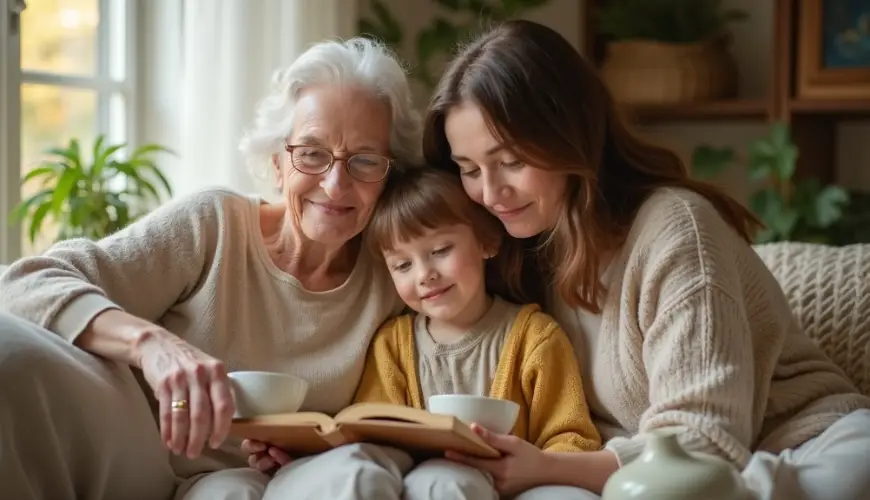
Each of us carries away from childhood something more than memories of holidays at grandma's or the smell of the school cafeteria. We carry away the ways in which we react to closeness, conflict, rejection, and love – and most of the time we don't even realize it. Psychologists call this emotional inheritance, and its influence on adult relationships is far deeper than it might appear at first glance. This isn't about esoterica or a trendy psychological fad, but about a phenomenon backed by decades of research in developmental psychology and neuroscience.
Imagine a situation that almost everyone knows. A partner says a seemingly innocent sentence: "I'll be working late tonight." One person shrugs and decides to have the leftover risotto from yesterday for dinner. But another immediately feels a tightening in the stomach, a flash of anxiety, and a compulsive need to verify that everything is okay – or, conversely, coldly locks the door to their inner world and decides to "feel nothing." The difference between these two reactions didn't originate in adulthood. It originated much, much earlier.
British psychiatrist John Bowlby formulated as early as the 1950s the theory of attachment – the emotional bond that describes how the early relationship with a caregiver shapes our expectations of all future close relationships. Bowlby's work was later expanded by developmental psychologist Mary Ainsworth with her famous "Strange Situation" experiment, in which she observed toddlers' reactions to brief separations from their mothers. The results showed that children react fundamentally differently – some with trust, others with anxiety, still others with conspicuous indifference – and that these patterns transfer into adulthood with surprising stability. The American Psychological Association (APA) today considers the quality of early attachment as one of the strongest predictors of mental health in adulthood.
But what exactly does "emotional inheritance" mean? It's not just another name for memories. It is a set of unconscious rules that we created as children based on how we were treated. If a child grows up in an environment where their needs are reliably met, where a parent responds to crying with comfort and to joy with shared enthusiasm, they form an internal model of the world as a safe place and of other people as trustworthy. Such a child essentially tells themselves: "When I need help, someone will come. I am worthy of love." And this quiet inner voice accompanies them throughout life.
But not everyone was so fortunate. Some children grew up with parents who were unpredictable – sometimes loving, sometimes unavailable, sometimes overwhelmed by their own problems. Other children experienced emotional coldness, criticism, or even neglect. And although an adult often doesn't remember specific situations from the first years of life, their nervous system remembers them perfectly. The body stores what the mind has forgotten, and in adult relationships, these imprints awaken with unexpected force.
Try our natural products


How Emotional Patterns from Childhood Manifest in Romantic Relationships
One of the most common manifestations of emotional inheritance is the so-called anxious attachment style. People with this pattern tend to constantly seek reassurance from their partner, fear abandonment, and interpret even minor signals – a late reply to a message, a change in tone of voice – as evidence that their partner is losing interest. This is not a whim or oversensitivity. It is a learned response of an organism that in childhood had to constantly "monitor" whether the caregiver was still available.
At the opposite end of the spectrum are people with an avoidant attachment style. They learned that relying on others is dangerous, because in childhood their emotional needs were not met, or were even punished. In adulthood, they come across as independent and self-sufficient, but behind this facade actually lies a deep distrust of closeness. When a relationship begins to deepen, they instinctively pull back – not because they don't want to love, but because closeness activates old pain within them.
And then there is the combination of both, which psychologists refer to as the disorganized attachment style. The person simultaneously longs for closeness and is terrified of it. They are drawn to a romantic relationship, but once they find themselves in one, they feel trapped. This pattern is most often associated with traumatic experiences in early childhood, when the caregiver was simultaneously a source of safety and a source of threat.
You might be asking now: does this mean we are condemned to repeat our parents' patterns? Fortunately, no. And this is exactly where the hopeful part of the story begins.
Neuroplasticity – the brain's ability to reshape its neural connections throughout life – is one of the most significant scientific discoveries of recent decades. It means that even deeply rooted emotional patterns can be changed, though it requires time, patience, and often professional help. Psychotherapy focused on attachment, such as Emotionally Focused Therapy (EFT) developed by psychologist Sue Johnson, achieves remarkable results according to research published in the Journal of Marital and Family Therapy – up to 70–75% of couples report significant improvement in relationship satisfaction after therapy.
But therapy isn't the only path. The first and perhaps most important step is awareness. Simply recognizing one's own patterns changes the rules of the game. When a person understands that their intense reaction to a partner coming home late has nothing to do with the current situation but with a long-ago feeling of an abandoned child, they gain space for choice. Instead of an automatic reaction, the possibility of a conscious response emerges.
Let's take a concrete example. Markéta, a woman in her thirties from Brno, couldn't explain for a long time why the same scenario played out in every relationship. After a few months of bliss, she would begin to feel intense anxiety, check her partner's phone, and start arguments "out of nothing." Partners would leave, and each time she confirmed her deepest fear: "No one will stay with me." Only in therapy did she realize that her mother suffered from depression and was emotionally absent during her childhood – she was physically there, but psychologically unavailable. Little Markéta learned that love is something unstable that can disappear at any moment, and she behaved accordingly her entire life. Recognizing this pattern allowed her to begin reacting differently – not immediately, not perfectly, but gradually and with growing confidence.
As American psychologist and bestselling author Harriet Lerner said: "Awareness is not the same as change, but without awareness, no change is possible."
Interestingly, emotional inheritance is not only transmitted from parents to children but can also pass through generations. Epigenetic research suggests that traumatic experiences can affect gene expression and that these changes can be passed on to subsequent generations. A study of Holocaust survivors' descendants, published in the journal Biological Psychiatry, showed measurable differences in stress hormone levels in people whose parents went through extreme trauma. This doesn't mean we are "genetically predetermined" to suffer, but it shows how deeply our emotional lives are connected to the lives of our ancestors.
The Path to More Conscious Relationships
Working with emotional inheritance is not a one-time project but a lifelong process that pays off not only in the relationship with a partner but also with one's own children, friends, and ultimately with oneself. There are several principles that can help along this path.
First and foremost, it is important to learn to distinguish between the past and the present. When an intense emotional reaction appears in the body that doesn't match the severity of the situation, it is often a signal that an old pattern has been activated. In such moments, it helps to pause and ask yourself: "Am I reacting to what's happening now, or to what happened long ago?" This simple question can be surprisingly effective.
Furthermore, it is essential to develop the ability of emotional regulation – the art of processing strong emotions without acting impulsively. Meditation, breathing exercises, time in nature, or journaling are tools that help create space between stimulus and response. This is not about suppressing emotions but about consciously experiencing them without letting them control our behavior.
Equally important is communication with a partner. An open conversation about one's own emotional patterns and vulnerabilities creates space for deeper understanding. When one partner says: "I know I overreact when you get in touch late – it's connected to my history, not to you," it is an act of courage that can fundamentally transform a relationship. Such honesty requires a safe environment, and if it doesn't exist in the relationship, building it can be the very first shared project.
And finally, it's worth remembering that a perfect childhood doesn't exist. British pediatrician and psychoanalyst Donald Winnicott introduced the concept of the "good enough parent" – a parent who doesn't have to be flawless but who is present, responsive, and willing to learn from their mistakes. The same principle applies to us in adulthood. We don't have to completely erase our emotional inheritance. It's enough to recognize it, understand it, and gradually reshape it.
Emotional inheritance is not a sentence. It is a map that shows where we come from – but it doesn't determine where we are headed. Every conversation in which we choose to be honest instead of defensive, every moment when we pause instead of reacting in the old way, every relationship in which we dare to be vulnerable, is a step toward rewriting the story we inherited. And that is perhaps the most valuable kind of self-care there is – care that doesn't end with the body but reaches all the way to the very roots of who we are.